The Work Among the Foreigners in the United States
By Steen Rasmussen
MANY of the faithful readers of the REVIEW watch with great interest the progress of the work in the homeland and abroad. Many have no doubt been following the progress of the work among the many different nationalities here in this country with marked interest. Reports, however, have not been many and long, and probably some of our brethren have been tempted to conclude that this foreign work in the home field is having but very little success and making but slow advancement.
It was a source of great encouragement to our deceased and beloved Brother O. A. Olsen to see the advancement the work made during 1914. His burden for the foreign work was a great one, and his thoughts were constantly occupied with plans and methods by which the most could be accomplished to win precious souls. Brother Olsen wished that much more could have been done; but on account of the lack of so many things, among which men and means are the more prominent, the work could not move so rapidly as we all desired. Nevertheless we are very thankful to God for the results attained.
During 1914 we carried on work in this country among eighteen different nationalities: Germans, Swedes, Danes, Norwegians, Italians, Frenchmen, Hungarians, Roumanians, Bohemians, Finns, Lithuanians, Servians, Jews, Russians, Hollanders, Japanese, Slavonians, and Spaniards.
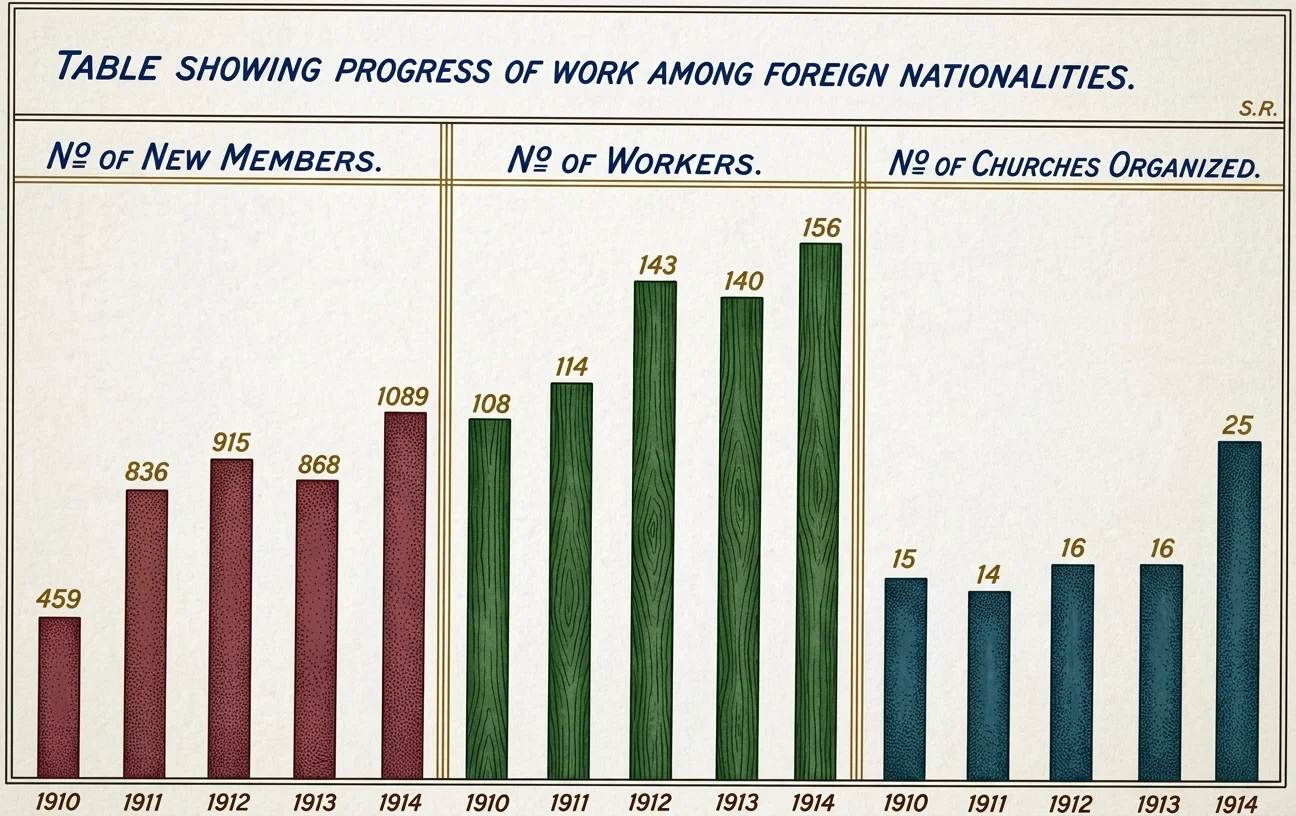
NORTH AMERICAN FOREIGN DEPARTMENT 1910 - 1914.
Four years ago, during 1911, we labored among ten different nationalities. Thus eight nationalities were added during the four years. This we feel we can call an advancement. By looking over the accompanying table, which has been specially prepared for this article, it will readily be seen whether progress has been made or not. On the table we have listed only three items: number of new members, that is, Sabbath keepers won during each year; number of workers; and number of churches organized. It will be seen that while 459 new members were gained in 1910, returns for 1914, which have just been compiled, show that 1,089 accepted the message. During 1910 and 1911 respectively we carried on the work with 108 and 114 workers, while in 1914 the force of laborers had increased to 156, another substantial gain.
When we look upon the number of churches organized during the last four or five years, it will be seen that practically the same number were organized during the quadrennial period 1910-13; but when we reach 1914, a marked rise sets in, and twenty-five new churches were added in one single year.
While, of course, much the greater part of this foreign work is being done among the Germans and the Scandinavians, among whom the work has been in operation for several decades, yet we have been very interested in taking note of the marked progress that has been made among all these other nationalities enumerated above. Take, for instance, the Russians. During 1914, ninety-two Russians accepted the message under the faithful and earnest labor of four or five workers. At one place alone—Yale, Va.—more than fifty accepted the truth at one time. Altogether we now have a Russian constituency of more than 250.
Then we have the Servians, with only one ordained minister and one licentiate. Twenty-three new members were baptized among that nationality during 1914, and we now have three good Servian churches, two in Canada and one in St. Louis, Mo. Among the Roumanians eleven were added to the Roumanian companies in Ohio, all through the faithful and self-sacrificing labor of one licensed minister. Among the Italians seven new members were gained and added to the Italian church in Chicago. The Slavonians report eight new members. And so we could go on and mention some here and some there gathered out from among all these many different peoples.
During the beginning of this present year, work has been started among another foreign nation, the Icelanders. Brother David Guldbrandsen, after completing his course at the University of Christiania, Norway, spent some time in Iceland, perfecting himself in the Icelandic tongue, and also doing colporteur and other missionary work. He has now been called to North America, and has taken up work in Winnipeg, Manitoba, Canada, where there is a large settlement of Icelanders.
Thus, little by little, we reach one after another of these many foreign peoples, who are waiting to receive the third angel's message; but an immense task is still before us in giving the truth to the scores of nationalities who are yet unreached. Great privileges and opportunities present themselves in the coming to our very doors of these many foreigners, and we have certainly reached a time in the history of this denomination when every wide-awake member should not only do something to bring the message of salvation to this great host of our fellow men, but put both heart and soul into a gigantic effort for the saving of benighted souls in this country.
STEEN RASMUSSEN,
North American Foreign Department.