The Burma Mission

5%

Review and Herald Publishing Association · Takoma Park Station, Washington, D.C. · May 20, 1915

FromReview and Herald, Vol. 92, No. 25.

Read the full edition

The Burma Mission

At the close of the Calcutta conference, Professor Salisbury and I went to Burma to visit the different interests of our work there. Brother and Sister Ludington, who had come from Emmanuel Missionary College to take charge of the Meiktila Industrial School in Burma, reached Calcutta just in time to accompany us. We are glad to add these teachers to our staff of workers in Burma.
Rangoon is the headquarters of our work in Burma. Here, as in so many other places in the Indian Union, we met fellow workers whom we had known and helped to select for this field. Prof. R. B. Thurber lives here. It was in their family tent on the East Michigan camp ground five or six years ago that I made final arrangements with Brother and Sister Thurber to come to Burma. Although they have remained in this warm climate the most of the time since coming, they both are looking well and are bright and cheerful in their work. Brother Thurber is acting superintendent of the field and pastor of the Rangoon church. This church has a membership of seventy-five. The members are principally Europeans and Anglo-Indians, very few Burmese having as yet taken their stand for the truth. This church pays a good tithe, and supports the work liberally in every way. The members are quite active in home missionary work.
There seems to be a good interest in the city to hear our message. The hall they use for their regular meetings was well filled at each of the services conducted while I was with them. At the last meeting quite a number were unable to get seats; and listened from a side room.
The treatment rooms have recently been installed on the third floor of one of the best buildings in the city. They are nicely arranged and well equipped. They are under the management of Brother and Sister F. A. Wyman, who came to Burma a year and a half ago from the Foreign Mission Seminary. It has been but a few months since this medical work was started, so it is impossible to tell just what it will accomplish. However, the present prospects seem good for making the enterprise self-supporting. An influential barrister and a number of other prominent business men have begun to patronize them. Brother and Sister Wyman are earnest, warm-hearted missionaries, and they are praying that this work may prove a blessing to the cause throughout all Burma.
Our Meiktila school is three hundred and twenty miles north of Rangoon. We have a block of twenty-nine acres in a good location, two miles from the railway station. There are four principal buildings,—the bungalow, school hall, dormitory, and industrial hall. The bungalow is of good size, and substantially built. The first story is of brick, the upper, wood. The school and dormitory are built of teak frames filled in with split bamboo. Many buildings are constructed of this material in Burma. The industrial building is of corrugated iron with cement floors. It is so constructed that the sides can be swung out and up on hinges, which gives all the ventilation possible.
At the time of our visit very little industrial work was being done, the war having cut off their supplies of material; but they had succeeded in obtaining a good supply, which they were expecting to receive in a few days. The three principal lines are furniture, split bamboo chairs, and boots and shoes. The samples I saw showed that the boys do good work.
Just now there are only thirty-five students in the school. There are various reasons assigned for the decrease; but the brethren believe that the attendance can be increased, and that the school can be made a greater factor for our work than it has ever been. Eight or ten of the boys now in the school have united with the church by baptism. Some of them are earnest young men who give promise of making good workers. A good beginning has been made toward the establishment of an institution for educating and training native workers for Burma. This is a most important requirement for such fields.
We have living in Meiktila Brother Stevens and family, who are a great help to our work. He is the government prosecutor of the city, and holds a commanding influence among the best men in that part of the country. Sister Stevens seems like a superior woman, and they have a nice family, who do a large amount of missionary work. When I was there, they had just ordered ten thousand copies of the War number of the Watchman. They also contribute freely to the cause. This family, with the teachers and Christian students in the school, form the nucleus for a goodchurch. At present the membership is about fifteen.
Leaving Meiktila, we went to Mandalay, about fifty miles north. This was the old and last capital of Burma under the Burmese kings. Its present population is 139,000, only a little more than half its population when taken by the British in 1885. Brother and Sister R. A. Beckner have charge of the mission here. For a year or more he has been selling papers and tracts in the city and surrounding country. Several persons have embraced the truth. They have a church of ten or a dozen members. Hereafter Brother Beckner is to give more time to Bible reading and ministerial work. But he is very energetic, and will also distribute a large quantity of literature.
Mandalay is the natural center of our work in Upper Burma. In a radius of from ten to fifteen miles around the city, stretching west to the Irrawaddy River and east to the Shan Hills, we could see from Mandalay Hill some five hundred villages with a population of five hundred thousand. The country is level, and here, as perhaps nowhere else in Burma, there are good country roads. With a horse and trap Brother Beckner could easily reach many of these villages. I am glad to report that Brother and Sister Beckner are in excellent health, and are very happy in their work. He is getting a good command of the language. Their hearts are set on building up a good, strong work in Upper Burma, and they hope to be able to remain in that country until the Lord comes.

The Karens

As you know, the brethren in Burma have for a long time been urging that work be begun among the Karens. Brother Hamilton was sent out two and a half years ago in response to this call. Sister Gibbs, who was chosen for this work, has mastered the Karen language, having passed the first and second examinations with high marks. She has also completed a course in midwifery in the Calcutta hospital.
The Karens number about one million, or one tenth of the total population of Burma. The majority of them live in the eastern part along the great Salween River. They are scattered along a stretch of territory nearly five hundred miles in length. There are three divisions or branches of the Karens: the Pwo (Po) Karens, the Sgaw (Skaw) Karens, and the Karannee. The Pwos are the most numerous, and are settled in the lower part about Moulmein. The Sgaws are second in number. They live in the central and northern parts. The Karannees live in the extreme north, close to the borders of Siam and Tibet.
It was among the Karens that Judson and his associates did the most of their work. The Baptists now have a large following of both Pwo and Sgaw Karens. Their total baptized membership in Burma is about fifty thousand.
In company with Brethren Salisbury, Thurber, and Hamilton, I made a visit to this district. We first ran over to Moulmein, two hundred and eighteen miles by rail. There we took a small steamer up the Salween River sixty miles to a village called Shwegun. This is the terminus of the steamship line. The place our brethren had selected for our station is fourteen miles farther on, at a village called Kawkayet, on the Yunzalin River, which forms a junction with the Salween River about midway between Shwegun and Kawkayet. Beginning at this junction there is a stretch of country at least a hundred miles long occupied principally by the Sgaw Karens.
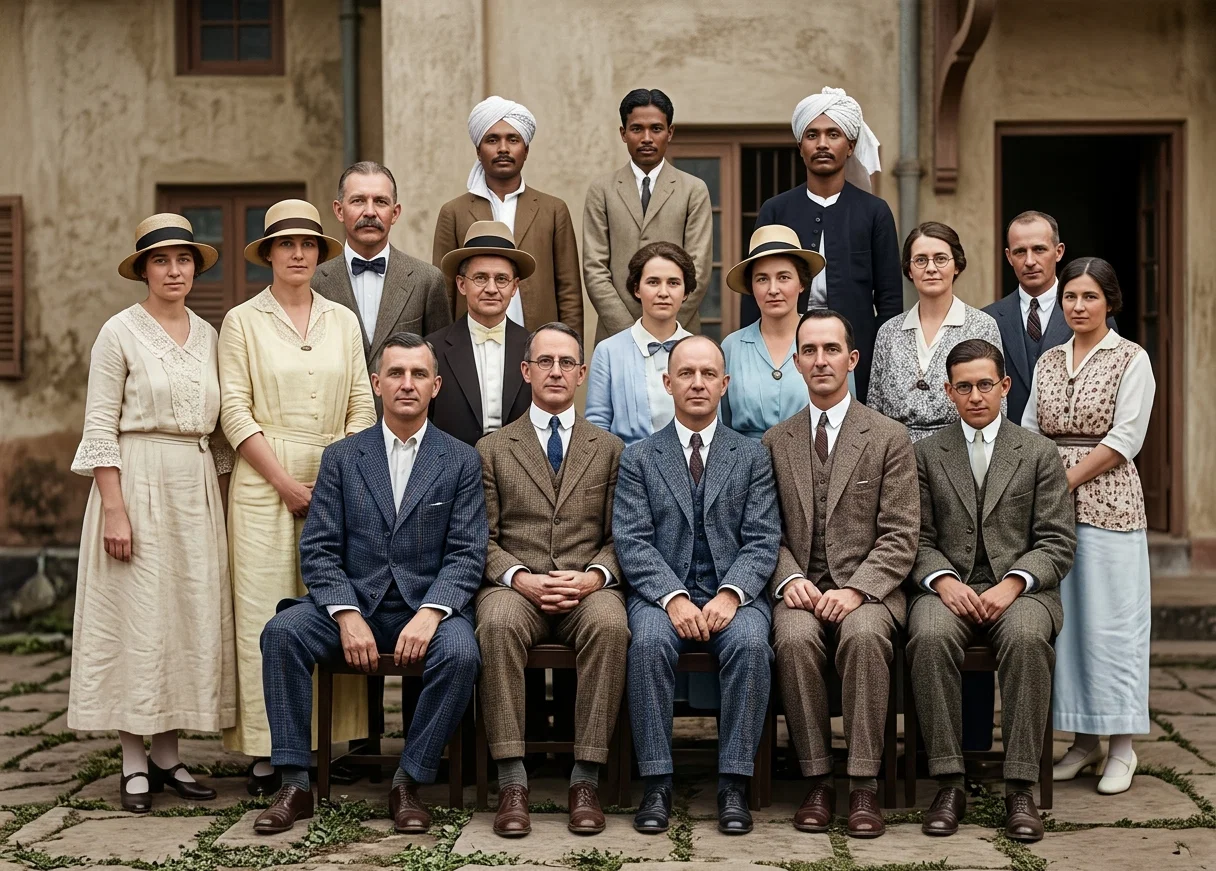
GROUP OF OUR WORKERS IN BURMA
When Brother Salisbury was in Burma last July he visited this region with the brethren, and agreed with them on the selection of a block of nineteen acres at Kawkayet for our mission station. As this land belonged to the government, Brethren Thurber and Hamilton went to see the district commissioner at Papun about securing it. They found him to be a very pleasant gentleman. After hearing them, he said he should go into the matter more fully, and if he found no objections, he should be glad to grant them the site for their mission. He also told them that he was authorized to give a certain allowance of timber for such purposes, and that he should give them all that he should be authorized to appropriate.
As we could not get a boat large enough to take us all up the river from Shwegun, where our steamer left us, to Kawkayet, it was decided that Brethren Thurber and Hamilton should go on in a small boat, and that Professor Salisbury and I should return. On arriving at Kawkayet, the brethren learned from the people that the commissioner had been down to inspect the block they had asked for. He had also posted the usual notice for thirty days, telling of our request, and giving opportunity for lodging objections. A man in the place told the brethren he had seen the written document containing the commissioner's decision to give us the land.
Although the brethren have not received final word direct from the commissioner regarding his decision, they have learned through another source that he has made the grant. We arranged for Brother Hamilton to go to Papun at once to have proper papers made out. If the commissioner makes the grant, we shall get a good block of ground in a healthful location, and, further, we shall get a supply of good timber for our buildings.
Now is the time to act. On account of the war, the timber business is dead. Millions of logs are tied up in rafts along the river banks. The mills are clogged with sawn timber, and are offering it for one third the usual price. Hundreds of men are wanting work, and can be secured at low wages by contractors. In view of the whole situation, I authorized the brethren to proceed at once with the enterprise. I have taken the responsibility of raising the two thousand five hundred dollars they have estimated it will require to put the mission in good shape. We cannot delay the opening of this mission without risking great loss.
Brother and Sister Hamilton and Sister Gibbs have been waiting a long time to get among the Karens, and they are happy beyond expression at the prospect of being at this new mission station in the near future. They have wonderful courage to go up that great river, and settle where tigers and other wild beasts are plentiful. Of course they will be safe, yet many would shrink from it. They believe the Lord has called them to that work, and that he will give them many Karens in return for faithful efforts. We shall watch the development and results of this new move with the deepest interest, not forgetting to pray earnestly for our dear workers and also the Karens. A. G. DANIELLS.