Another Door Opened

11%

Review and Herald Publishing Association · Washington, D. C. · Jun 10, 1915

FromReview and Herald, Vol. 92, No. 29.

Read the full edition

Another Door Opened

HERBERT EDMED
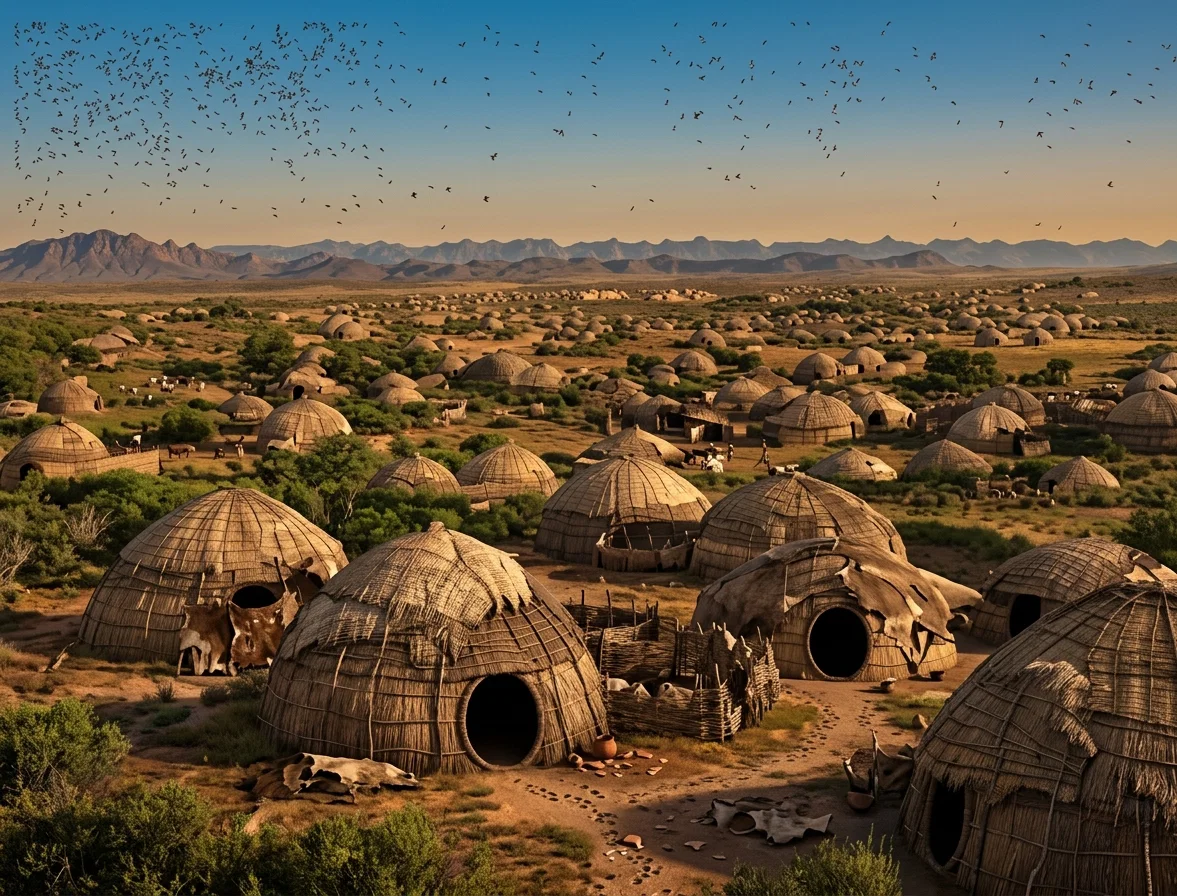
NATIVE HOMES OF THE HOTTENTOTS
Our great message is still forcing its way among the tribes of benighted Africa, whose dark-skinned people and heathen hearts are susceptible to the Lord’s soul-winning love. The above picture shows two colored men of far different types. The one on the left, Brother van der Westhuizen, is one of the Cape colored people, educated and refined. He is a member of our oldest church in South Africa, and has a family wholly devoted to the truth. The brother on the right is one of the Koranna tribe of Hottentots, that inhabits the western lands of this country, from Cape Town to German Southwest Africa, and of which there are about 100,000.
The Korannas are heathen, with no idols and few religious forms. They cherish some vague idea of a supreme being, but pay little regard to him. From babyhood, however, they are taught to venerate the moon as it first appears, and a well-without a snake to insure water does not suit their superstition. They are skillful hunters, and wear the skins of the animals they eat. Unclean animals are discarded, and roots form a large part of their diet. They are tender-hearted, exceedingly hospitable, and respect their women. As shepherds they rank high, and are generally regarded as excellent farm help. Like most wild creatures, they smear their bodies with fat, and in warm weather wear the leather side of their skin cloak to the body, turning the hair side in when the cold weather comes. In this way their cloaks are not only adapted to weather conditions, but are made to last almost a lifetime.
Last year, when the suggestion was made that our church members each seek to bring a convert to Christ during that year, Brother van der Westhuizen decided that he would attempt to bring a soul to Christ, so he began with his Koranna servant. The young man could neither read nor write. He drank and smoked, used profane language, and was as rank a heathen as any of his tribe. So the work had to begin from the bottom, and it looked as if it might be a long time before that young man could be fully restored to his Lord. But when God begins a work in these days, he often makes a short work of it. Our brother was rewarded daily as he saw the response of this heart. The alcohol disappeared, the pipe and tobacco gave place to better things, and the worship of the moon and snake were exchanged for the worship of God. Peter began to meet with the family to pray, and after a while could himself pray. Then, in August, after the great war in Europe broke out, our people in South Africa set apart a day for fasting and prayer for the success of our paper work and the conversion of souls.
It was on that day that Peter stood up in the meeting and fully surrendered his heart to God. October 24 the writer had the privilege of burying the first Koranna boy in the waters of baptism.
Peter Mashurna comes to Jesus, like the Greeks, to tell us of more open doors. The union conference had the book “Steps to Christ” translated into the language of the Korannas.
The second picture shows a village of the Korannas, in which there are about 30,000 living under normal conditions, right in civilized regions.