MRS. VINA SHERWOOD-ADAMS

6%

Review and Herald Publishing Association · Washington, D. C. · Jul 1, 1915

FromReview and Herald, Vol. 92, No. 32.

Read the full edition

MRS. VINA SHERWOOD-ADAMS

Bird Studies With Our Children — No. 2

MRS. VINA SHERWOOD-ADAMS
It is very easy to interest the older children, from the ages of six to fourteen, in a study of the birds. In the spring let the children each select the bird he would like to study. Then from books, magazines, and personal observation inform yourself regarding the birds they have chosen, that you may have a reserve fund of knowledge to answer the questions they may ask you, and also as a guide to test the correctness of their observations.
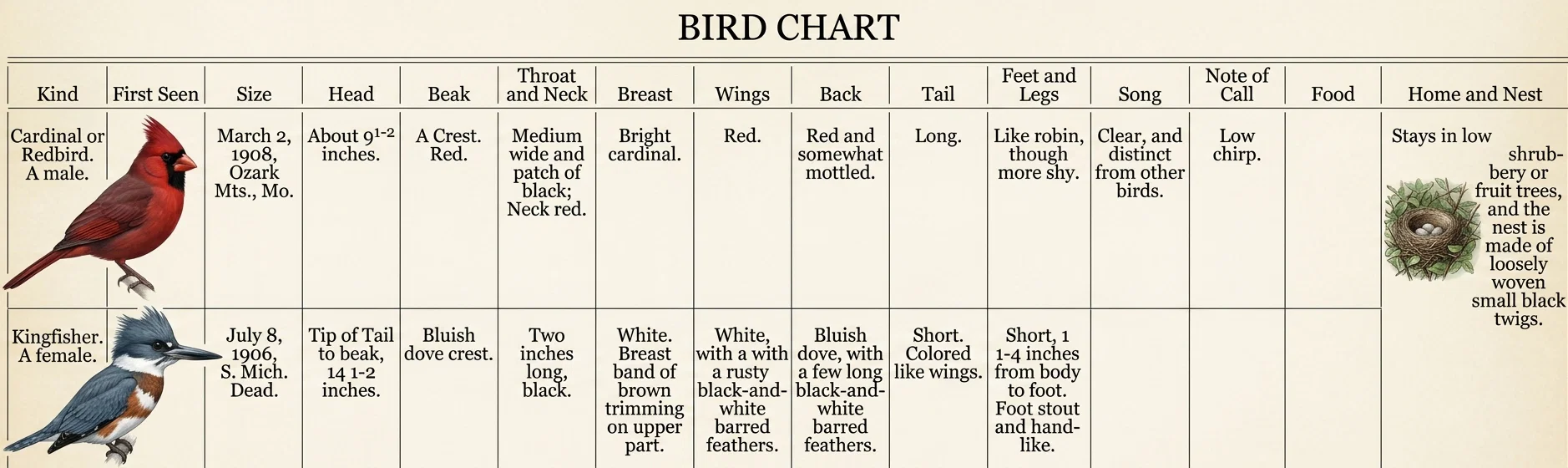
BIRD CHART
BIRD CHART
Select a bird for your personal study; for the surest way to interest the children is for father or mother to join them in this fascinating study. Be sure to ask your child to give you only such information concerning his bird as he actually observes for himself.
A bird chart, found in an old school magazine, has been used successfully with different groups of children. Place it on the blackboard or on a large sheet of paper tacked to the wall. As an illustration of how to use this chart, I am giving you, with it, some personal observations from my notebook.
Think how keen in observation a child will become by watching his bird for the various items. Each bit of knowledge acquired will stimulate him to complete his bird chart. These personal observations will remain with him far longer than anything you can read to him from books. As he discovers that not only on the bird he is watching, but on many other species also, are found various beautiful colors in artistic arrangements, he will gain a new feeling of reverence for his Creator, by whose power all things were made.
Children beyond the age of eleven years would be interested in a notebook of their own. You can make it yourself or show them how. Select rather heavy plain white paper, and have twenty leaves five by six inches in size. Tie with a pretty ribbon or cord, and on the outside cover either paste the picture or make a sketch of a favorite bird; also print in an artistic manner the words My Bird, The Friendly Wren, Robin Redbreast, Bird Lore, or whatever title the children prefer.
In this book they may enter items already jotted down on rough note paper regarding each bird observed, thus:—

CHEWINK

First seen — S. Mo., Ozark Mts., March 11, 1908. Size — From 7½ to 8 inches. Head — Black. Wings — Black with some white on long primaries.
Any peculiarity of bill, foot, etc., may be entered in this book. Feathers showing the markings may be sometimes secured, and mounted on the pages, as flowers are mounted in the study of botany.
“Bird Guide,” part 2, for birds east of the Rocky Mountains (price, 75 cents), and “Western Bird Guide” (price, $1), for birds west of these mountains, are valuable and interesting books. Each book is just the size to slip into the pocket while on a jaunt in the woods; and with the aid of its descriptions and colored pictures, any new bird may be easily identified. The “Flower Guide,” by the same author, I have found of equal value in studying the flowers. Any or all of these books may be obtained from Chas. K. Reed, Worcester, Mass. A field glass especially adapted to bird study may also be obtained from the same source.
After the children have made a systematic study of one bird, they will be more interested in literature on birds. “My Garden Neighbors,” by L. A. Reed (Review and Herald Publishing Association), is an interesting book to place in their hands.
Battle Creek, Mich.