SUNDAY, after a hard morning’s work with the books and papers at Santa Lucia, we take the train for Retalhuleu, where we must pass the night and take another train in the morning for the port of Ocos, on the Mexican line, which will be the most distant point we shall visit. Early in the morning we are again rolling along through a rich and beautiful, but mostly uncultivated country, stretching from the grand old mountains on our north to the sea, and away beyond our view to the south.
For traveling companions we have several Mexican gentlemen who have been obliged to forsake their homes and property and flee, on account of the terrible revolutions in Mexico. One of them, we are told, is the alcalde (mayor) who with much bravery defended the Americans about Tapachula, and saved many lives from the angry mobs when the American forces landed in Vera Cruz. Although very rich, he has been obliged to leave all and flee for his life, and we are told that several of his valuable farms have been confiscated. Thus we are reminded that the day is not far off when all the treasures of this world will have to be forsaken by those who have spent their lives in accumulating them, and only that which is deposited with the Lord will be of any further use to us.
The last twenty miles of our ride is very hot and dusty. We arrive at the port about 4 P. M., and it takes less than five minutes to convince us that we would better leave again in the morning. The town is built upon a bank of deep sand, and consists of three large frame buildings used as customhouse and barracks, of railroad offices and hotel, several small board shanties which serve as stores, a small hotel, and a number of huts built of upright canes and thatch roof.
As soon as we can make ourselves tidy we are out at work, and by dark Mrs. Stuyvesant has put papers in all the houses. By working until about nine o’clock, and getting at it again by dawn in the morning, I am able to take subscriptions for the monthly Signs and Watchman from the American hotel keeper and the American consul, and to sell several copies of “His Glorious Appearing” and “The Coming King” in Spanish. The consul, who is also the railroad superintendent, gives us passes to the next town, and orders “The Coming King” in English. We are too late in the evening and too early in the morning to see the commandant in his office, but he comes to see the train leave, and we sell him “The Coming King” as the train is starting.
This was a very important port and served a rich coffee district before the railroad from Guatemala and the other ports was connected with the one here. One can still see the remains of a fine iron pier extending into the sea. In 1902 the volcano Santa Maria blew out on one side, covering the country to the west with a deep layer of sand, which fell for several days. Much of this sand was washed down the river, which empties at Ocos, and formed a large bar, cutting off the pier from the shore. Part of it was destroyed, and all was rendered useless. Freight is now landed by lighters near by.
Arriving at the Ayutla station about 10 A. M., and finding no conveyance, we are obliged to walk to the town, about two miles distant; and as it is very hot and the dust several inches deep, we are weary, dusty, and wet with perspiration when we reach the hotel with our hand luggage. Here we meet our Mexican traveling companions again, who are waiting for an opportunity to reenter Mexico.
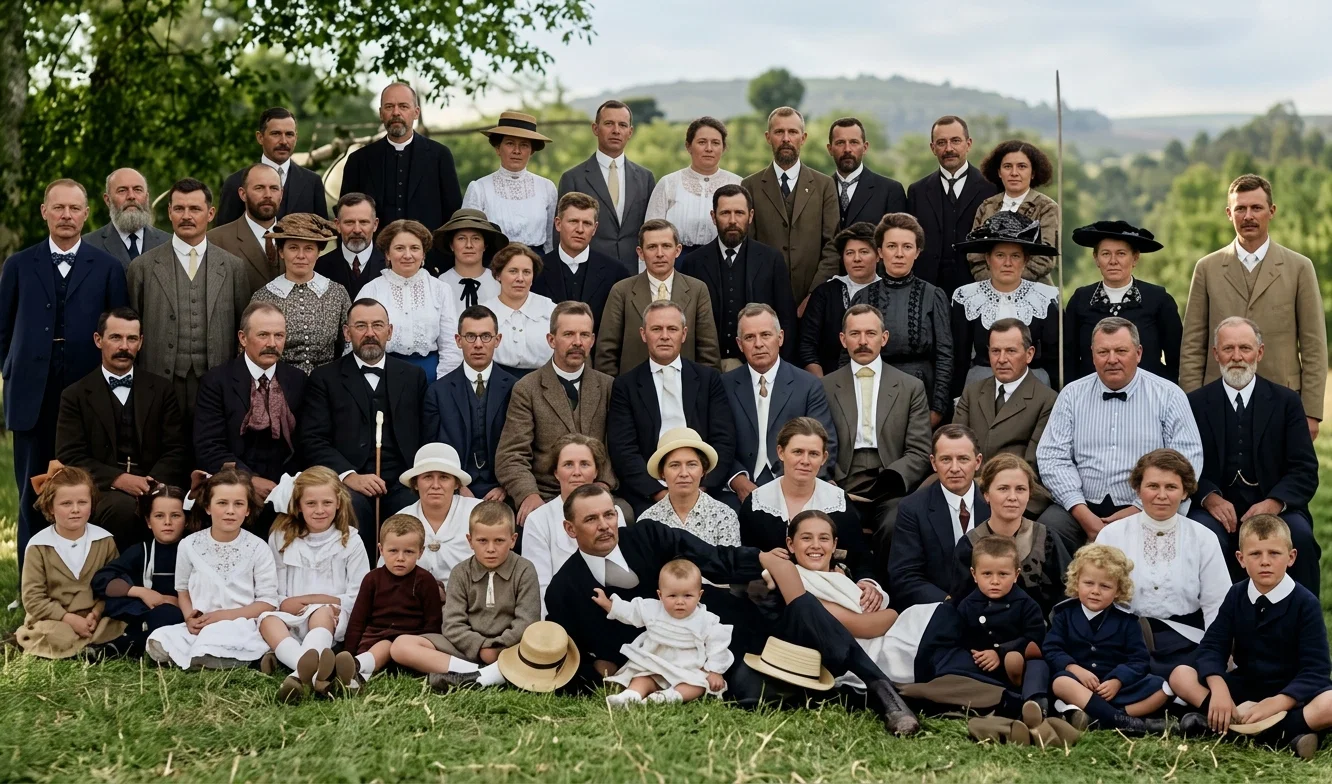
MINISTERS AND DUTCH BELIEVERS AT THE SOUTH AFRICAN UNION CONFERENCE
This is a border town. The terminal of the Pan-American railroad in Mexico is just across the river in the little village of Mariscal. There are several hotels in Ayutla, and here we meet other refugees. At present there is a gap in the railroad of about two miles, but they are now building the line into the town, which will enable passengers to make better connections when Mexico settles down and trains can run again. The houses here, like those in Ocos, are nearly all of upright canes, with dirt floors and grass roofs. Mrs. Stuyvesant distributes many papers, while I secure the commandant’s subscription for Las Senales, and sell a few books.
After visiting Cuatepeque, we go back to Retalhuleu and enjoy a Sabbath of rest. Early Sunday morning we are on our way to the port of Champerico, where we have just two hours to work. This place is a little larger than Ocos, and has more business. The little houses are of lumber instead of cane. As it is on a low bluff, the ground is solid and the sand absent. Here and on the train we sell several books and magazines, and distribute many papers.
Returning from this place, we go to San Felipe in the evening, where we must leave the railroad. Before daylight the next morning the stage coach calls for us, and we begin our climb of the steep grades for Quezaltenango. The scenery is grand as we wind higher and higher up the sides and in behind Mt. Santa Maria, sometimes shut in by the mighty hills, and then coming out on a bold point, from which one can look many miles south toward the sea. After a hard, steady climb of about twenty-four miles, we reach our destination just before dark, and go to a hotel.
This is one of our largest and best cities, having about 20,000 inhabitants,14many nice buildings, and a fresh, cool climate. It has an altitude of between seven and eight thousand feet.