By taking a brief glance at the map, you will see that the German Union is the largest union field in the world, occupying the eastern portion of Europe, the northwest of Asia, and German East Africa in the Dark Continent; its area is 9,140,000 square miles, two and six-tenths times as large as the United States, including Alaska. It contains over 260,000,000 people, or about three and one-half times as many as there are in the United States. While there are probably one hundred different languages and dialects used in this field, thus far we are laboring in about twenty different tongues.
In July, 1901, the union conference was organized. We had at that time four organized conferences and six mission fields. During the biennial period just closed, three more conferences have been organized, also a union district, and two more mission fields, so that we have now seven fully organized conferences, a union district, and seven mission fields. Our membership has increased from 4,256 to 6,297; while during this period 2,104 were baptized, and 761 were added by vote, making the total membership received 2,865, with a net increase of 2,041.
Our tithe has increased from $26,947 to $43,597, a net gain of $16,650. Our donations have also increased in like manner,—our Sabbath-school donations from $2,423 to $3,880, our First-day offerings from $449 to $1,525. This great increase is due to the starting of our German East African Mission, to which the First-day offerings are devoted. Our annual offerings have increased from $998 to $3,029, our book sales from $39,150 to $55,000. Thus our donations and tithes have increased from $30,817 in 1902 to $52,031 at the end of 1904, or a net gain of $21,214 in our annual income. Truly the Lord has helped us throughout the field. Our churches and companies have increased from 160 to 273, and our workers from 86 to 122, giving us forty additional workers.
The German Conference, organized in 1898, was in 1902 divided into the West German and East German Conferences, and several mission fields. At that time the West German Conference, with a population of 26,000,000 people, had a membership of $1,053, and an annual tithe of $10,006. The West German Conference was again subdivided in January, 1904, the Rhenish-Prussian Conference being separated from it; and in January, 1905, another division was made by taking out the large churches in Hamburg and Friedensau, where our union institutions are situated, as a separate union district. While its territory is only a little larger than the State of Washington, yet its population is nineteen millions, or twenty-eight times that of the State of Washington. The membership at the end of 1904 was 1,167, but since the union district has been formed, this has been reduced to 859. The tithe for the two years ending Dec. 31, 1904, amounted to $22,528, and the offerings to $3,815. There were thirty-four evangelical workers, and four hundred and seventy-three persons were added to the membership.
This conference, like all the rest, pays two tithes of its income to the general mission fields, and until the union district was created, also supported the Bible teacher in our missionary college.
Rhenish Prussia
This one province, which was organized in 1903, is about the size of the States of New Hampshire and Rhode Island, but it has nearly six million people—as many as there are in Pennsylvania. Here the work in Germany began. It is one of the richest manufacturing portions of Germany. The church-membership is 380; the tithe amounts to $7,063, and the donations to $933. While they had only nine workers and one ordained minister (the president), yet they report two hundred and fifty additions in the biennial period. Though this field is largely Roman Catholic, yet they are raising up many faithful believers. The tithe averages over eleven dollars per capita.
South German Conference
Its area is about as large as Alabama, but it contains 13,200,000, or more than seven times as many persons as live in Alabama. It was organized in 1902, with a membership of 268. Now it reports 441; this gives 238 additions. There are nine workers. The tithe for the two years is $8,484; the donations are $1,548.
It is in this field that we have had so much difficulty about holding our meetings. By an old statute, only those societies that are recognized by the government are allowed to celebrate the Lord's supper, baptize, or even assemble for worship, in the State of Bavaria. Our church in the famous city of Nurnberg has had its meetings broken up by the police, and its members dragged before the magistrates, and fined. We have repeatedly tried to get toleration, but thus far have not succeeded. Our books have also been forbidden in this territory. This has caused us a great deal of trouble. There is a German law which makes it possible for any man on any local official committee in the empire to say that he finds a certain book contains sentiments that are distasteful to a certain class of people, and his unfavorable report, when accepted by the respective local committee, is carried up to the central government at Berlin. If no protest to his adverse action is raised inside of two weeks, the book is forbidden to canvassers throughout the whole German empire. Thus you can see how easily our enemies can make us trouble. We have had whole lists of books and papers, some of them the most harmless, as “Christ's Object Lessons,” stricken by the government censor, and have been put to great annoyance and considerable expense to secure a reversal of the decision. When our privileges hang on so slender a thread, you can see what need there is of care on the part of our agents, and of constant watchfulness by our publishing department.
East German Conference
The area is the same as that of Georgia, with a population of 17,000,000. Berlin is located in this field. The membership is 1,031; the biennial tithe, $16,880; donations, $3,760. We have twenty workers in this field, and the additions reported are four hundred and twenty-five.
Prussian Conference
The youngest of our conferences in the German Union is the Prussian. It was organized in 1903, being cut off from the East German Conference. Its area is 24,120 square miles, and its population is 3,561,000. It is largely farming region, so that the income of the people is considerably less than in Western Germany; but the third angel's message is making good progress here. During 1904 they had, with only seven workers in the field, one hundred and five additions. The tithe amounted to $2,629, the donations to $538. The present7membership is 552. Thus far they have but one ordained minister, and he is the president. This, with the newly organized union district, gives, in the German empire, about 3,500 Sabbath-keepers, and $31,754 tithe, or nine dollars per capita.
But we must remember that our brethren in Germany have by no means the wages which the brethren have in America. On the other hand, these churches are mostly in large cities, where we have to pay large rents—from one hundred dollars to one thousand dollars a year. In Berlin, where we have now three hundred Sabbath-keepers, we have to pay for a meeting hall in the center of the city, a thousand dollars rent per annum. But while our people have all these extra expenses, yet they pay a good tithe, and are also liberal in all their donations. We have only three chapels of our own throughout the whole field.
German Swiss Conference
This we separated from the Latin Union Conference as early as 1901. Its population is 2,320,000, somewhat smaller than New Hampshire and Delaware combined. We find that God's message is also penetrating the Swiss valleys, and he is gathering out a remnant, who are preparing to meet him. Our additions the last two years were 162; the tithe amounted to $5,520, and the donations to $1,150. This conference has six workers. The property at Basel is now sold, and the sanitarium removed to French Switzerland, and, naturally, a number of the members will move to that portion of the field. Taking in the French portion, we have now in Switzerland a membership of 3,800, as high a proportion as in any other portion of Europe.
South Russian Conference
This conference is altogether composed of German colonists in Russia who settled there many years ago, enjoying privileges and specified liberties granted them by the czar. Among these, the message first made entrance into Russia. The population here is about 1,500,000, scattered over the southeastern portion of European Russia. We have seven workers, and a membership of 887; they report two hundred and thirty-one additions. The tithe for the last two years has been $5,660, and $981 has been given as donations.
North Russian Mission
This field is composed of the Germans, the Esthonians, the Lettonians, and the Poles in the northern and western parts of the empire. It has a population of about twenty million. It is here that we have successfully carried our appeal for more religious liberty to the Russian Senate, and it is through the rendering of that senate that we can work so much more freely here now than formerly. We have had an addition of two hundred and forty-four through baptism and by vote in the last two years, bringing our membership up from 280 in 1902 to 494 at the close of last quarter. We have nine evangelical workers here. Our biennial tithe was $2,983; donations were $722, and book sales, $416.
Middle Russian Mission
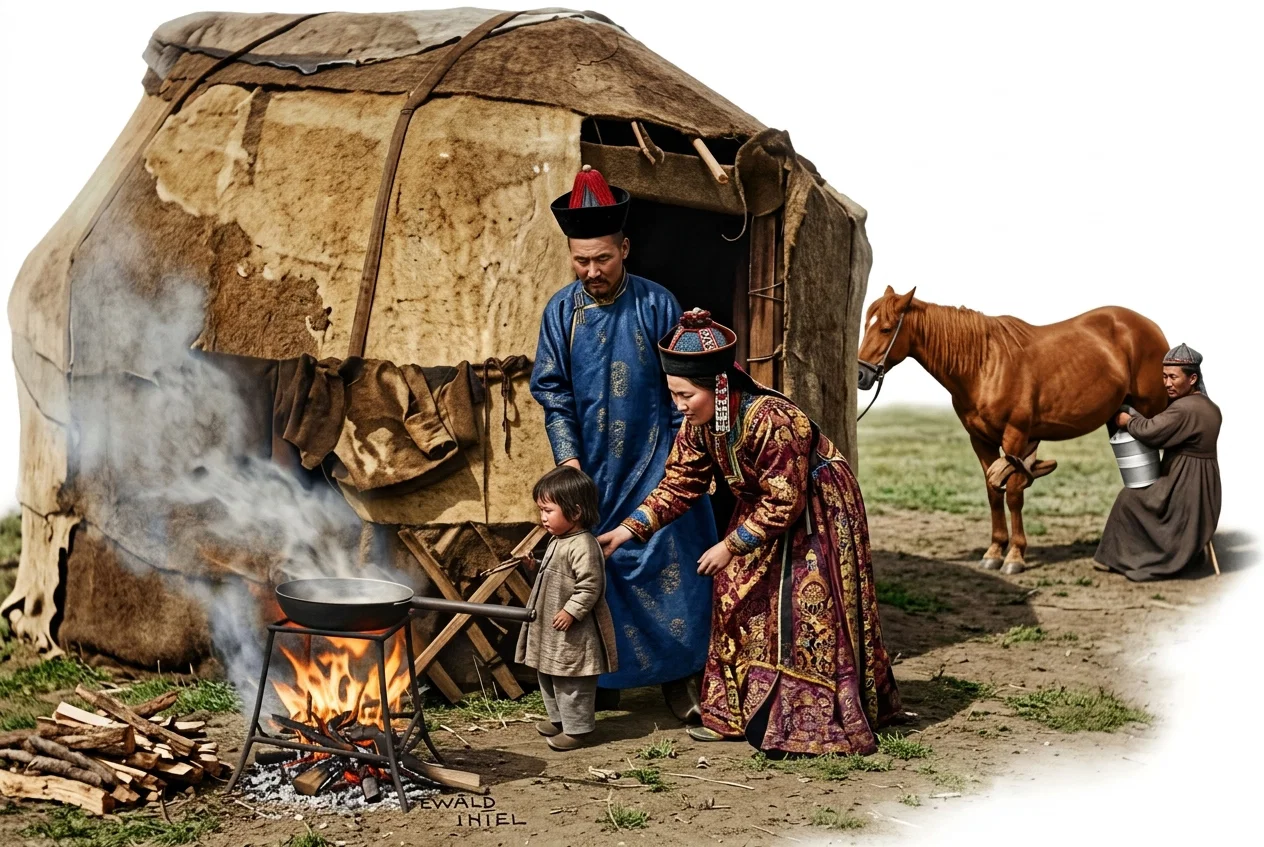
AMONG THE KALMUCKS, RUSSIA
This is by far our greatest mission, both in extent of territory and in membership. It includes all the native Russians—the White Russians, the Little Russians, the Red Russians, and the Great Russians. There are probably about 103,000,000 souls in this mission. The work among this class has moved forward very rapidly, though we have had less liberty here than in any other part of the German Union. We had 221 members at the beginning of 1903, and now we have 630. During the two years, we had 599 additions in this field; $2,119 tithe was paid, and $104 was donated; we have only four workers laboring in this vast territory. The people tell one another the glad news of the soon-coming Saviour, and thus our work spreads.
While this success has been attending the work among great difficulties, we are now receiving the glad news that religious liberty has indeed been granted in the Russian empire. A meeting is now called in St. Petersburg, where all the different denominations in Russia are to be represented to make known their desires.
Trans-Caucasian and Siberian Missions
Dr. Pampaian and his brother were located here in the latter part of 1903, to labor especially among the Armenians; but as he has a knowledge of only the Turkish, and not the Armenian itself, much of their time has been devoted to the study of the Armenian and Russian. There are about six million people in this portion of the field. We have also some scattered believers now in Siberia, and in Asiatic Turkey in Central Asia. Calls are coming for workers to visit these fields. Thus an immense territory is opened up before us in that empire, in which we have over two thousand Sabbath-keepers. As the people generally are poor, the tithe averages only three dollars a member; and this accounts for the tithe in the German Union seeming low, when compared with Great Britain or America.
Austrian Mission
Here is a country containing 115,900 square miles, and twenty-eight million people. Vienna, the capital, is one of the great cities of the continent. German is the predominating language, but there are many others; the Czech is the language of Bohemia, the Polish is heard, the Ruthenian, which is a sort of Russian, is used, not to mention Italian, Servian, Croatian, etc. Formerly we worked this field in connection with Hungary, but the two were divided in 1902. As there are so many Romanists, this is a hard field. Because of unfavorable laws, we can not send out colporteurs into the country. We have six workers in Austria. Our membership is fifty-three; we have had thirteen additions, $825 tithe, $143 donations, during the last two years.
Hungarian Mission
This field has a population of twenty-one million. It is, in some respects, a more favorable field for our operations than is Austria. There is at least greater religious liberty here. The Hungarian language predominates, but there are many representatives from other countries, as Rumania, Servia, Germany, Italy, Croatia, etc. There are also a large number of Gipsies to be found here, as well as Slovaks, Slovenes, and Ruthenians. Among our believers in8Hungary, we have quite a number of Hungarians, Germans, and some Rumanians and Servians. Our additions the last two years were 99; the tithe was $1,829; the donations were $250. Our present membership is 193. We employ seven workers.
Balkan Mission
The Balkan field, as you may know, has ever been a great political storm-center in Europe. To-day, the Balkan holds the key to the great Eastern question of Europe. It is also one of our most interesting mission fields. It is composed of the countries of Rumania, Bulgaria, Servia, Montenegro, and has a population of 12,600,000 people. We have only one paid worker in this whole field. Our membership is seventy-three. Some of the former members have moved from the Balkan States to Germany, where they have settled upon the former farms of Polish noblemen, whose land the government has bought and opened up for German colonists. Our tithe for the two years was $1,011; donations were $116; additions, eighteen.
Holland and Flemish Belgium
After the great crisis in this field, which happened in 1902, had cut down our membership to thirty-seven, we began steadily to build up the work anew. We are glad that God has been with us until we now have one hundred and twelve members, among whom are laboring seven workers at the present time. Our accessions the last two years were fifty-seven; the tithe was $983; the donations were $160; book sales amounted to $1,439. In Antwerp, which is in Belgium, our workers have had some very hard experiences, as this is largely a Catholic city. It has been no easy thing to secure a meeting hall here. The opposition of the clergy and of the laity has been bitter; their persecution has been felt. Still our workers have been of good cheer, and they have now a little company of seventeen in Antwerp. Belgium is one of the most densely populated countries of Europe, containing 8,860,000 people, living in an area of only 17,650 square miles, not quite half the size of Indiana.
The latest of our missions to be opened is the German East African Mission. This is truly heathen soil. It is a territory containing about as many square miles as the States of Texas and Colorado, or 368,830 square miles. Its population is 6,500,000. The Bantus and Suahelis are the leading tribes. The opening of this mission has had a wonderful, quickening influence on the work throughout the entire German Union. The First-day offerings have been dedicated to this field, and the fact that every week our members give for the heathen in Africa has had a great influence on their Christian life in general. We believe that one of the benefits of foreign missions is the reflex influence on the home churches.
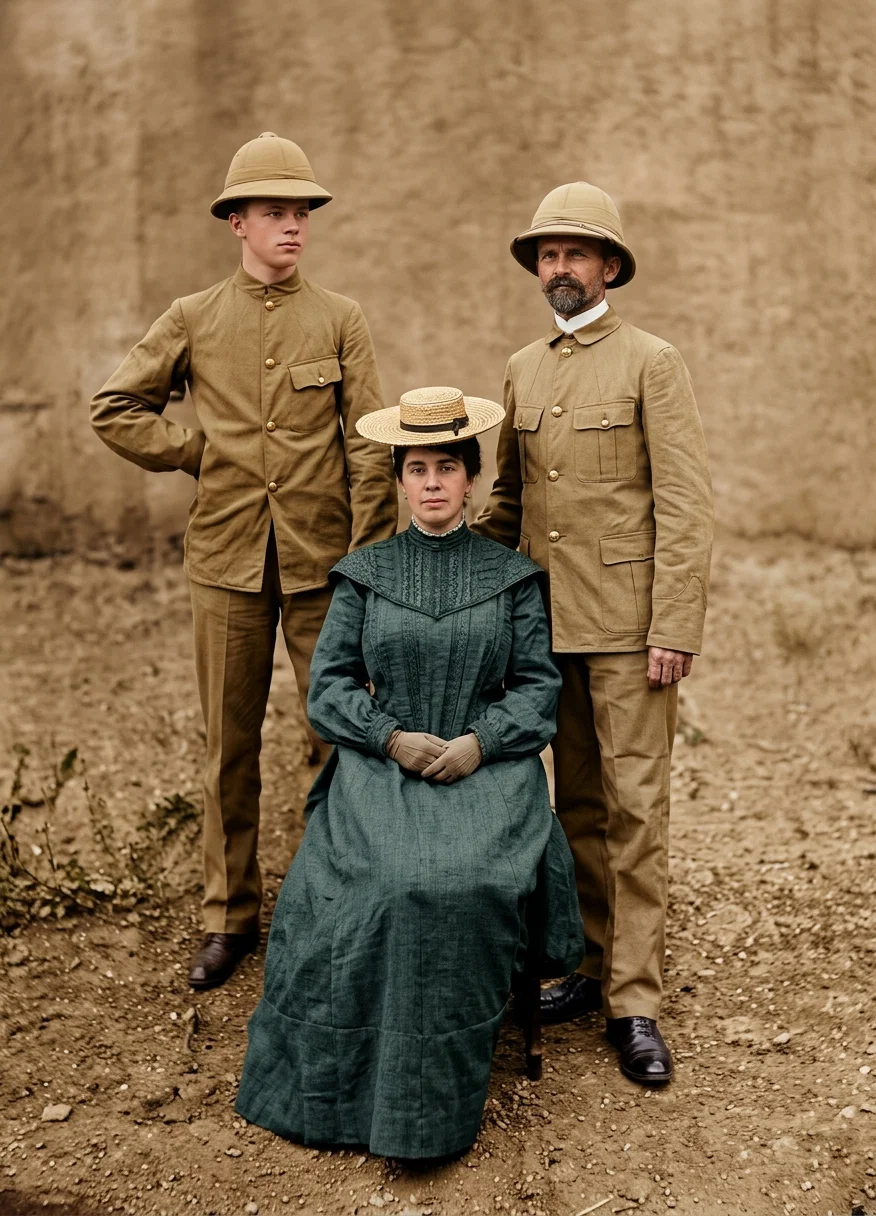
MISSIONARIES EN ROUTE TO GERMAN EAST AFRICA
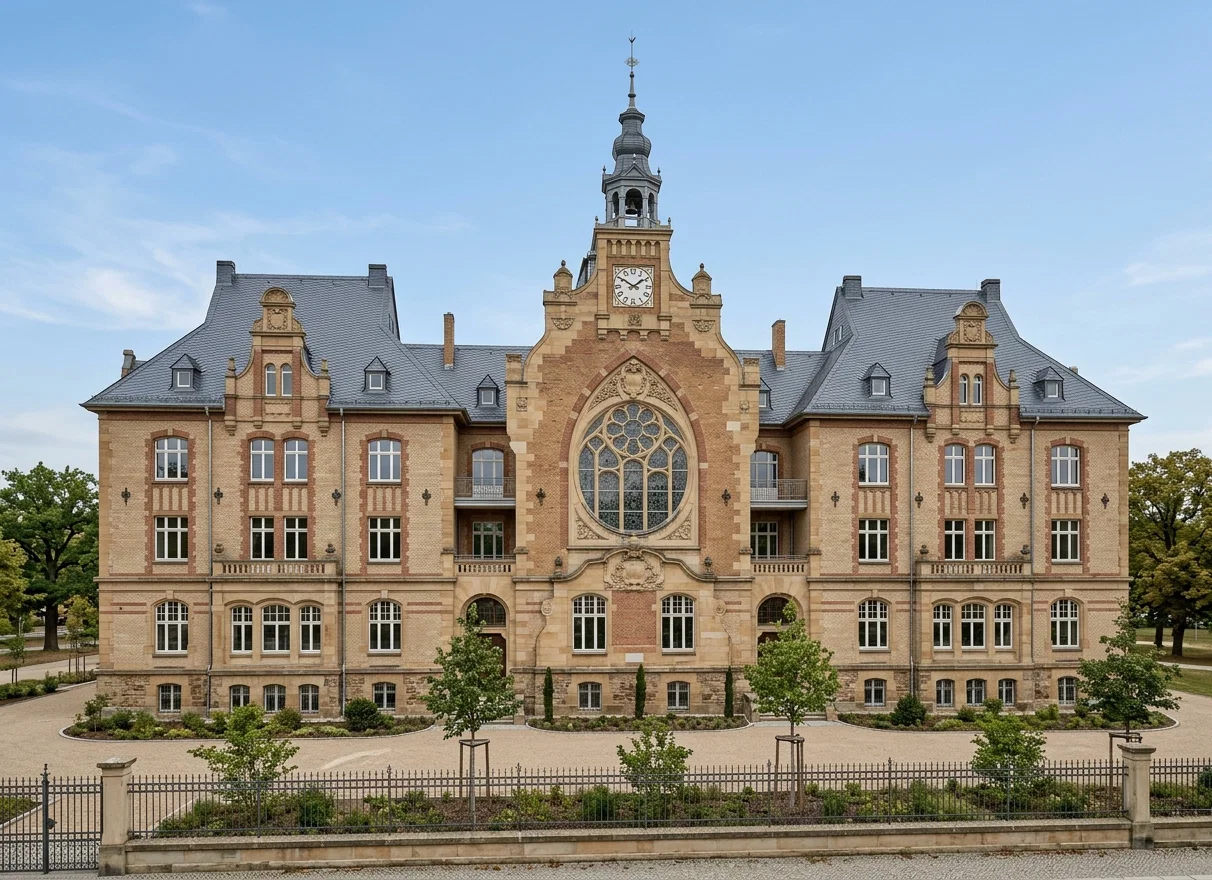
MAIN BUILDING OF THE FRIEDENSAU SCHOOL
It was my privilege to spend six weeks in German East Africa last spring. I was much pleased to be able to take part in planning for the work, and to assist in getting started in the erection of our buildings. We have made good progress in getting a beginning. Our workers are mastering the language. Indeed, they can already hold services in the native tongue. The past winter we have had two more intelligent young men preparing for this field, one of whom is a nurse, the other a teacher. The government is very anxious that the natives shall be educated. These workers sailed from Hamburg the fifteenth of this month, and are now on their way to this needy field. This will give us six evangelical workers in German East Africa, as one of these brethren married one of our nurses before sailing.
Our Institutional Work
As early as 1891 the property in Hamburg was secured for the mission house, and later a chapel was built with sufficient room for a small printing plant. After the Basel house had been closed up, we transferred the printing to Hamburg, and the work has grown steadily ever since. When we transferred, the German paper had a semimonthly circulation of 2,000, now it has 30,000; our health paper has a monthly circulation of 10,000, our union paper a semimonthly circulation of 4,500, our children's paper a monthly circulation of 6,000, our Dutch monthly a circulation of 1,200. We have also begun to publish Russian and Hungarian periodicals. At present we publish in fifteen different languages. Our sales during the last two years amounted to $105,000. We have lately put in two good presses for our periodical and small tract work; but our large books are still published in Leipsic. Our publishing house in Hamburg has gradually built up until its present worth is fifty-five thousand dollars. Last year our net gain was about seven thousand dollars. We have a small debt yet, which would have been paid off ere this had we not helped out other institutions. We have about thirty employees in the house. We carry on a branch at Basel. Our publishing house would not be so strong financially to-day had we to divide our gain with tract societies. While our people throughout the field all love church tract societies, yet all the canvassers and the churches order books and periodicals direct from the publishing house.
Our next institutional work was the starting of an industrial school at Friedensau, in the country about seventy miles from Berlin. We have here ninety acres of land, and gradually we have erected the necessary buildings as far as our means would allow and the needs seemed to necessitate. At first we had very small, inadequate school buildings. Then we put up one dormitory, and had our school there; but soon we found this9entirely too small, and the way the buildings were planned, we were forced to put up the school chapel and the other dormitory at the same time. We can now accommodate about one hundred and fifty students, and our last enrollment was one hundred. Our new buildings are neat and commodious. By the liberality of our American brethren, and the sale of “Christ's Object Lessons” in the German Union field, we have been able to do our building without increasing our indebtedness. The Hamburg house has also helped us by very liberal donations. We have strengthened our teaching force, and lengthened our courses. We train Bible workers as well as medical workers. Various nationalities of our field are represented here. Many of these are poor. In order to help them we have increased our education fund, which now amounts to nearly five thousand dollars. Our school is industrial in its nature, and the students can earn about one third of their way. Our tuition is very low, only about two dollars a week for board, lodging, and tuition. We have a large number employed in the health food factory and bakery and on the farm and grounds.
Our nurses are laboring in different parts of the German Union. Several have gone to the Orient and to German East Africa. While the school building has cost us about thirty-seven thousand dollars, we have now about twenty-eight thousand dollars of that covered, and a sufficient number of “Christ's Object Lessons” on hand to wipe out the debt. Last year our school showed a gain of over one thousand dollars, as the German Union treasury helped us with the paying of the teachers.
Our sanitarium and food factory work has also developed well. We have enlarged our buildings, so we now have room for about fifty patients. We have a good run of patients, especially in the summer-time. Our food factory is also steadily increasing its business, and our present worth is now about twenty-eight thousand dollars. As the health association owns all the property, and the buildings and inventories, etc., its investment is quite large, about seventy thousand dollars. It is now in a good condition, and we can gradually wipe out the debt.
We have every reason to be grateful to God for the many blessings which he has bestowed upon our large field, and for his prospering hand which has been over the field, as well as the institutional work. While we shall be glad to receive more help in the way of men and means, yet we see the pressing needs of the fields beyond, and as we know that God blesses the liberal soul, our great desire is to be where we are willing both to help and to be helped. While we all have to reach out to secure assistance in our work from our brethren, we, above all, reach out to Him who is over all, and implore his aid and blessing to be with the work in this field.