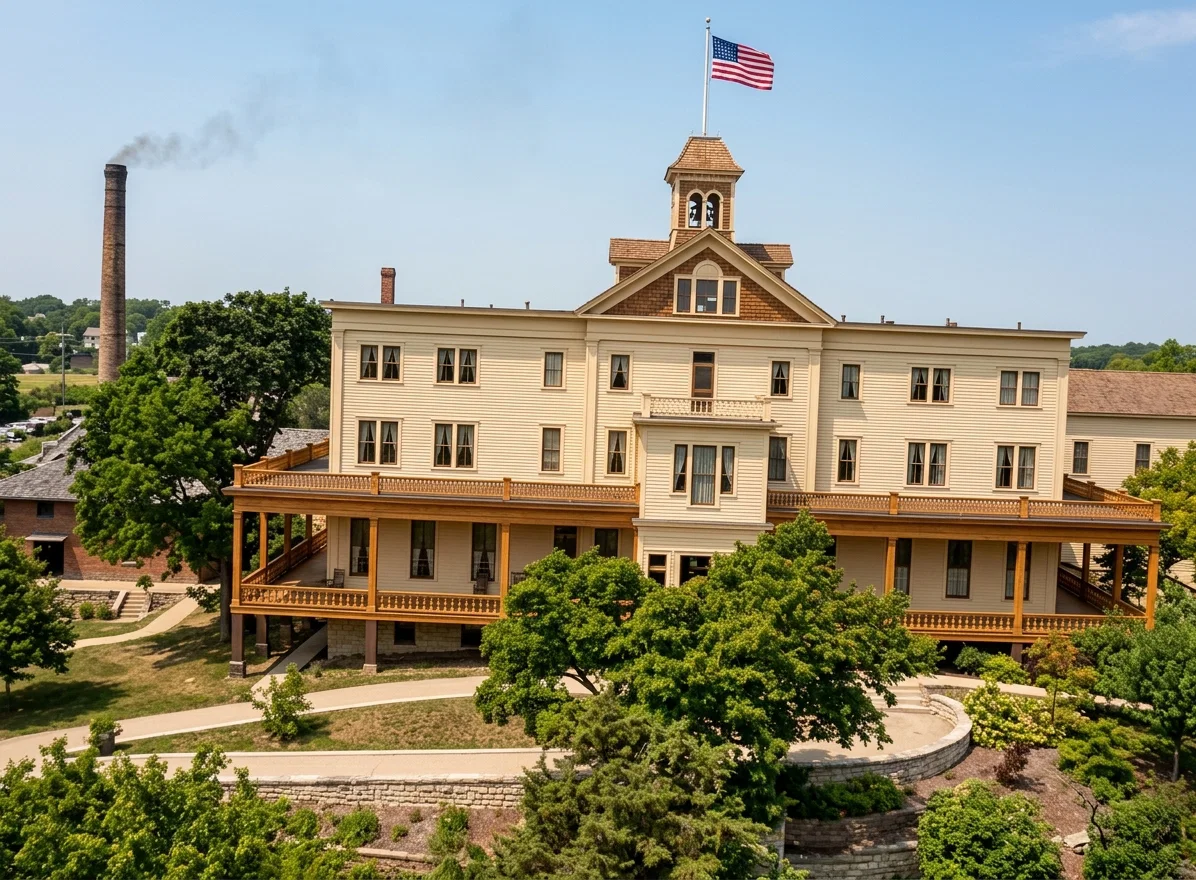
The Madison (Wis.) Sanitarium

11%

Review and Herald Publishing Association · Washington, D. C. · Jun 29, 1905

FromReview and Herald, Vol. 82, No. 26.

Read the full edition

The Madison (Wis.) Sanitarium

In June, 1881, a camp-meeting was held at Madison, Wis. To this meeting Brother and Sister James White came. After the camp-meeting they stayed a few days, enjoying the superb scenery which the poet Longfellow has described in a beautiful poem. They picked out this place as one well located for a sanitarium, and selected a site with the view to purchase. The negotiations were left to Dr. Stillman, of Madison, who had nearly finished the arrangements when the news came of Brother White's death. The purchase was consequently postponed indefinitely.
Ever since this time the brethren and sisters of Madison looked forward to a time when a sanitarium should be established. Finally, in the fall of 1899 there seemed to be an opening for graduate nurses to work in Madison. Sister Stillman wrote to Dr. Kellogg for two nurses to locate in Madison. In response to this call Miss Laura Neilsen and Miss Edith Miller, who lately married Dr. Law Keem and is now a missionary to China, were sent. These nurses did their work so well that a demand for treatment rooms grew among their many patients, and the doctors for whom they nursed. They did not feel equal to the task, and so Dr. Amelia Zipf, who was then in the employ of the Wisconsin Conference as their State physician, came to look over the field. She gave a favorable report, and the newspapers of Madison became interested and agitated the question. In response to a call for a gentleman nurse and more help, Brother J. H. Bramhall and his wife were sent to join the forces already on the ground. After looking over the situation the nurses decided to lease 118 Monona Avenue, an old club house, for their work. Through the aid of the Wisconsin Conference Committee fifteen hundred dollars was secured with which to equip the building. Before it was ready, a large number of patients were waiting for treatment. Among these were some of the most influential citizens of the place. In June it was open to the public, and soon a score of treatments were given daily, except Sabbath, and the demand for nurses became so great that there were thirteen employed at the treatment rooms and on private cases.
Health foods soon became popular in Madison as a consequence of the recommendations of those connected with the work, and hundreds of dollars' worth were sold.
In the fall, in answer to a request, Drs. C. P. and A. B. Farnsworth came to unite with the work. They found that there were already five patients being cared for in the nurses' quarters. Mr. Bramhall was chosen business manager, and the nurses came together often in counsel. It was decided to rent a dwelling for the use of patients who wished to come from a distance. Accordingly No. 113 West Doty Street was secured, and soon there were twelve patients there for treatment. The principles of health and the gospel were rigidly adhered to, and the Lord prospered the work. In a year's time the debt of fifteen hundred dollars was wiped out, and five hundred dollars was on hand, after paying the running expenses. A restaurant was secured at No. 426 State Street for the accommodation of the University students. Meantime Drs. C. P. and A. B. Farnsworth were called to Mexico to take charge of the Guadalajara Sanitarium. Dr. Harry B. Farnsworth, of CollegeView, Neb., was sent to fill the vacancy.
The demand for a sanitarium became more pronounced, and the Wisconsin Conference bought the present site of five acres on the south shore of Lake Monona, near the Chautauqua Assembly grounds, where our people have held camp-meetings. The kitchen of the little eight-room cottage was fitted up for a treatment room, and patients were received. July 3, Drs. C. P. and A. B. Farnsworth, having returned to the States, joined the work in Madison at the request of the Wisconsin Conference. At the next camp-meeting, held in Grand Rapids, 1902, the conference created the Medical Missionary Department of Wisconsin, under the incorporated name of the “Medical Missionary and Benevolent Association of Wisconsin,” which is organized to do all the business pertaining to the medical missionary work. Plans were submitted for a building, and were adopted. Thirty minutes was allowed for presentation of the plans and organization and the soliciting of funds. Eleven hundred dollars was pledged toward this work, half of which the workers of the sanitarium pledged. The first of September, ground was broken for the sanitarium. Not one dollar was in the treasury for the work. The little band of workers assembled and prayed earnestly to God for guidance. Brother Bramhall took charge of the building, and Dr. Farnsworth went out soliciting gifts and loans. The Lord moved the hearts of those who had money in the bank to give some and to loan more. As the work progressed, we hardly knew which way to turn. There was the material to be paid for, and the men to be paid; but God sent the necessary means. In the following spring the building was finished and equipped. The problems to solve were our own electric lighting, sewage, water-supply, elevator, and the thousand and one things that go to equip a sanitarium.
Finally, on June 7, 1903, the building was dedicated. Thirteen patients were there. Dr. J. H. Kellogg gave the dedicatory address, and spoke of the principles for which our sanitariums stand. Judge Arthur then said, “This is the first sanitarium with which I have not had something to do so far, and it is the pearl of them all.” There was a steady running behind of the current expenses the first four months. Then we made both ends meet, then the income was more than the expenses. The net gain the first year was nine thousand dollars, and we also did over six thousand dollars' worth of charity work. The total amount of business done came to over thirty-six thousand dollars. About four hundred patients were treated. During this time over twenty young men and women had been received in the nurses' classes and were being trained. The little eight-room cottage was too small to accommodate them, and so we had to rent rooms for them. It was proposed at the camp-meeting held at Oshkosh in 1904 that a dormitory be built for these faithful workers. The instruction given was that we would have to get some one to give the whole amount. We came home, and on our bended knees asked God to help us. We were moved to write to those of our brethren and sisters who we knew had means. One responded with the gift of six thousand dollars for a nurses' dormitory. This sacrifice was made by Brother M. E. Boutelle, who, with his brother Ernest, had succoured the General Conference with this amount in its hour of need. This home was built during the winter, and in the spring was finished, and the young women have moved in. In the year which has just closed, we have graduated a class of six nurses, and there has been received a large class of nurses who are in training. The standard of the training-school is that of the New York State requirements. Our class to be graduated this fall will consist of eleven members. During the past year Elder Scott, of Cheteck, Wis., has been added to our force as chaplain. We have received about six hundred patients. One hundred and thirty-three operations, many of them major, have been performed without a single fatality. Ten have accepted the truth, and prejudice has been broken down. The Lord's name has been magnified. When the doors were opened to the public, the institution was involved for about four thousand dollars of its cost. Now the assets are about $76,000, and the liabilities $45,000. The lame walk, the deaf are made to hear, the blind to see, and the gospel is preached to all. God has been with us, and we praise his name for it.
C. P. FARNSWORTH, M. D.
THE MADISON, WIS., SANITARIUM