Ecuador

8%

Review and Herald Publishing Association · Washington, D. C. · Jun 29, 1905

FromReview and Herald, Vol. 82, No. 26.

Read the full edition

Ecuador

SINCE reporting to the REVIEW I have taken a trip up the Guayaquil and Quito Railroad, canvassing for books, taking orders principally for “Patriarchs” in Spanish. This was a pleasant change, after spending several months in Guayaquil.
My first work was in and about a small town called Milagro, where hundreds of people work during the summer season, gathering rice and sugarcane. All the land is owned by large landowners, so that a poor man, if he wants to work for himself, must pay a very high rent.
At that place, a rice miller, a German, invited me to stay at his house. He was a vegetarian, and I therefore gladly received the invitation.
At Naranjito, a little farther up the line, several Catholics attacked me with their arguments. One affirmed that my teaching was false, and that his Catholic Bible was the only true one. From his own Bible I showed him that his idea was wrong. Two gave me orders for “Patriarchs” at that store, and a laboring man bought “Steps to Christ.”
It is useless to solicit orders from the lower class, as they would seldom take their books. I always take a grip full of small books, and sell them as I go along.
My next stop was at Bucay, at the foot of the mountains. A Christian family who keeps a restaurant charged me nothing while there. One of them, a young lady, cried while she told her Christian experience—the only tears I have seen as yet here shed for Christ. This was worth all my trouble, and more. O if only our hearts could be kept melted with the love of Christ, that a change there would be in our own lives, and how many would see that we had been with him!
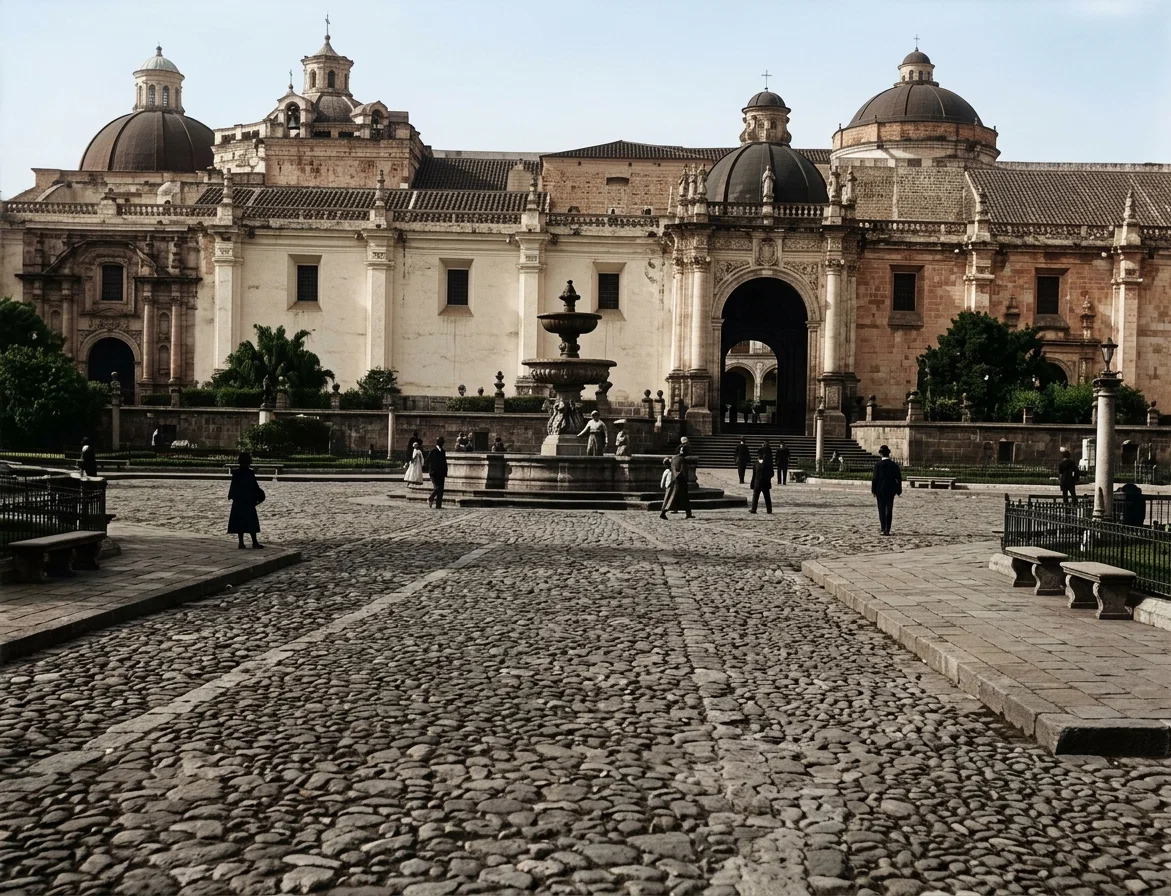
ONE OF ECUADOR'S CATHEDRALS
From Bucay to Huigra is the prettiest scenery I ever saw. The mountains are almost abrupt. The plants have leaves as large as a wash-tub. Flowers can be plucked from the car. There is such a growth of plants that the company occasionally sprinkles a poisonous liquid from the engine, to check this growth. Huigra is four thousand feet above the sea-level, and is supposed to have about the finest climate of Ecuador.
On asking for the general manager of the line, at Huigra, his secretary let me know positively that he could not be seen. As I passed his house, he came out, asked me to his office, paid me nine sucres for a book in advance, took me to his house, and showed me his splendid library.
The station-master treated me very kindly, also helped me to get more orders. While we were talking about the book, a young man of the laboring class drew near, asking that his name be put down for a book, at the same time giving me fifty cents to bind the bargain. He knew himself that his class is not to be trusted. Several colporteurs could work right along here, and have a choice of climate—warm, temperate, or cold. Every effort put forth to save others will be blessed by the Lord. I find this always true while out in the work.
In my last article I spoke of a club of about ten English Signs for this field, but as yet no one has responded. Only a few days ago a young man asked me if I had any more of those Signs, as he thought they were very good. He had to be refused, as there were none. Back numbers of the Life Boat, Signs, REVIEW, and Life and Health could be used to good advantage in this country among the scattered English-speaking people. As very little English reading-matter gets into this country, everything is read. Address the writer, at Guayaquil, Ecuador. T. H. DAVIS.