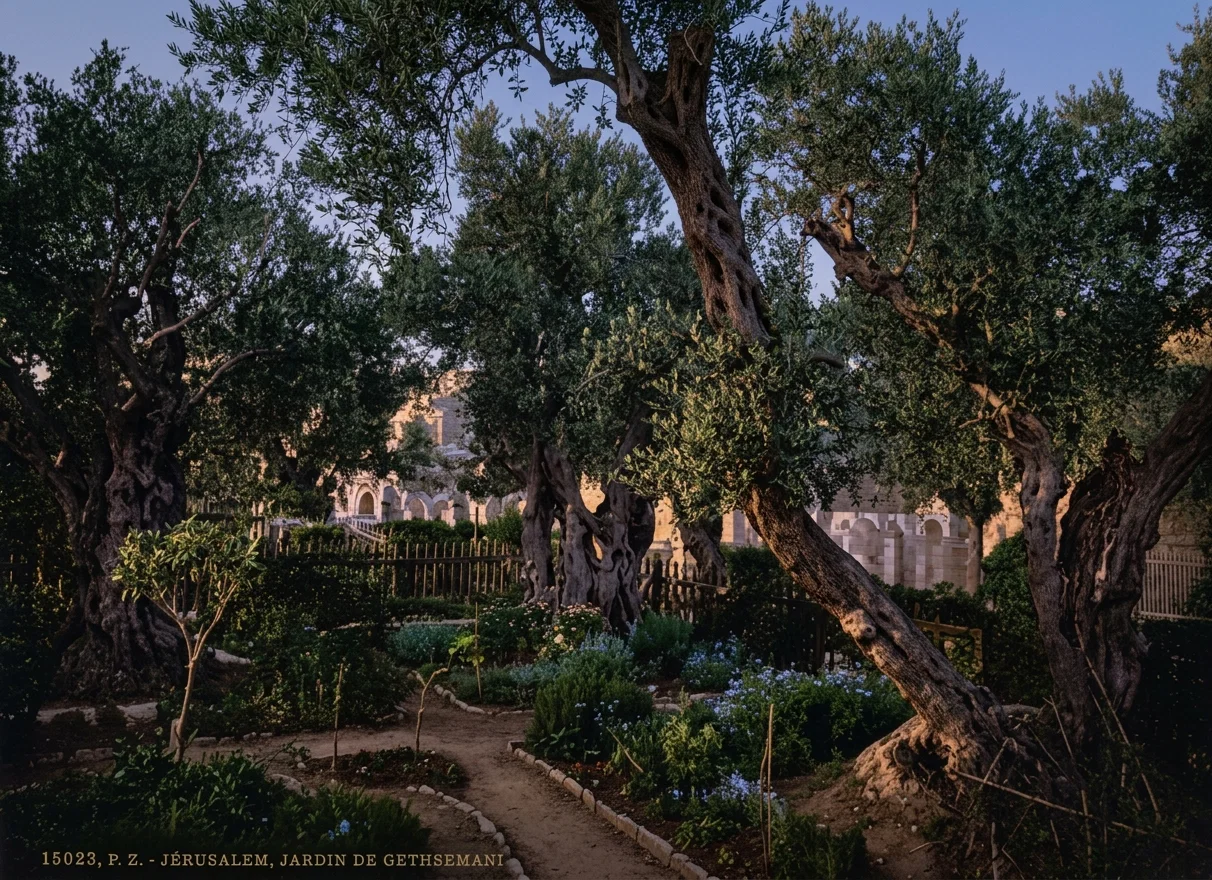
THIS view shows a plot of ground memorable for its association with the most tragic night in earth’s history,—the night when the destiny of the human family trembled in the balance, while from Him whose petitions had never been denied there went up to the throne of God the prayer, “If it be possible, let this cup pass from me.” The Garden is situated on the east side of Jerusalem, about half a mile from the city walls, and at the foot of the Mount of Olives. The location is marked by an enclosure measuring about fifty-seven yards square, and containing eight ancient olive trees, some of which are shown in the accompanying view.
Here, on this little plot of ground, without sound of contending hosts or sight of carnage and ruin, was fought the mightiest conflict, and here was won the greatest victory, that earth ever knew. Here took place the last decisive battle between Christ and Satan for the mastery of the earth and its inhabitants, for the perpetuation or the final overthrow of Satan’s kingdom.
“In the wilderness of temptation the destiny of the human race had been at stake. Christ was then conqueror. Now the tempter had come for the last fearful struggle. For this he had been preparing during the three years of Christ’s ministry. Everything was at stake with him. If he failed here, his hope of mastery was lost; the kingdoms of the world would finally become Christ’s; he himself would be overthrown and cast out. But if Christ could be overcome, the earth would become Satan’s kingdom, and the human race would be forever in his power.”—“Desire of Ages,” page 687.
“The history of the human race comes up before the world’s Redeemer. He sees that the transgressors of the law, if left to themselves, must perish. He sees the helplessness of man. He sees the power of sin. The woes and lamentations of a doomed world rise before him. He beholds its impending fate, and his decision is made. He will save man at any cost to himself. He accepts his baptism of blood, that through him perishing millions may gain everlasting life.”—Id., page 690.