From persons in various countries I have received inquiries about the inscription, Vicarius Filii Dei, which is commonly believed to be inscribed upon the tiara of the pope. And with the view of responding to these various inquiries and settling a much discussed question, I have made a special effort to gain the desired information.
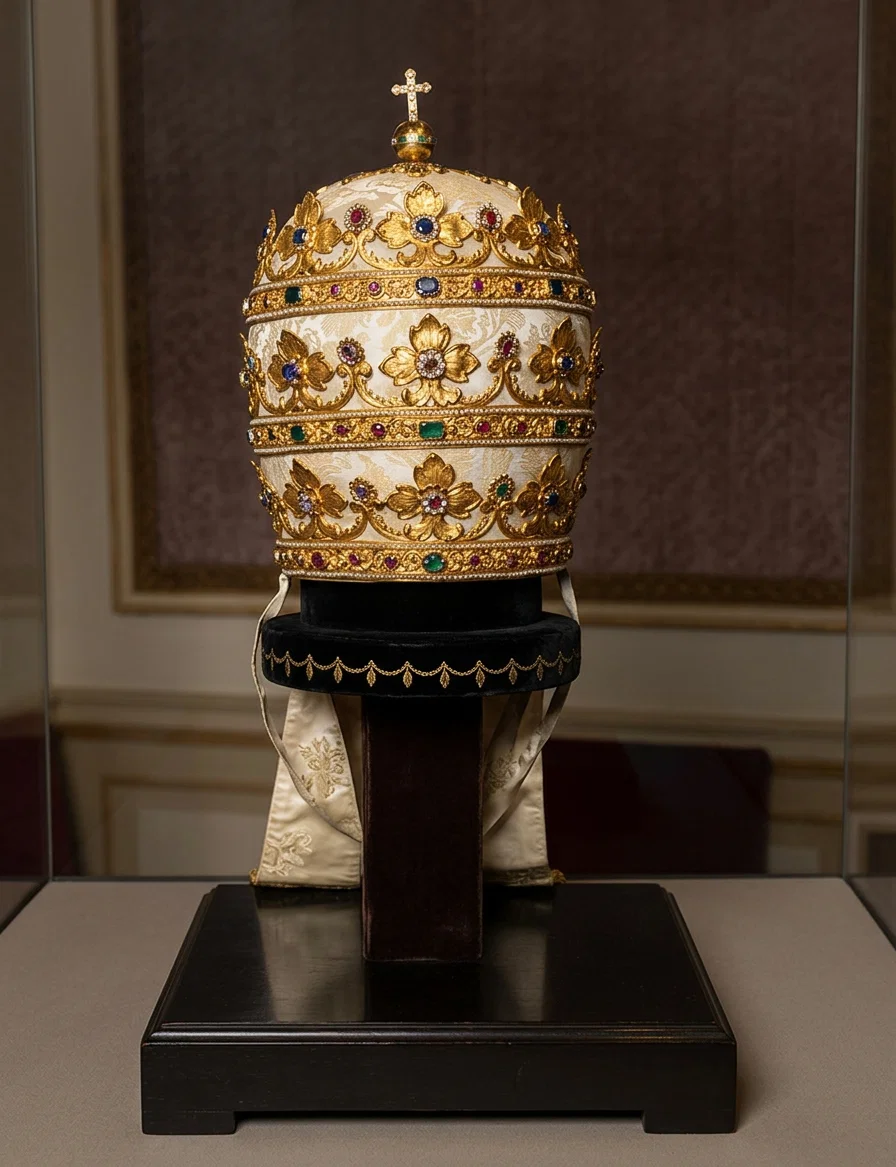
THE POPE'S TIARA, FRONT VIEW
I have seen the tiara upon the head of the pope on various occasions, when great functions were held in St. Peter's Cathedral, such as the Jubilee of Pope Leo XIII, the coronation of the present pope, etc. And on the occasion of the fiftieth anniversary of the Declaration of the Immaculate Conception, I had a position in the church very near where the pope passed, and with the aid of an opera-glass saw the tiara quite plainly. Also on a later occasion, when two “saints” were canonized, I had a reserved seat near the front of the church, and then saw the tiara exceptionally well. But in order to leave no possible room for doubt in this matter, I sought to gain the opportunity of seeing the tiara privately and of examining it minutely.
Through the aid of a friend who is well acquainted with officials of the Vatican, I obtained a personal card from the private secretary of Cardinal Rampolla, which requested the person in charge of the pope's wardrobe to show us whatever favor we might desire. Armed with such a document, we felt sure that we would easily gain the desired privilege. But when we presented the card to the person in charge, we were informed that this pope had forbidden absolutely any one's seeing privately his apparel, and no argument would induce the officer in charge to grant us the favor, and so the case looked hopeless. However, we did not give up the task, but went here and there, and finally saw the official photographer of the pope.
We told him that we desired a photograph of the tiara, and also the opportunity of seeing the tiara close at hand. He said that he would try in some way to pass us in to see the tiara. When we returned, he said that he had asked the authorities in charge about the matter, but they said that it was absolutely impossible for any one to gain an admission to see the tiara, as it is kept in the private apartments of the pope. But finally an agreement was made with the underlings, without the knowledge of the higher authorities, whereby we might gain an entrance into the inner recess of the Vatican and see the tiara.
One morning quite early we ascended the long staircase leading to the apartments of the pope, traversed the hall where the pope holds his private audiences, passed through the Sistine Chapel and other noted rooms, and finally arrived at the private apartment of the pope, and stopped in the room where the pope dresses himself for the great functions in Sistine Chapel. Here we were given an opportunity of seeing the tiara close at hand. We also saw two other tiaras that had been presented to the pope, one from France and the other from Bologna, as well as the miter of the pope. I might say at this point that many persons confound the pope's miter with his tiara. The miter of the pope is the tall cap that he wears on occasions of minor importance, and is similar to miters worn by the bishops all over the world, only that it is more beautifully adorned. He wears his miter as bishop of Rome, while his tiara is the triple crown which he wears as the sign of his authority as pope. That there has never been an inscription upon the miter is evident in the nature of the case, and therefore a careful examination of it revealed no writing whatsoever.
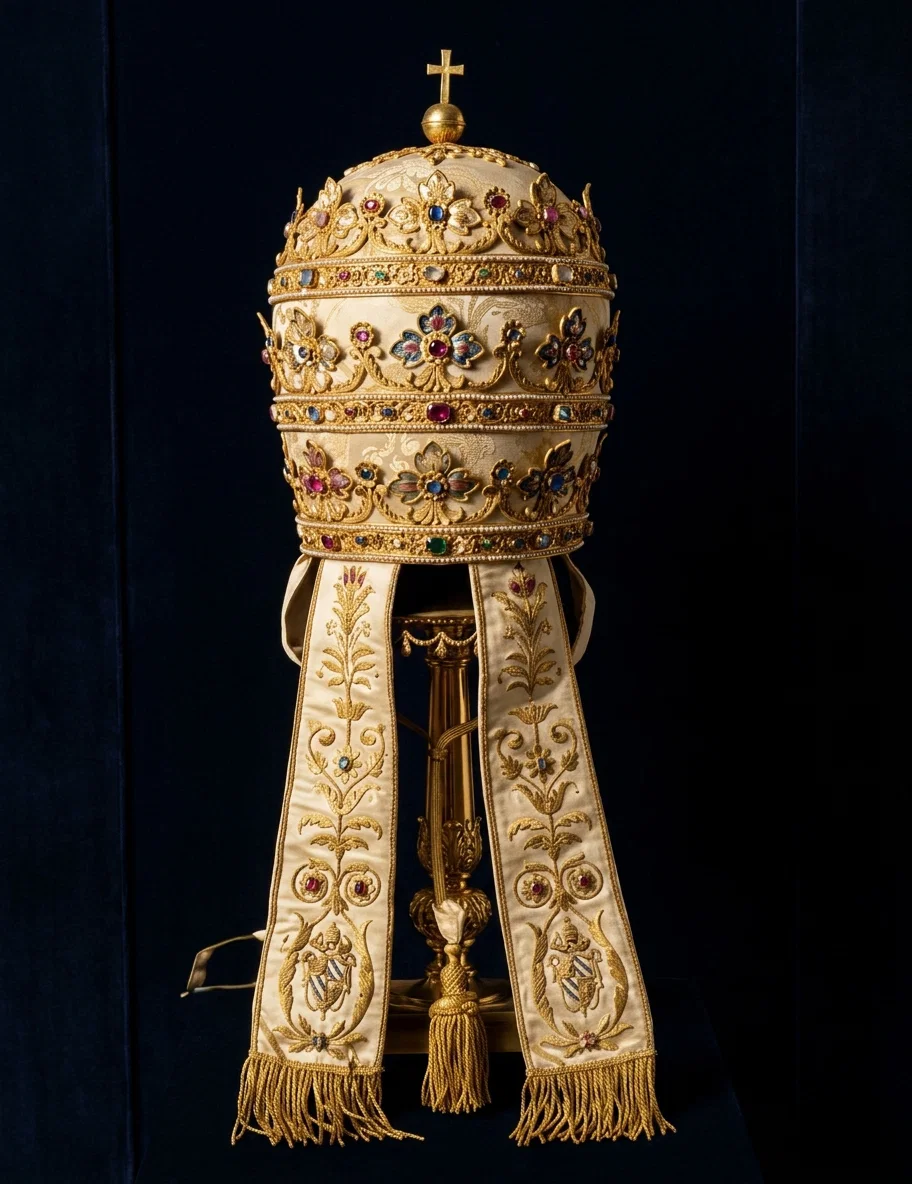
Now as to the tiara, which is the triple crown worn solely by the pope, I shall say a few words. The present tiara has been in use since 1836, and was worn by Pius IX, Leo XIII, and Pius X. This is the official tiara with which the popes are crowned, and which they wear on great occasions. There is no tiara extant that was worn before 1836; for when Napoleon came to Rome on his famous pillaging tour, he destroyed all the tiaras existing, in order to utilize the jewels and the precious metals contained in them. The present tiara, however, is a beautiful piece of workmanship. By observing the accompanying photographs one will readily appreciate the following description of it: On the inside it is lined with white silk well padded. The groundwork on the outside is a silver netting, and the three crowns are of gold set with many precious stones, among which are the following: the amethyst, the garnet, the emerald, the sapphire, the ruby, the topaz, etc., and each crown is lined with two rows of Roman pearls. On the top of the tiara is a cross of diamonds.
But while we were pleased to see this brilliant crown, yet we were disappointed in not finding the object of our search; for the inscription Vicarius Filii Dei was nowhere to be found inscribed upon the tiara, as the accompanying photographs show very plainly. On the back view will be seen the coat of arms of Pius IX, but it contains no inscription. We must therefore conclude11that there has not been any inscription upon the official tiara at least since 1836.
THE POPE'S TIARA, REAR VIEW
The tiara presented to Pope Pius IX on the occasion of his jubilee in 1865 also failed to reveal any inscription. The tiara presented to Leo XIII in 1903 is of gold and silver, and contains three inscriptions, but none of them reading Vicarius Filii Dei. The inscriptions that it contains are written upon the three crowns, and read as follows: (1) Omnis Regis Christi Pastorum Pastor Ovilis (Chief shepherd of the whole fold of King Christ); (2) Nescius Errandi Fide Morumque Magister (Incapable of erring in the faith and master of customs); (3) Sacerdos Maximus in Terris Divino Jure (High Priest in the earth by divine right).
Even these inscriptions are useful in showing the titles that the pope assumes. But it is evident that the tiara in actual use, and officially recognized at least since 1836, reveals no such inscription as Vicarius Filii Dei. The question naturally arises as to whether this fact that the tiara fails to reveal any inscription has any real bearing on the interpretation of the number six hundred and sixty-six as applied to the pope. It seems to me that this fact in no way changes our interpretation of the text in Rev. 13:18. For this verse does not indicate that the inscription must be written necessarily upon the tiara, but, to fulfil the specifications of the text, it is sufficient that this inscription is recognized by the pope as his title. And that this title is officially applied to the pope is unquestionably true. However, I shall not leave the question at this point, but shall endeavor to prove in another article that also upon the tiara was found the inscription Vicarius Filii Dei at one time.