“THEY that go down to the sea in ships, that do business in great waters; these see the works of the Lord, and his wonders in the deep.” “Let them give glory unto the Lord, and declare his praise in the islands.”
Newfoundland, the most ancient of England's colonial possessions, was discovered by John Cabot and his son Sebastian, in the reign of Henry VII, 1497, and Aug. 5, 1583, was formally taken possession of by Sir Humphrey Gilbert, in the name of Queen Elizabeth, and incorporated into the realm of England.
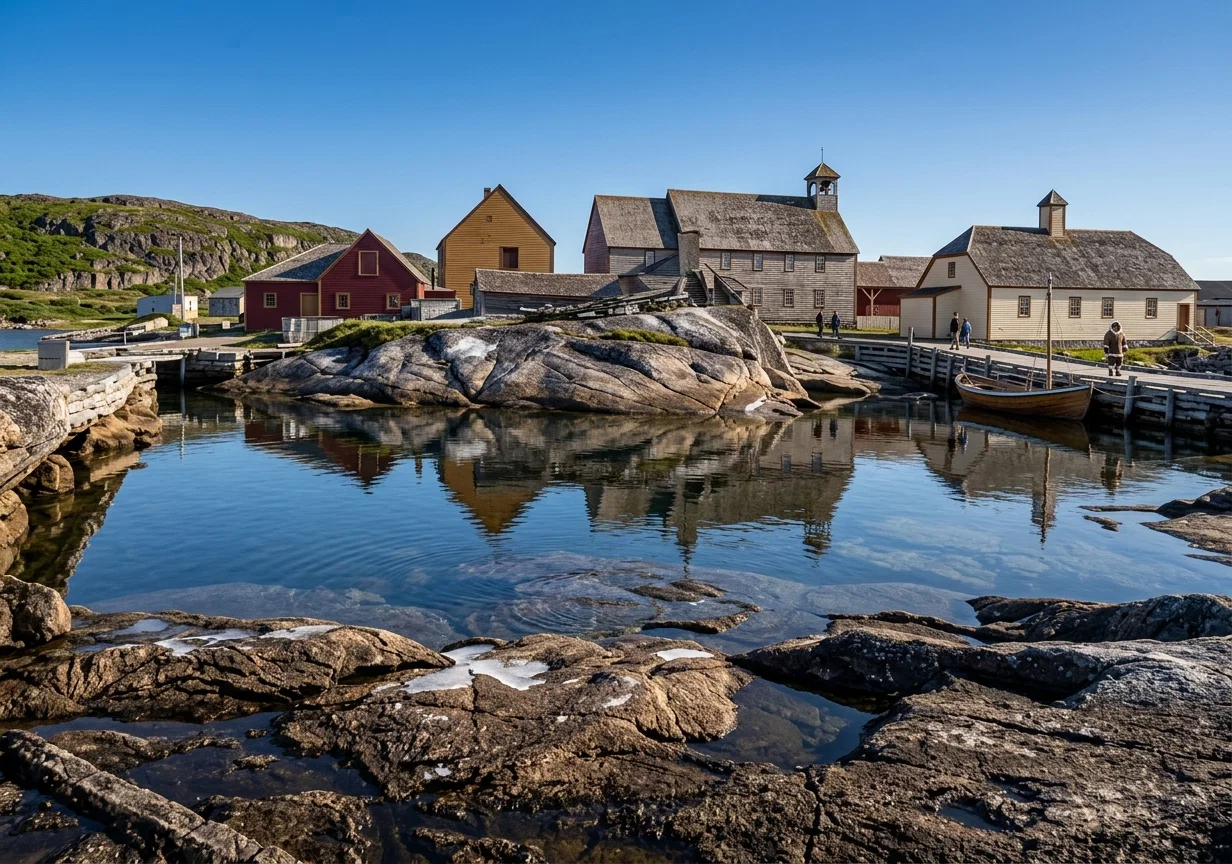
HOPEDALE (LABRADOR) MORAVIAN MISSION
The coast is everywhere rocky, massive, and abrupt, rising in some places to a perpendicular height of seven hundred to one thousand feet. The banks of Newfoundland are large submarine plateaus, lying to the east and southeast of the island. The Great or Grand Bank is the most extensive submarine elevation known to exist in any ocean. It is six hundred miles long, and two hundred miles broad. Off the shore of these banks is the natural home of cold-water fish, as the cod, etc., which have been frequented by Europeans for the purpose of the cod fishery, ever since the year 1500. The codfish is more abundant here than in any other portion of the globe. The fishery gives employment to about one half the population of 202,000.
Owing to its insular position, the climate of Newfoundland is much modified by the surrounding ocean. It is cooler in summer, and less rigorous in winter, than any part of the adjacent continent within the same parallels of latitude. Its chief drawback arises from the presence of the arctic ice, which usually drifts along the east and northeast coasts during the months of February, March, and April, chilling the atmosphere, but coming laden with myriads of seals, which are one of the chief sources of wealth to the colony.
The seal fishery gives employment to about ten thousand men during the months of March, April, and May, and is vigorously prosecuted by powerful steamers built expressly for contending with the ice from the arctic regions. The annual average value of this fishery is about one million dollars.
Newfoundland, up to the beginning of the present century, had little to commend it as a field of enterprise to the farmer. Before that time the cultivation of the soil was held to be a penal offense. The direction of capital was oceanward, not landward.
The whole of the interior is one vast game park for the sportsman. With the exception of one small town on the railway, there is no inland settlement on the island.
St. John's is the center of nearly all the trade of the country. The population numbers thirty-five thousand. There are only two other towns of importance. The rest of the population is scattered along the shore, in small settlements.
The standard of present truth has been planted in St. John's about nine years, and we have a neat little church building, with a membership of twenty-seven. There are no Sabbath-keepers in other parts of the island, and very little work has been done in what are called the “outports.” Though our work is small, and we have no general council or conference meetings to attend, we rejoice to have a part in the closing work of the gospel.
Separated from Newfoundland by the Straits of Belle Isle is Labrador, under the jurisdiction of Newfoundland, having an area of one hundred and sixty thousand square miles. It is one of the most barren and desolate regions in the world. The northern part is the proper home of the Eskimos, who number about fourteen hundred. The southern part is sparsely settled by European colonists, who numbered in 1891, 2,706. The Eskimos live almost entirely by fishing. They are nearly all Christianized and civilized, through the praiseworthy exertions of the Moravian missionaries. The Moravians, or Unitas Fratrum, have had missions established on this coast since 1765.
While so much work and effort is being spent on pleasant, populous places of the world, I wonder if Jesus will come while we neglect to follow the noble missionaries who have gone before and given to this people the message, or are they included in the “every people” of Rev. 14:6?
After living in Newfoundland nearly one year, and learning something of the country, we wonder if any one will come over and help us in “hasting the coming of the day of God.” Our faith is strong in him.