Your ShelfYour Projects

JOPPA

17%

Review and Herald Publishing Association · Washington, D. C. · Aug 3, 1905

FromReview and Herald, Vol. 82, No. 31.

Read the full edition

JOPPA

Joppa is one of the most ancient of the world's seaports. Its historical importance was derived from its relation to Jerusalem, being the natural port through which flowed the traffic and travel between Jerusalem and the western world. It was a border town of the tribe of Dan, and is situated in a large plain, about forty-five miles northwest of the Jewish capital. It has a very poor harbor, affording but little protection to ships that come within it, but it is believed to have had a much better harbor anciently.
To the annals of Joppa belong many interesting incidents of sacred history. Here the ships of Hiram, king of Tyre, landed the timber for the building of Solomon's temple. Here Jonah, fleeing from the Lord, took ship for Tarsus, and embarked upon his short but eventful voyage. Here Peter, upon the housetop, had his vision of the sheet let down from heaven, filled with clean and unclean creatures, which he was bidden to slay and eat. Here dwelt the woman Dorcas, “full of good works and almsdeeds,” who was raised from the dead by Peter.
At the time of Judas Maccabeus and on a number of occasions since, the town was subjected to the vicissitudes of war, sustaining several sieges. It was a natural objective point of the Crusaders, and was taken by them from the Saracens, but was retaken by the latter when they recovered their ground in Palestine after the power of the Crusades was spent. Its last siege and capture took place as late as 1776, at which time its inhabitants were barbarously massacred.
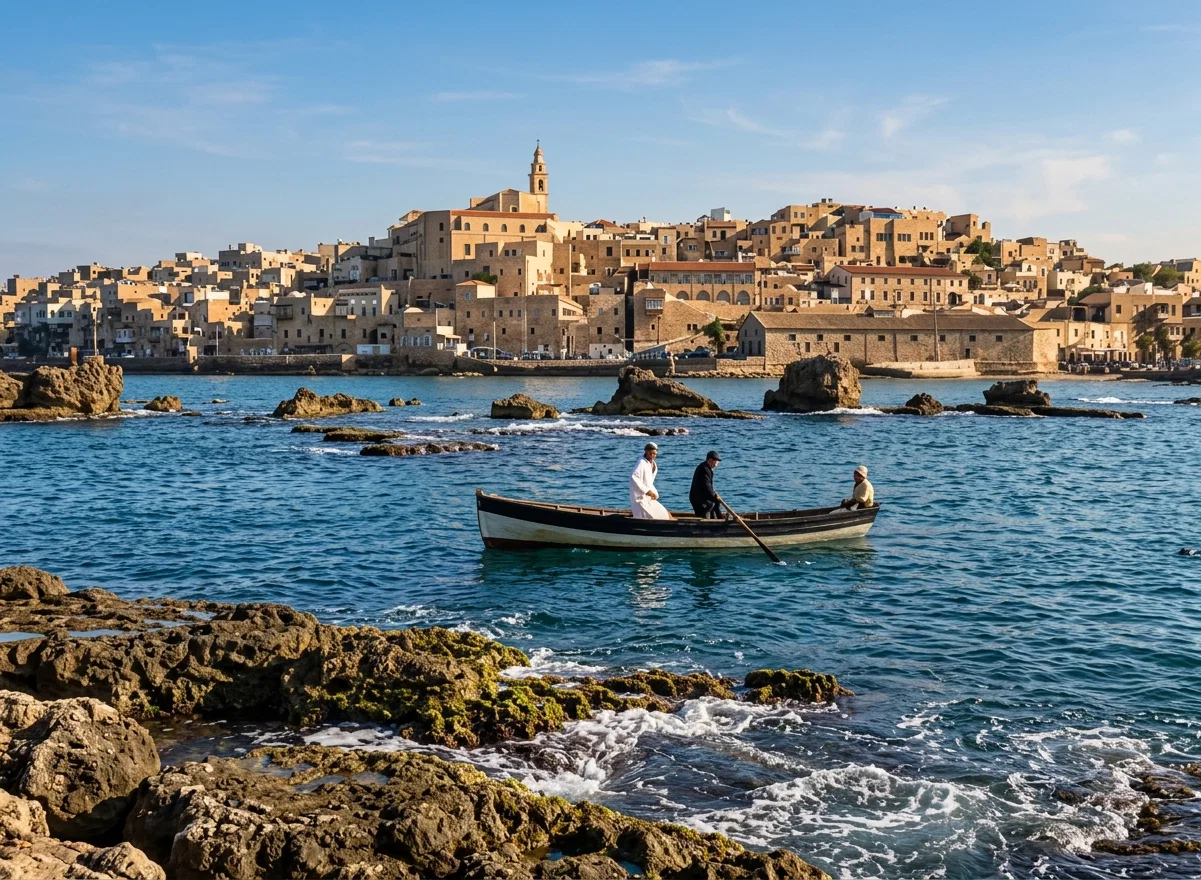
The modern town of Joppa rests on a promontory jutting out into the sea, and rising to a height of about one hundred and fifty feet above its level. The buildings face chiefly to the northward, and are crowded very closely together, appearing in places to stand one upon another, on account of the steepness of the site. The streets, as would be expected, are very narrow, and are also very uneven and dirty. The inhabitants number between four and five thousand, of whom about six hundred are Christians, the remainder being Turks and Arabs. The Latins, Greeks, and Armenians have each a small convent for the reception of pilgrims.