While I had visited almost every other country in Europe, it was not my privilege to see Spain and Portugal until last March. In order that I might be of greater assistance to our brethren in that field in counsel, I accepted their invitation to spend a short time with them, and left Hamburg March 9, stopping in Berlin, Friedensau, Basel, and Gland, and reaching Barcelona March 14. There was quite a difference in the snow-covered landscape of northern Germany and the blossoming almond-trees of the sunny south.
I was glad to find the home of Brother and Sister Robinson, who had been laboring faithfully in this field for about a year. While Spain has a population of nineteen million, only eight thousand of these are Protestants, whose faith has been tolerated by the Romanists for a very short time. Spanish history is very much like the history of other Catholic countries, and even to-day there are still many difficulties that stand in the way of the advancement of the pure gospel of Christ, unmixed by human traditions, unadulterated by man-made theories.
In the province of Cataluna, of which Barcelona is the chief city, they do not speak the real Spanish, but a dialect; however, this is the most progressive province in Spain, and commerce and industry flourish here. Barcelona, a city of five hundred and fifty thousand, is the chief commercial center of this part of Europe. After getting my bearings here, I took a direct route to Madrid, where I stopped two days—the sixteenth to the eighteenth.
En route to the Spanish capital, I found much rocky country. In many places in Spain one sees only the bare rocks, as in parts of Scandinavia. In general, the rivers do not contain much water, and where water is to be found, it is used for irrigating purposes, and the land that is supplied with sufficient moisture, seems to be very fruitful.
During the day the weather was very warm, but at night it was quite chilly; and as the ordinary cars are unheated, I was glad I had my good warm blanket with me. As a rule, the trains move slowly, and about fifteen or twenty miles an hour is as much as one can make.
While Madrid, the capital of Spain, has by no means a beautiful location, yet it contains some fine buildings. The city lies over two thousand feet high, and its climate is anything but favorable. The most interesting part of my visit at this place was the time I spent with the sons of Pastor Fliedner, who came here years ago from Germany to do missionary work. They had to be satisfied with very narrow, unhealthful quarters.14
Later the way opened for them to purchase, at a reasonable figure, some property outside of the city, not situated on a good road. Still later they purchased another property, and as the city desired a part of the first land for their water-works, the pastor was able to sell for a good price, so that he could pay for the property last purchased, and still have a few thousand dollars left. When he wanted to begin building, and the Spanish architects learned that he was a Protestant, they declared they would not put up an institution for a heretic. He secured a German architect, and then the cardinal of the papal legacy tried in every way to prevent his securing the necessary permission to build. Finally, the pastor succeeded, and there is now a beautiful college, where hundreds of young people are educated.
From the school one obtains a fine view of the whole city of Madrid. One can even see, away in the distance, the monastery Escorial. The terrible persecutor of Protestants, Philip the Second,
built this monastery among the mountains, as he desired a place where he might spend his life in retirement. It cost nearly three and one-half million dollars. The immense building forms a rectangle six hundred and eighty feet long, and five hundred and thirty feet wide, and the combined length of the corridors is said to be one hundred miles. While superintending the details of the construction of this remarkable structure, Philip lived in a small building near by, for a number of years; and strange as it may seem, that small building has since been converted into a Protestant orphanage, so that where once the power of the Spanish Inquisition was supreme, to-day the Holy Scriptures are being taught, and Protestantism is doing its deeds of mercy.
I enjoyed my visit with Mr. Fliedner, who is president of the college, and also with his brother, who is editor of several Spanish papers. He knew of our work, and was much interested in our literature. One of the great journalists of Spain, Senr. Echegaray, was celebrating his jubilee, and all the newspapers were filled with articles about it; but when Mr. Fliedner made use of this occasion to republish a speech the gentleman once made in the House of Representatives (1869) in favor of religious liberty he
had the greatest difficulty in securing permission for getting out a reprint of the document. I was glad to learn from Mr. Fliedner of the wonderful manner in which the eight thousand Protestants of Spain have been brought together; and surely if Protestantism, with only a part of the great truth for this time can gain such a foothold, we, with the message God has committed to us, ought certainly to gain a footing here.
Twenty hours on the slow train brought me from Madrid to Lisbon, where I found everything decorated for the reception of the queen of England. Immediately afterward, the German emperor also visited this place.
I was happy to find the home of our workers, Brother and Sister Rentfro, and enjoyed a few days' stay with them. Portugal has a population of five and one-half millions, and there are nine millions more in its colonies. Lisbon is widely known on account of its great earthquake in 1755. It is a hilly city, and in some places the streets are so steep they are climbed by the electric incline roads.
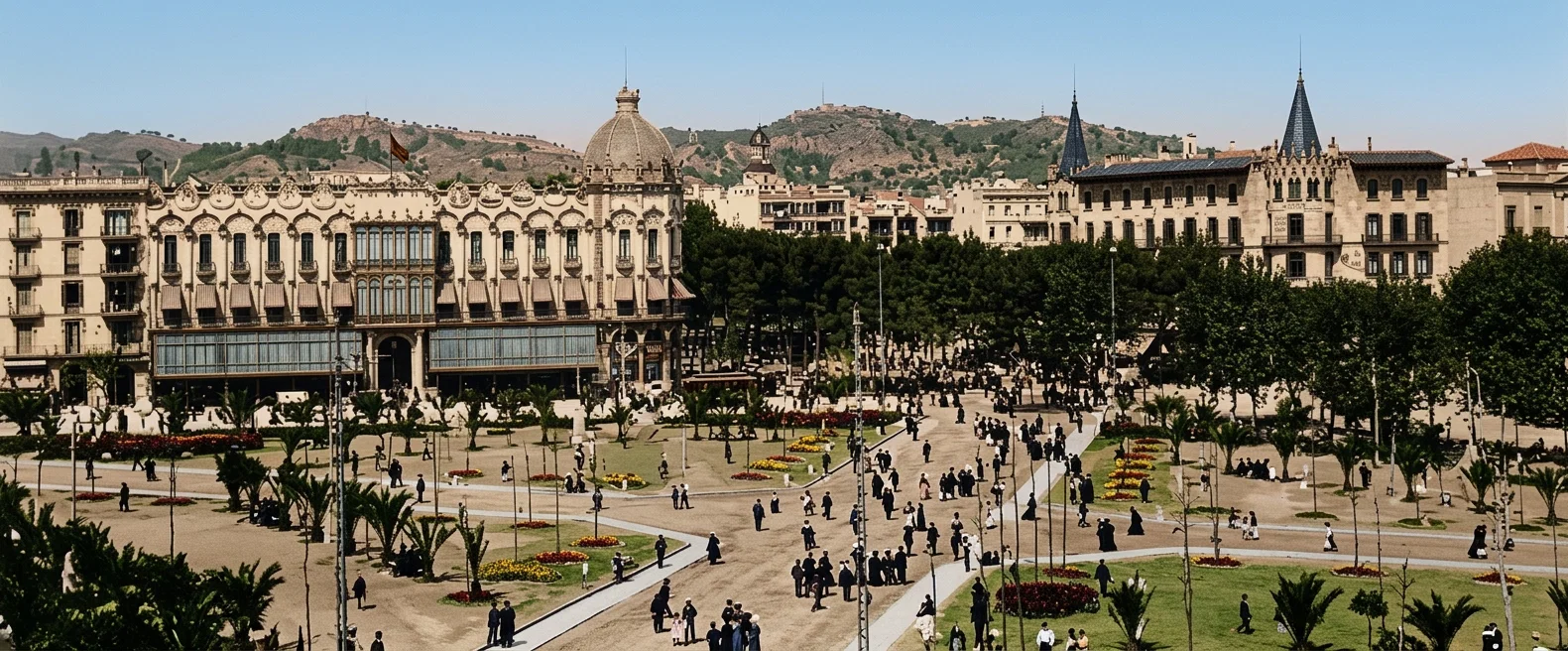
PLAZA CATALUÑA, BARCELONA, SPAIN
In all Portugal there are but five hundred Protestants, and many of these are foreigners. The circulation of periodicals is rather difficult, as such high customs must be paid when importing them. The next morning after my arrival, I visited the British Bible Society's headquarters, which are now in an old monastery. Where the monks once lived in their secluded cells, there are to-day large stacks of the precious Word of God dispensed from this place to all parts of Portugal and her colonies. The director of the society told me that one of his colporteurs living in the northern part of the country had his Bibles and other publications taken away by the authorities, and he was imprisoned. He was finally released, but they had to appeal to the government for the recovery of his books. I was glad to say that they were not the only ones who suffered for the truth of the gospel.
As Brother Rentfro must first acquire a knowledge of the Portuguese, we thought it best to advise that he get out of the hot city of Lisbon, into the cooler suburbs, where he could have better health, and just as easily learn the language. He has felt benefited by this change.
On the twenty-first I started homeward, going via Badajoz and Valencia, to Barcelona. I was two nights and three days on the cars. The region through which I passed was not very fertile, but as soon as I neared the coast at Valencia, the picture changed. Here I was in the midst of almost a paradise. The forests of orange-trees and palms, and the many mulberry-trees testifying of the silk culture, were a delight to the eye. There were also many fields of rice. The country has an oriental aspect, and the climate is singularly mild and dry. Sabbath, June 24, I spent with our small company at Sabadell, about twenty miles from Barcelona. Here is our first small church in Spain. Lately Brother Robinson had baptized two souls. There are now eight believers, mostly from among the Roman Catholic section of the community. They are happy in the Lord, and search his Word diligently. Two young people were anxious to go with me to our school at Gland, but as the young man was taken
sick, he could not come at the time, but will be at the school later. The sister is at Brother Vuilleumier's.
What we need in Spain and Portugal are some good colporteurs and Bible workers to sell our publications, thus assisting the ministry in their work. God promises to gather a people from every nation, and kindred, and tongue, and if we are faithful, we shall ere long see a number of groups and churches in these two dark lands. Let us remember the work in these fields, and liberally support it with our gifts, and pray the Lord of the harvest to send forth the necessary laborers to this great Iberian