Introduction

7%

Review and Herald Publishing Association · Washington, D. C. · Aug 17, 1905

FromReview and Herald, Vol. 82, No. 33.

Read the full edition

Introduction

M. E. KERN
The Bible is the Book of books. Written by no less than thirty-five authors, extending over a period of a millennium and a half, yet it is the same sweet message of salvation in every part. It is the message of God to humanity.
But the Bible has not always been received as the word of God. It has been the object of most powerful attacks; yet it has stood the storms of centuries, and, like the mighty rocks on the ocean's shore, is only polished by the waves that beat against it. In the last great conflict—the greatest spiritual battle of the ages—a conflict in which we all have a part—God's Word will be no less an object of attack. All the subtilty and power that the forces of darkness can command will be brought into operation to weaken the hold of God's Word upon the people. Through science, so called; through history and destructive criticism; through mystical philosophies; and in a multitude of ways, Satan will seek to overthrow the Word of God. Yet, while the forces of darkness have been gathering for the last conflict, God has prepared his witnesses. And it is our duty, who know God, to be ready always to give a reason for the hope that is within us. It is our duty to study to present the truth in such a way as to meet men under all conditions.
As an illustration of what I mean, I remember an instance where one of our ministers tried to talk with a man on present truth. The man stated at once that he did not believe the Bible; whereupon the minister said he had nothing more to say. In other words, the man must accept the Bible as the inspired word of God before the minister would proclaim to him the message. We shall pass a great many by in this world if we require that they first accept the Christian's Bible.
We judge men in two ways,—by what others say of them, and by what we ourselves find them to be. So with the Bible there are two lines of proof of its authenticity,—the outward proofs, such as miracles, prophecy, and history; and the internal proofs, or the demonstration of the soul. The first line of proof is good, but the second is better, and is all-sufficient. And it is this line of proof that is accessible to all, regardless of scholarship or learning. If this outward proof were absolutely necessary, the Bible would not be supreme, because dependent on authority outside of itself. It demands acceptance on its own merits, and contains within itself the assurance of its authenticity. External proofs, however, may serve as lights to direct to the Bible the feet of those who refuse at first to recognize the light of the Bible itself, but that is all.
It is to one of these side-lights that I wish to direct your attention. A recent writer says that “perhaps the most remarkable event in the history of modern Christianity is the unexpected confirmation of Bible truths from the hands of what seemed to be its arch-enemy, modern science.”
The past century has been distinctively one of scientific investigation. Since the days of the Reformation man's mind has been freeing itself, and refusing to accept dogmas either in science or religionon authority merely. Everything has been tested by the fires of criticism, the Bible not excepted. Its claim to be such an old book challenged investigation, and, depending only on human resources of course, the Bible one hundred or even fifty years ago, was ruled out as a book of genuine history by these critics because there was no contemporaneous evidence, that is, there were no writings that were so old or told the same story. The Bible stood alone, and told of nations and peoples and civilizations far anterior to anything known to historians. With great display of scientific knowledge, the skeptic declared that genuine history could not reach back so far. Books were written to prove that the Bible was not in accord with history. Many illustrations of the arguments of these books might be given. Two will suffice.
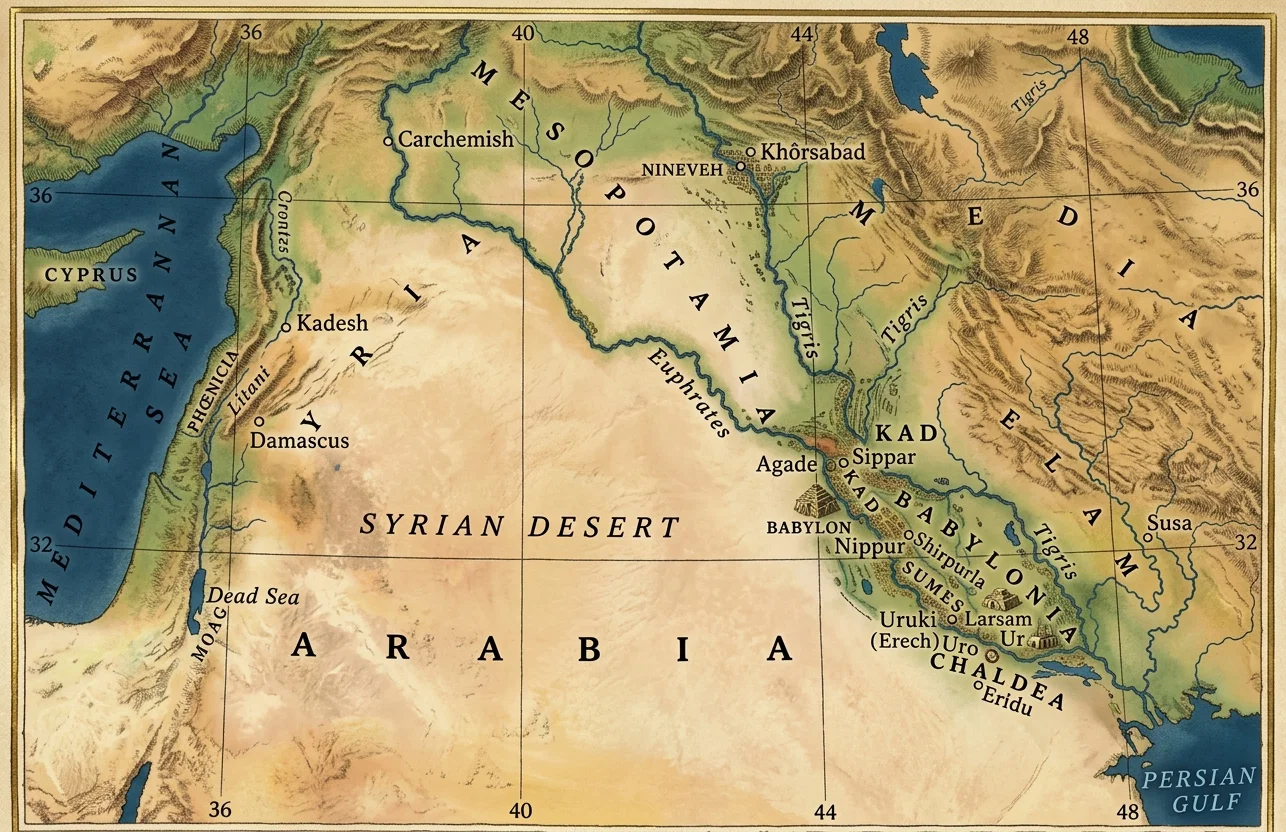
A MAP OF BIBLE LANDS
Our critics said there was no evidence of the existence of a nation called the Hittites, of such power and greatness as brought to view in the Bible. We were told that there never was such a person as Belshazzar king of Babylon, that his name was found in no other history, but that this was simply a mythical character introduced into the Hebrew legend of the overthrow of Babylon. Such criticism could but be viewed with deep concern by those who knew from personal experience that the only hope of a lost world is in the reception of God's message to man, the Bible.
But now all is changed. As quoted in above, the Bible has met a remarkable confirmation at the hand of modern science. A new department of science, Oriental archeology, has come to the rescue, and we to-day stand face to face with the contemporaries of the Bible writers and men who lived before them. One writer forcefully remarks that not only have we been making history in these days, but we have been discovering history. Buried cities have been recovered, palaces and temples have been unearthed, bringing to light civilizations long forgotten except for the references to them in the Bible. Cities and countries spoken of in the Bible have been found. The records of the nations that had dealings with Israel, such as Assyria, Babylon, Medo-Persia, and Egypt, have been brought to light, and naturally all these discoveries have thrown much light on the Bible. They have given a historical background for the Old Testament, and brought out in clearer distinctness its story. The mouths of the critics of our sacred book have been stopped. No one now dares to make the charge of fable or fiction against the Bible history. On the foundation-stone of the Haskell Oriental Museum at the Chicago University are the words in Latin, Lux ex Oriente (Light out of the Orient). Truly light does shine out of the Orient. From every Eastern land God has caused light to shine forth upon his Word to illuminate the darkness of this skeptical age.
College View, Neb.
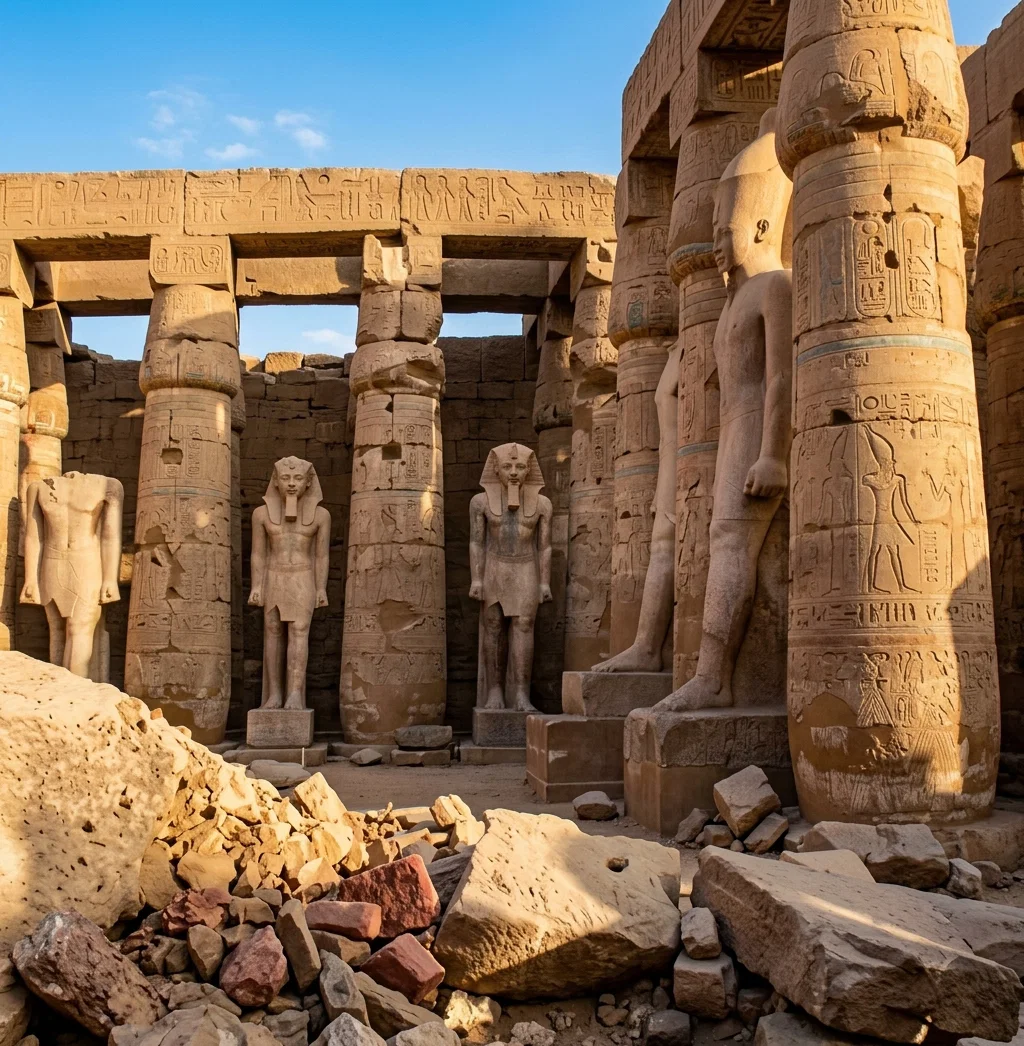
RUINS AT THEBES. THE NO-AMON OF NAH. 3:8