As we have engaged in this work, we have studied the methods adopted by Jesus, the Great Teacher, that we might learn, if possible, his plan of labor. His servants were to go to all nations with the “glad tidings,” and he was to train men for this work. To-day we also have a message to go to all nations, and we are sure that to follow his methods will prove as successful now as then. As we studied the subject, we saw that the training of the twelve disciples constituted a great part of what Jesus did to make known the gospel to mankind; and if it were not for the preparation given these men, there would have been very little to be seen for the years of his ministry.
In the book “Education,” is to be found a statement bearing directly upon the Saviour’s methods as a teacher. The writer says: “The most complete illustration of Christ’s methods as a teacher is found in his training of the twelve first disciples. Upon these men were to rest weighty responsibilities. He had chosen them as men whom he could imbue with his Spirit, and who could be fitted to carry forward his work on earth where he should leave it. To them, above all others, he gave the advantage of his own companionship. Through personal association, he impressed himself upon these chosen as co-laborers.” “The Life was manifested,” says John the beloved, “and we have seen it, and bear witness.”
The great question before us is how to reach the many tribes and tongues with the message that is to prepare some of all nations for his coming. We feel sure that this work must be done largely by Christian natives, who know the people, their ways, and their languages. These men can go from village to village, eating and sleeping among them, and teaching them the Word of God. But they must receive a training before they can do their work or be entrusted with its responsibilities; hence the need of training-schools, where the same work can be done that Jesus did for the twelve.
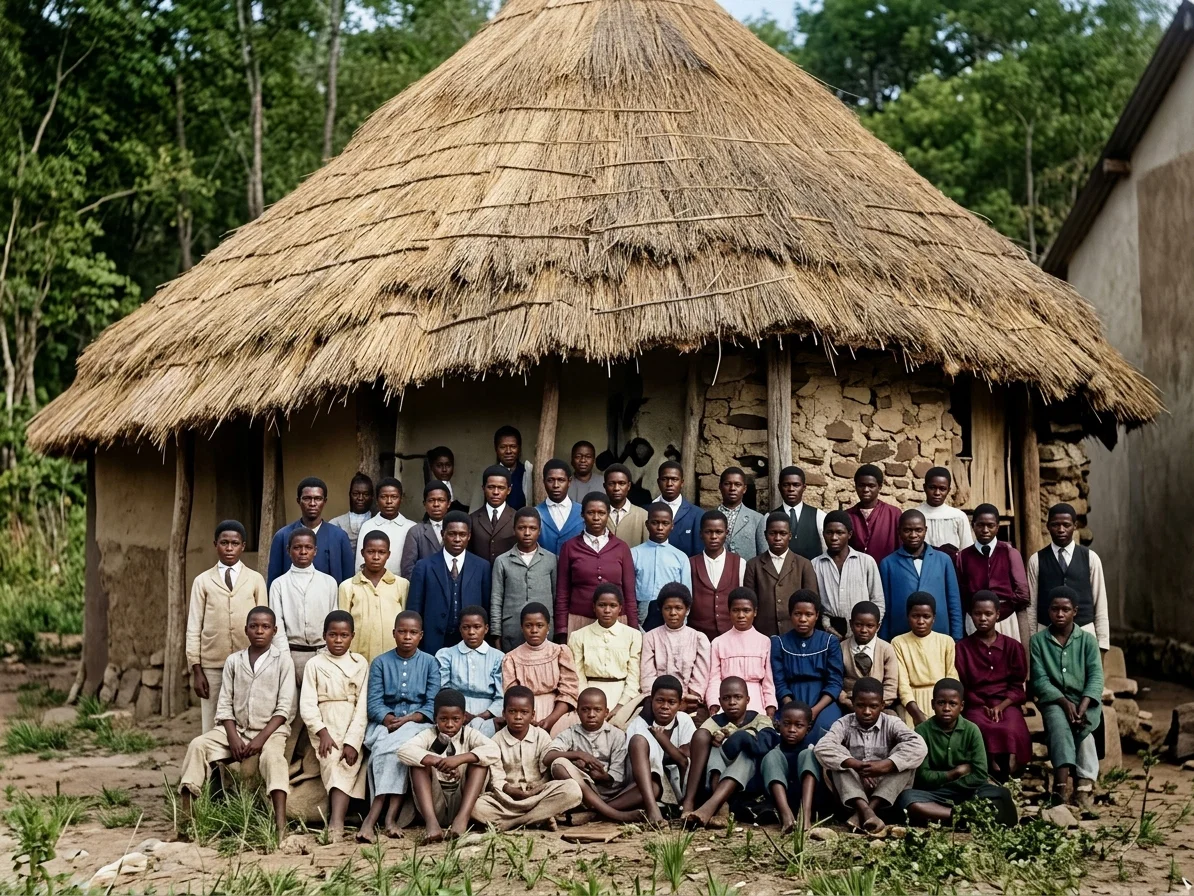
I feel sure that God has guided our brethren in the starting of our native work. I have visited many missions, but have never seen any methods adopted by them that I consider better than those adopted by us for the education and training of our native laborers. At each of our missions we have gathered about us a company of young people, and these we are keeping with us, as far as possible, till they are prepared to go out into the work. While receiving their training, a portion of their time is devoted to teaching village schools and laboring for their people. In this way they are gaining a valuable experience while obtaining an education.
NATIVE SCHOOL AT THE MISSION FARM, MATARELELAND
In our schools we first teach them to read and write their own language; and, after one or two years, we begin to teach them English, and continue the study of their own tongue. The Bible becomes the reading- and spelling-book of both languages, just as soon as they are far enough advanced, and we endeavor to press home to their hearts the truth of God. Some have questioned the advisability of teaching the native the English language, fearing that this knowledge might encourage him to go out from us and seek employment where he can get large wages. It is possible that this instruction opens a door of temptation; but it also opens an avenue whereby the native workers can become intelligent. When we give them the English language, we open to them all the treasures of wisdom and knowledge in that language, while their own language offers opportunities which are very limited. Some may go out from us, but this proves that they were not of us. We have long felt the need of intelligent native teachers. We need young men who can assist us in translating into their own language.
If our native teachers can interpret for us, then any of our laborers who visit the country can instruct them, and at the same time be able to reach the natives through them. Those who understand the English can read our books, and be filled with the message, the same as other workers. We can not hope to be able to print all these books in each of the native languages, but being able to get these truths in the English, they can give them to the people in their own tongue.
But our teaching does not stop with giving them an education mentally and morally. We realize that if they are to be well-balanced, the physical part must not be neglected. Accordingly, we teach these young men that labor is honorable, and that they never reach a position where honest labor is a disgrace. Every boy and girl has a part to act in the work of the mission, and we try to train them to do all kinds of work we have to do, whether it be caring for crops and cattle, or the making of brick and the building of houses. We are only sorry that we are not prepared to do more for them, that they may be fitted for usefulness. Undoubtedly, here is where many missions have failed. They have developed the mental and moral faculties, but have neglected the physical, and the result is that these young men are unbalanced; hence the great amount of complaint against native education.
At the present time we have fully four hundred and fifty boys and girls in our four mission and ten village schools. We thank God that so many are under the influence of the truth of God. But this is only a drop in the bucket, as it were. Other centers should be sought out, and consecrated teachers should go there and begin their work of training natives, so that God can put his Spirit upon them, and send them forth to the work of giving the “loud cry” by and by.
The message must go to darkest Africa, till “the light of the knowledge of God shall shine into every dark corner of this vast continent.” God has sent devoted men and women into this field, and to-day the Bible, or some portion of it, is within the reach of nearly every tongue and people. But these teachers know not the message, and we have done, O! so little, to give it to them. Surely it is time that the light of present truth was planted in Central Africa. A few well-chosen centers would give us access to nearly all of this great country, and at these places young men could be trained and sent forth to bear the message to every nation, kindred, tongue, and people of Africa. Are there not many of our people upon whom the Lord is laying the burden of this work, and whose hearts are stirred to give themselves and the necessary funds to open these centers?