South Africa

9%

Review and Herald Publishing Association · Washington, D. C. · Aug 31, 1905

FromReview and Herald, Vol. 82, No. 35.

Read the full edition

South Africa

KENILWORTH, CAPE.—We enjoyed Brother Anderson's visit here at the Cape very much. He is now on the site of the future mission, preparing a temporary place in which to live. Sister Anderson and Brother Anderson's mother will leave Buluwayo soon, for the north. Brother Shone and Brother Moko are working for the Kaffir natives in the vicinity of King William's Town. Brother Chaney and his wife are doing all the good they can among the Basutos. They are selling a great deal of our literature to those people. Brother Sturdevant is largely engaged in harvesting the crops, and finding a market for them, in addition to his school work. Sister Hyatt is at the Somabula Mission, with Brother Albert White and his wife. Elder Armitage is very slowly recovering from his recent severe illness. He is at the sanitarium, but hopes to leave soon. Elder and Sister Hankins have been visiting the churches in the eastern province, and will now go into a new place, where they will endeavor to teach the truth to the people. Elder Edmed is directing the work in Natal and the Transvaal from the new office of their conference. They have recently erected a neat and substantial church building in Maritzburg, with a wing on each side for the office and church-school.
O. O. FORTNER.
THE NEW CHURCH, SCHOOL, AND OFFICE BUILDING IN MARITZBURG
The following interesting description of the new church appeared in the Natal South African Witness of May 27, 1905:—
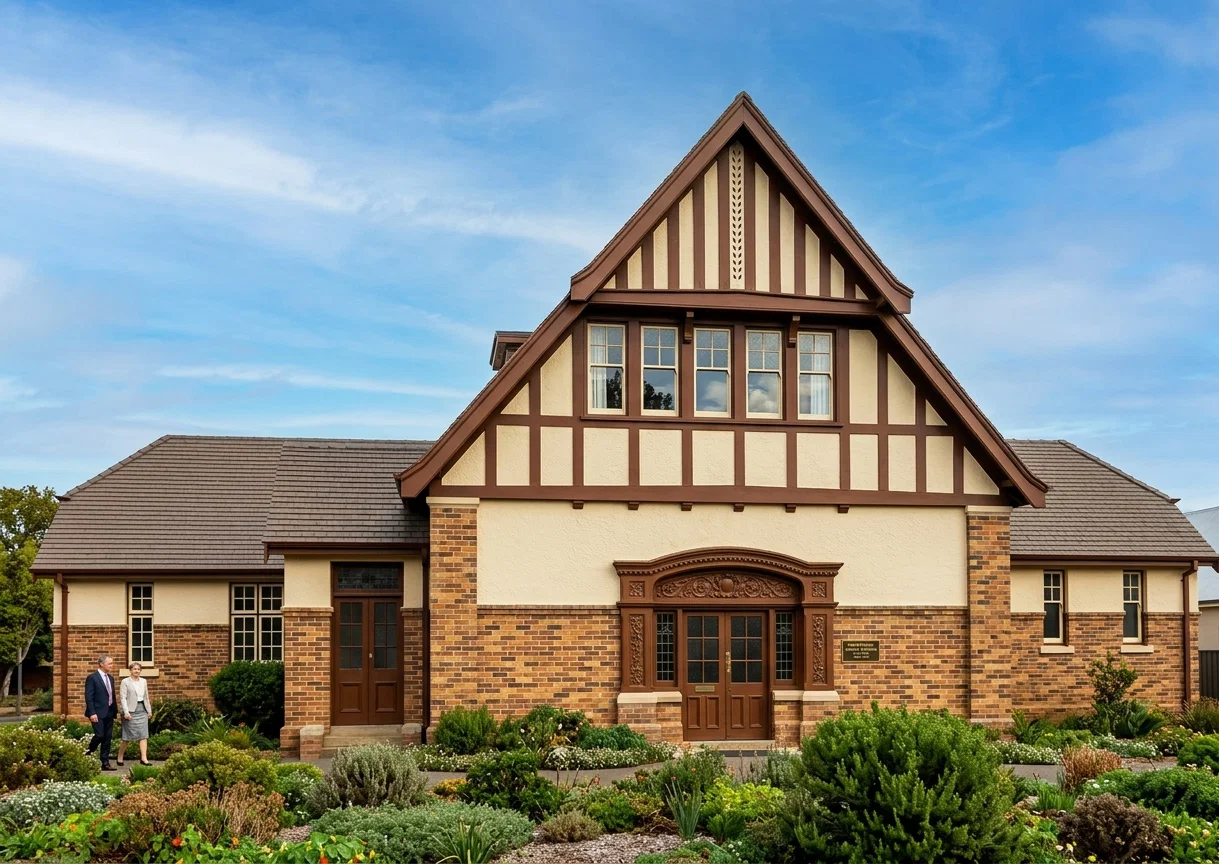
“The building is situated in Stranack Street, on the left-hand side going down, and occupies two building sites which were recently sold for the purpose by the municipality at a cost of four hundred and fifty pounds. The plan of the whole structure is cruciform in shape, with the arms of the cross elongated to include, on the one side, the tract society's office and the vestry, and on the other side a schoolroom. Each of these has a separate entrance from Stranack Street, with communication to the church. The schoolroom forms one arm of the cross, and is placed on the low side of the site, and is separated from the church by folding doors, which can be thrown open so that the schoolroom may be used as part of the church during special services.”
“The church itself is placed in the center of the building, with a main entrance through a porch situated on one side of the building, which is approached directly from Stranack Street.
“The exterior of the edifice is very pleasing, and forms an exceedingly good group when seen from the opposite side of the road. It was the design of the architects that this building should have a special and distinctive character, and they have treated the plans on simple lines. The building possesses a deep base of pointed brickwork, with the walls rough-casted above, tinted a pale color, and separated from the base by a string course, supported on corbels. The steeply pitched roof, painted red, with its broken, overhanging, and half-timbered gable in front, and overhanging eaves, casts a welcome shade on the tinted rough-cast.
“The whole scheme bears evidence that an attempt has been made to depart from the stereotyped, and often mutilated, so-called Gothic style of architecture, usually adopted for buildings of this description. The architects have thus departed from the ordinary course, and presented something at once distinct and uncommon, yet in keeping with the purposes for which the building is intended.
“The interior of the church is enhanced by an open timber roof, lending it a lofty and cool effect, the roof trusses being supported by neat corbels. At the eaves' level, cross ventilation is provided across both ways of the building by opening the dormers at the sides, and by windows at each end. A neatly painted dado of wood lines the building, with the walls treated in three simple colors above, presenting a restful appearance to the eye. A baptistery is provided under the rostrum, with steps leading to the same from the church; and a motto with the words, “Enter His Courts with Praise,” is suitably inscribed in gold and red lettering over the rostrum.
“The church will comfortably seat two hundred persons, but by using the schoolroom, seating can be arranged to accommodate three hundred and fifty people. The building of this handsome edifice undoubtedly marks a new era in the history of Adventism in Natal, as it gives permanency to their work as a Christian denomination in our midst.”