QUITE a number of the old pioneers in the work came from the State of Maine. Among these were Elder James White, Mrs. E. G. White, and Elder J. N. Andrews.
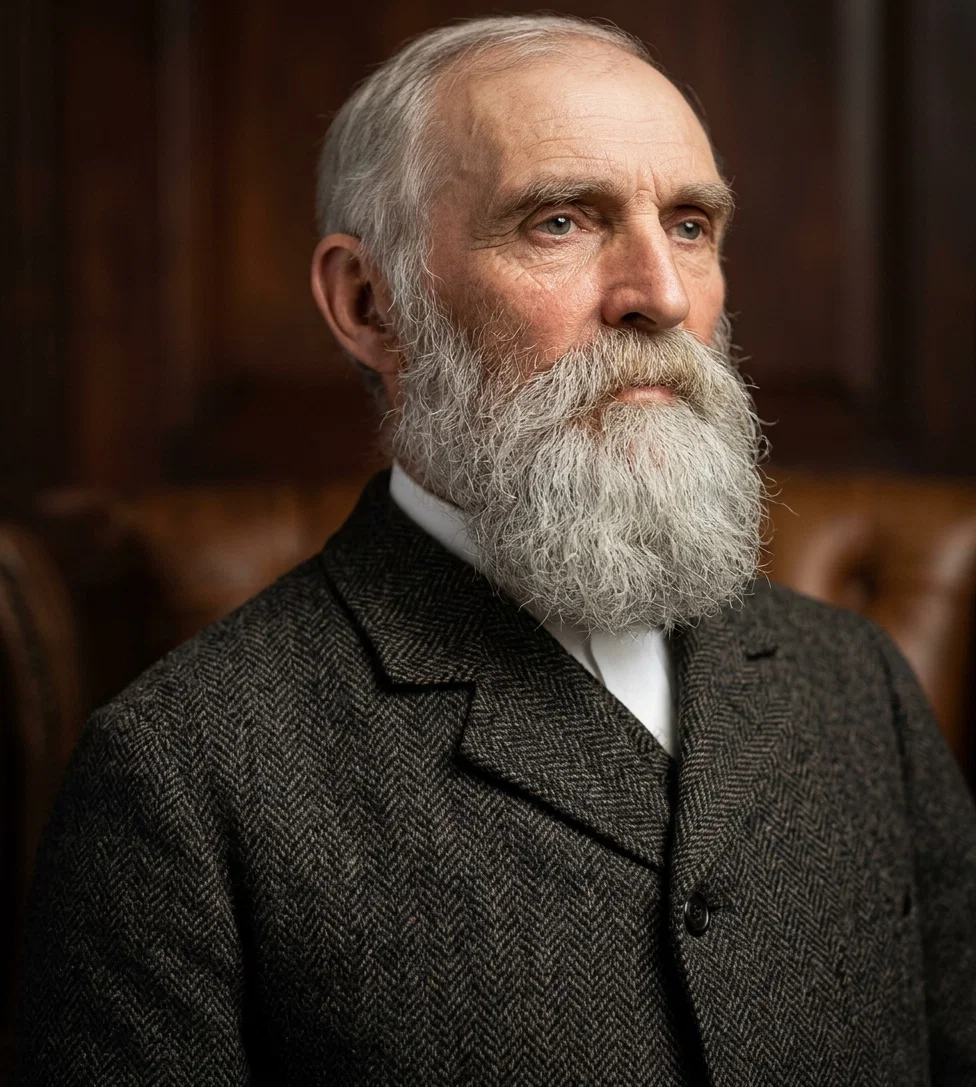
In Portland, Maine, Elder Calvin Augustus Washburn was born Oct. 25, 1834. He died at the Iowa Sanitarium, Des Moines, Iowa, at 5 A. M., Sabbath, Aug. 5, 1905, at the age of seventy years, nine months, and ten days.
His father and mother were originally members of the Methodist Church, but were in the first advent movement, and were among those who believed with all their hearts that the Lord would appear the second time in his glory on the twenty-second of October, 1844. My father well remembered that day, and has often spoken to me of his own child-like, simple faith, and of his great disappointment.
At the age of eighteen, with other members of his father's family, he began to keep the Sabbath when there were but few Seventh-day Adventists in all the world. In 1856 he left his father's home and family in Maine, and moved to Allamakee County, Iowa, where he was for many years a member of the old Waukon church.
My father loved all living creatures. It was his delight to till the soil. He was a natural farmer. This occupation, combined with teaching in the public schools during the winter, he followed until, at the age of forty, he began his work as a minister with Elder J. H. Morrison, who had the sad privilege of preaching the funeral sermon of his former collaborer in the work of proclaiming the third angel's message.
The family home was at Waukon until the year 1875, when it was removed to the State of Maine for one year. Since returning to Iowa in November, 1876, Mt. Pleasant has been the family home, and my father's ministerial labors have been in connection with the work in Iowa since that time. He has been closely connected with the conference work, having been for many years a member of the conference committee, holding this position at the time of his death, and being actively engaged in tent labor when attacked by his fatal illness.
He had been a man of robust and vigorous health. In fact, I do not know that he was ever seriously sick until this last illness, which was apparently the same as that which recently removed another pioneer in the work, Elder D. T. Bourdieu. The immediate cause of his death was gall-stones, but a post-mortem examination revealed the fact that a cancer was developing in the liver, which, had he lived long, would have filled his closing days with suffering.
Everything in the way of medical and surgical help was given to prolong his valued life. He fell asleep quietly, and apparently without realizing but that he should live longer, fully expecting on recovery to find needed rest with his son, Dr. F. A. Washburn, of Boulder, Colo.
My father regarded death as an enemy, but we know that he was always ready to die, and did not need to make special preparation, and we feel truly to say, in the words of the beloved John, “Blessed are the dead which die in the Lord. . . . Yea, saith the Spirit, that they may rest from their labors; and their works do follow them.” Sudden and great as the shock to his family and to his fellow laborers has been, we feel it is well, and we say truly from the heart, “God’s will is best; God’s will be done.”
Jan. 1, 1861, Elder C. A. Washburn was united in marriage to Mary A. Butler, a sister of George I. Butler. Six children were born, five of whom are still living. The next to the youngest daughter, Grace, sleeps on the island of Grand Cayman, where, at the age of twenty, she died of yellow fever at Christmas in the year 1897, while on a journey with her husband as missionary teachers to the Bay Islands. This first sudden break in our hitherto complete family circle was a great shock to my father, one from which I think he never thoroughly recovered.
ELDER C. A. WASHBURN
The remaining members of the family had the sad privilege of a complete reunion at father's funeral, which was held in the Mt. Pleasant church, Monday afternoon, August 7. Words of true comfort were spoken by Elder J. H. Morrison, from whom I will quote:—
“Little did I think when I was here the last time at this church, that my next visit would be brought about by the sad event, the death of my good brother and lifelong friend and co-laborer, Calvin Washburn. With me he began his labor in the ministry. About thirty-two years ago we were engaged in our first series of meetings in the tent. I was standing by his side when he was passing through that trying ordeal that usually tries the hearts and the courage and the faith of beginners in the work. The circumstances revealed to me at once something of his latent powers, high ideals, broad humanity, and purity of character; and as such he was a source of inspiration to me, and I always felt that I was bettered by his association. His convictions settled, his mind intently fixed on giving the light of truth to others, with cheerful courage he discharged his duties not only as a minister, but as a husband, father, friend. In him I saw a noble soul striving for a higher life, one who is not at the mercy of circumstances that would easily depress or elate, sad to-day because things are troublesome, joyful to-morrow because things are pleasant. If trouble did come, he thought of that world where there is no sorrow. If friends or possessions were lost, he thought of that wealth and life of the faithful. So he was not simply joyful over success or miserable over failure, but seemed always balanced, strong, composed, just, suave yet firm, gentle yet dauntless, warm-hearted yet deliberate, confident yet without egotism, and equipped with large experience, yet a man of the greatest caution, true to his convictions, true to himself and his God, and false to no man.”
“Nothing attracts our attention more than the sepulchral home of our honored dead, as we move through her cold, damp aisles, and stand amid her pathetic monuments. O how the history of the past comes and lifts the gates of memory, and opens a passage through the windings and the intricate mazes of life! Then my imagination begins at once to rebuild the crumbled home of my childhood and youth, and to repeople it with known and familiar friends until they stand before me living as of old. But I dare not gaze on the scene, for in a moment all will change, and it will appear as with a cloud settled upon her glory, and her magnificence faded and gone. Why should I hope for a long life amid the wreck and ruin of all that I have loved? I would choose rather to pass on with the long procession to the last resting-place than to remain alone beneath the sorrow and afflictions that beset us on every hand.”
“To the Christian, Jesus comes as the unspeakable gift. His face, beaming with a joyous radiance, lights up all the dark future. His resurrection fixes in our sky a star of hope that never shall be dimmed.”
From a letter of sympathy recently written to my mother, by Elder George I. Butler, I quote a few words:—
“My heart was made very sad half an hour ago by a telegram announcing Calvin’s death. Your family has been spared such severe afflictions until the death of Grace, and now the stalwart, strong father is laid low. He has always seemed near to me. We were intimately acquainted. He was strictly honest and upright to a fault; truthful to the core; always kind and tender to the erring, and never exacting; always ready to go more than half way for peace; sensible; strictly pure and conscientious in his religion; staunch and true for what he thought was right; faithful to his children to bring them up to respect right principles, yet a tender, kind father and husband. He was an honor to the good old manly, conscientious Maine stock from which he came. Like the granite rocks amid which he was reared, he knew no human fear, nor could he be turned aside from his honest convictions. He was a man of excellent judgment. This is my judgment of him after many an experience20with him. He will be missed by many a circle in Iowa.
“How blessed is the Christian’s hope at such a time as this! Poor Hobbs, the noted infidel of a past generation, as he stood upon the ragged edge of the awful precipice separating the transient present from the eternal future age, could but say, as he stood trembling on the brink, ‘It is a leap in the dark.’ Think of the expression and the sadness of it—standing in the blackness of midnight upon the edge of the chasm, and springing off into the unknown, no pilot, no light, no hope! And is that the end of life? Turn to the blessed apostle, and note the difference: ‘I have fought a good fight, I have finished my course, I have kept the faith. Henceforth there is laid up for me a crown of righteousness, which the Lord, the righteous Judge, shall give me at that day: and not to me only, but unto all them also that love his appearing.’ Precious words! It will not be long until the dear ones will ‘meet ne’er to sever.’”
Father was quiet and retiring, in honor preferring others, willing that they rather than himself should stand in honored positions or do work which might bring praise. Calm, deliberate, not emotional, yet when the depths of his deep, still nature were stirred, when the cause of God was at stake in a crisis, I have seen him moved to such eloquence that all was swept before it. A man not given to extremes, pursuing the even tenor of his way unmoved by censure or praise, stern and firm in his convictions, he believed in the word “duty.” This he followed without fear. When others around him were carried first to one extreme and then to another, he pursued his even, quiet way. Many times when it seemed as if he were not keeping up with the “advanced light,” it was found in the end that his cool, calm judgment was right. He hated all that was crooked. He cared not for surface work. He loved righteousness. Always ready to acknowledge a mistake or a fault, expecting, demanding justice and right from others, yet he was always ready to forgive a wrong. Physically and morally he was without fear.
Thus has passed away another pioneer, one of the generation of whom Jesus said, “This generation shall not pass away, till all be fulfilled.” He was one of those present at the meeting in 1856 in Battle Creek, when it was stated that there were those present who would die, and others who would live to see the end. He had fully expected to be among those who would live to see the Lord come in power and great glory.
Though startled by his sudden death, yet we believe that he who knows how terrible is the storm just before us has permitted the tired, true soldier who fell at his post to rest for a little time until the first resurrection. Then we shall see him strong again in the vigor of immortal youth. Hasten, blessed day! Come, Lord Jesus, come quickly.