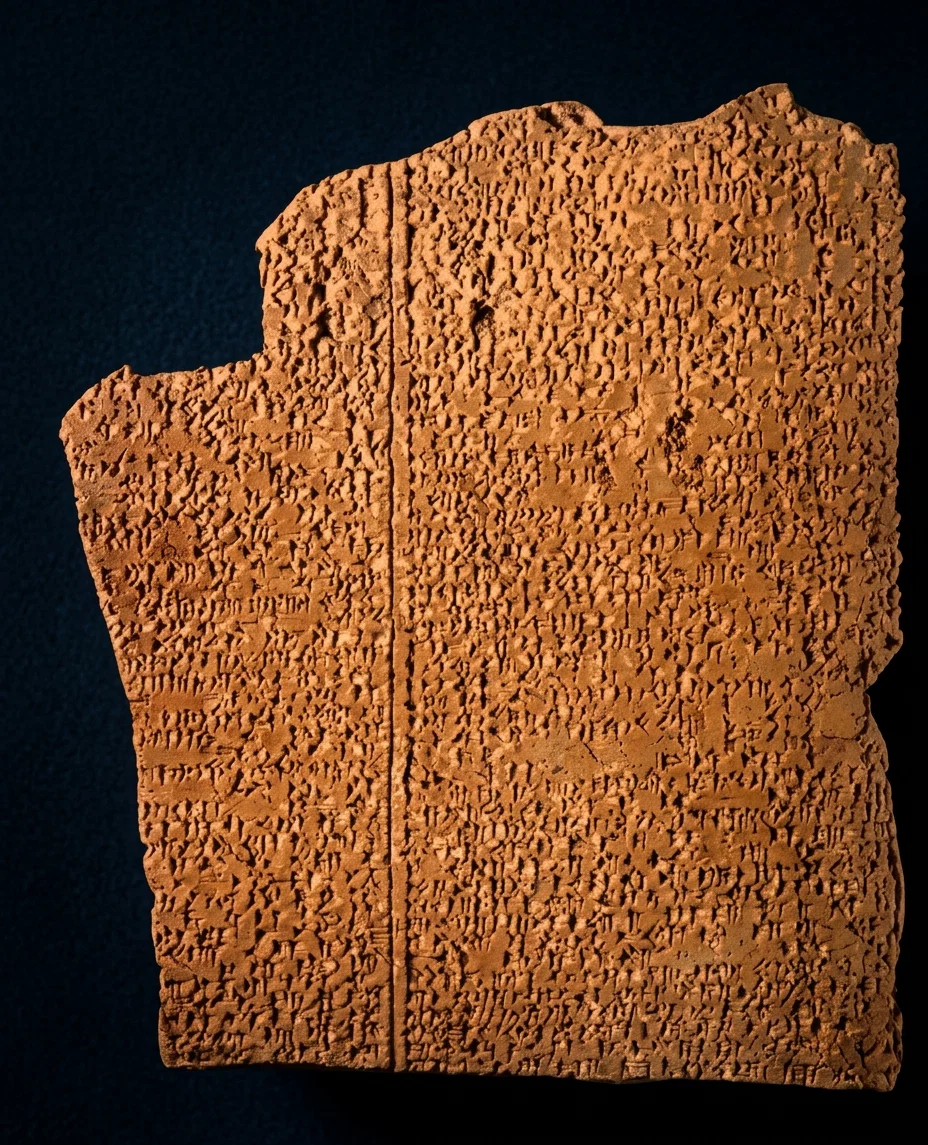
A LITTLE over thirty years ago George Smith found in the ruins of old Nineveh a great library of over thirty thousand clay books, the library of Assurbanipal king of Assyria, 668 to 626 B. C. There was evidence to show that they had been once arranged in order according to subjects. Among them he found an account of the flood in many respects like the Bible account. The deluge tablets tell how Bel commanded that a boat be built in which to preserve life. It tells of the storm, the landing of the ark on a mountain, the sending out of birds, and the offering of sacrifices on landing. But the Babylonian account shows plainly that the story has been handed down through minds that had chosen to forget God and corrupt themselves. The story is polytheistic. It says at the close that when the sacrifice was offered to the gods, they smelled the sweet savor, and swarmed around like flies.
A DELUGE TABLET
Present Excavations in the East
There has been quite a revival of Oriental study in the last few years. With much difficulty the work is carried on, because of the conservatism of the Turkish government, lack of funds to properly conduct the explorations, and because of danger from an unfriendly climate, and often hostile tribes. Wild beasts are sometimes also a menace, for the prophecy of Babylon has been literally fulfilled that the wild beasts should make their home there. Work is being carried on in Persia at Susa, or Shushan, by the French. The German Oriental Society is excavating in the ruins of old Babylon, on the tower-temple supposed to be the original “tower of Babel.” The French are excavating at Tello, a city that flourished before the birth of Abraham; and a new society organized by the University of Chicago has lately received a firman, or permit, to excavate at Bismya, in central Babylonia. The University of Pennsylvania has been excavating at Nippur, about fifty miles from Babylon, and has brought to this country probably the most remarkable relics in existence. Nippur is supposed to be the Biblical Calneh, and is the oldest city yet investigated. The illustration shows the appearance of Nippur before the arrival of the expedition. The miniature mountains cover an area three fourths of a mile wide by one mile long. The highest mound is one hundred and ten feet, and the average height of the mounds is sixty feet. The ruins are about equally divided by the dry bed of an old navigable canal, of which I shall have more to say later. The earliest stratum found is thirty feet beneath the plain, the surrounding country having filled in by inundations and other causes to that amount.
THE NIPPUR MOUND
Results of Excavations
The history of early Babylon is being largely reconstructed as a result of the excavations at Nippur. Dr. Clay, of Philadelphia, says:—
“The antiquities of the earliest known period, instead of being rude, primitive, or aboriginal, are found to be very highly developed. The earliest known inscriptions show that the characters, instead of being pictorial outlines as they once were, have gone through a long development.”
“The skill of the gem cutter and sculptor,” he says, “surpass later periods.” “In many respects,” he further says, “The culture is not surpassed even at the present day.”
These are remarkable statements, and these discoveries are revolutionizing men's ideas of antiquity. Here, too, lies the danger. Still wedded to their evolutionary theories, scholars take the unearthing of these advanced civilizations to mean that the world is thousands of years older than it was formerly believed to be. Thus the author just quoted says: “Several thousands of years at least must have passed before a people was advanced far enough to produce such masterpieces.”
We do not know just how old the world is, and the Bible does not reveal it; but I believe that in history as well as in science there are wild speculations to be avoided. And one not to be led astray must study with the Bible in hand and the heart in touch with the Infinite One. We may sometimes have wrong ideas of what the Bible says, but the Bible is never wrong. And in all the efforts that have been made against it, not one demonstrated scientific truth nor one proven historical fact has ever contradicted the Bible. But in history as well as in science, men take the very witnesses that God has left to show the truthfulness of his Word and try to make them prove their preconceived ideas of evolution. These evidences of very early remarkable civilizations, comparable even with our own, do not prove that there were millenniums before that in which these people developed from savagery to civilization, but they prove, on the other hand, that there was no such long development, but that man made in the image of God possessed a powerful intellect and remarkable genius. And it stands us in hand to know these things, and to be able to combat infidelity hidden under the cloak of science and history.