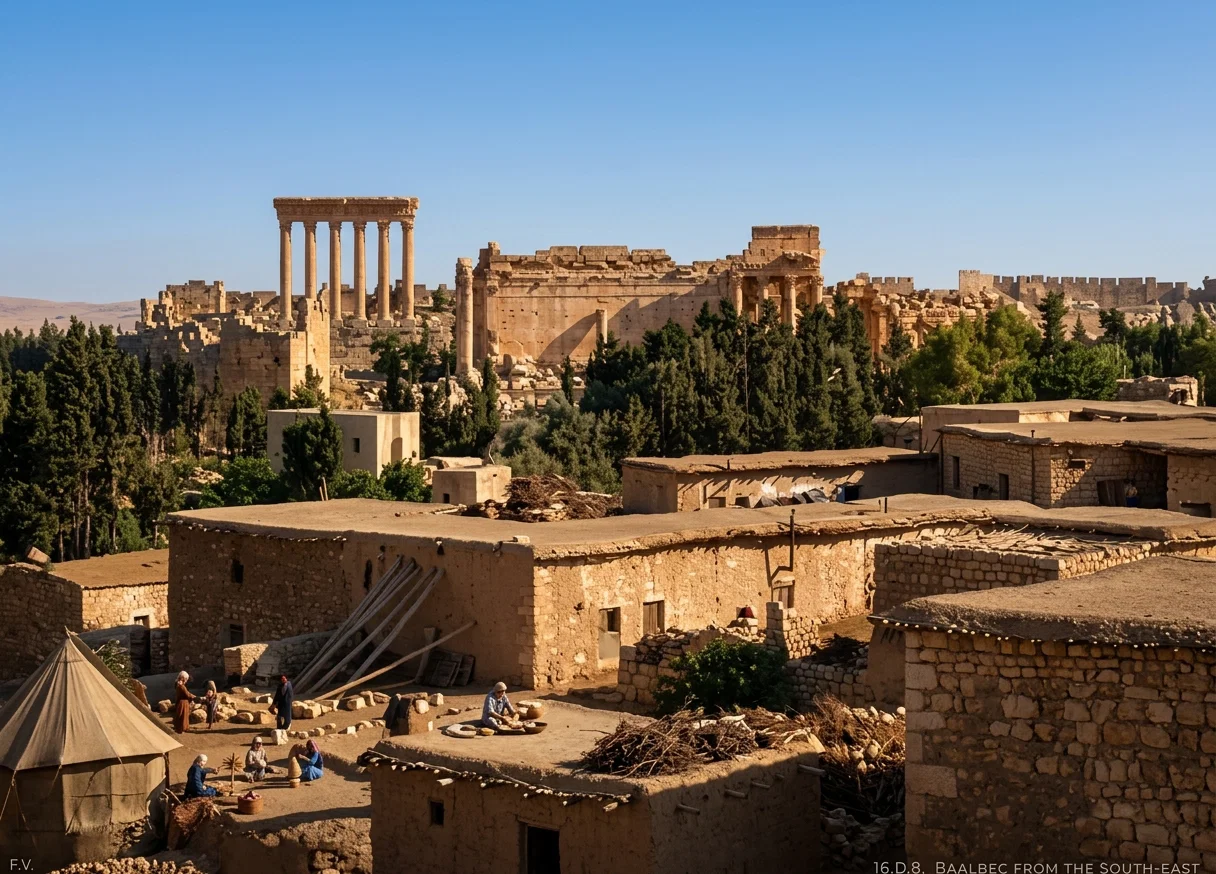
The Ruins of Baalbec

25%

Review and Herald Publishing Association · Washington, D. C. · Sep 21, 1905

FromReview and Herald, Vol. 82, No. 38.

Read the full edition

The Ruins of Baalbec

BAALBEC
BAALBEC
A GENERAL view is here given of the famous ruins which are an object of interest to all travelers in Syria, and for which alone Baalbec is now noted. Baalbec was formerly one of the chief cities of Syria, having much the same natural advantages of situation as those enjoyed by Damascus, which lies to the southeastward of it only thirty-five miles away. The city was situated on the lowest declivity of the anti-Libanus range, having an altitude of 4,500 feet above the sea. It flourished down to the time of the Moslem invasion of Syria, being taken by them after the capture of Damascus. It was a later siege and capture, however, by the caliph of Damascus, which gave a fatal blow to its prosperity. By this conqueror the city was sacked and dismantled, and most of its inhabitants put to death, 748 A. D. It continued, however, to be a place of military importance, and was an object of dispute for several centuries between the caliphs of Egypt and various Syrian dynasties. In the twelfth century it suffered severely from several earthquakes.
The ancient walls of the city are about four miles in compass; but the existing town is described as being, with the exception of some of its Saracenic fortifications and its two mosques, "a cluster of mean-looking buildings, which serve only to bring out into greater prominence the grandeur of the neighboring ruins." These ruins "consist of three temples, usually known as the Great Temple (and it well deserves the name), the Temple of Jupiter, Apollo, or the Sun, and the Circular Temple. The Great Temple, which would seem at one period to have been a kind of pantheon, is situated on a magnificent platform, which raises it high above the level of the ground, and extends from east to west a distance of about 1,100 feet." The portico of this temple extended 260 feet from north to south. A portion of the temple called the Great Quadrangle covered an area of between three and four acres. The Sun Temple and Circular Temple were smaller structures, but the Sun Temple is in a much better state of preservation.