AFTER briefly referring to the two apartments of the earthly sanctuary and the work done in each, the apostle, in Heb. 9:8-11, says that the Holy Spirit signified that while that tabernacle existed, the way into the “holiest of all” was not yet revealed, but that the typical work then done was, for the time, a “figure” of a “greater and more perfect tabernacle, not made with hands.” Speaking of the intent of that figure, the apostle went on to say that it was necessary for those “patterns” of things in the heavens to be purified with the blood of animals, but that the heavenly things themselves must be cleansed with a better sacrifice. As the reason for this conclusion, he says that Christ is not entered into the earthly holy places, but into heaven itself, to appear in the presence of God for us. Verses 23, 24.
One point in the foregoing should be emphasized here. It will be noticed that Christ’s work as high priest is said to be the cleansing of “heavenly things.” This means more than the cleansing of sinful hearts in earthly forms. So in the apostle’s comparison of the two systems, he has the year-end cleansing of the earthly sanctuary, after the individual forgiveness of sins through confession, stand as a figure of a final cleansing of heavenly things, after men have received personal forgiveness for sins which they have laid on the heavenly High Priest through confession. It therefore follows that a time must come in the work of Christ as high priest when he shall carry in before God all the confessed sins of those whose names are in the book of life, and there confess them before God, in the presence of the angels. Rev. 3:5. This is the occasion when men’s eternal at-one-ment with God is decided.
It further follows that in confessing only for the names of “overcomers,” preparatory to laying their sins on the head of the originator of evil, to be borne by him, all whose names are not so confessed must bear their own sins, and so have part in the lake of fire with Satan and his angels. Matt. 25:41; Rev. 20:15. With such a doom awaiting them, it is evidence that these have not received the at-one-ment with God, but were judged to be separated from the holy people, and receive punishment for the sins which they still retained after the atonement work for the world is completed. This work, it will be quickly recognized, is the exact antitype of the whole work carried on in the earthly sanctuary on the annual day of atonement.
As in the earthly typical work a specific day was set apart for the work of deciding who were to be counted in at-one-ment with God, so for the heavenly and final service God has “appointed a day, in the which he will judge the world” by Jesus Christ. Not only was this emphatically proclaimed by Paul at Athens, but an angel of God was sent to an ancient prophet to reveal the same truth. While contemplating the future through prophetic eyes, Daniel was spoken to by one clothed in white, who said concerning the work God was yet to do for his people, “Unto two thousand and three hundred days; then shall the sanctuary be cleansed.” Dan. 8:14.
When we consider that the earthly sanctuary of Daniel’s days was cleansed regularly each recurring year, we feel sure that this text has reference to another sanctuary, and another cleansing; for whereas the interim between the cleansing ceremonies of the earthly tabernacle was, at most, but three hundred and sixty-five days, the sanctuary here spoken of must wait for its cleansing 2,300 days,—a period of more than six times as long, even though the days be pronounced literal time. But that the days under consideration are not literal days, the words of the angel confirm, when in response to the command to reveal the intent of the matter, he explained to the trembling and prostrate Daniel that the vision referred to “the time of the end.” Verses 16, 17.
These, then, are symbolic days, and according to God’s established rule of their interpretation (Eze. 4:1-6) the 2,300 days signify a corresponding number of years. At the time the vision was given, Daniel became so dazed at the revelation that he fell ill, and so the full explanation of the thing to him was deferred. But when able to look into the matter, the angel was again at hand to guide his understanding. So while at prayer over the meaning, the angel said: “O Daniel, I am now come forth to give thee skill and understanding.” Chap. 9:22. Then, after commending the prophet for his zeal in trying to settle so perplexing a question, he added: “Therefore understand the matter, and consider the vision.”
The angel next proceeded to make the subject clear to the prophet’s mind by saying: “Seventy weeks are determined upon thy people and upon thy holy city.” The Hebrew word here rendered “determined,” is defined by Gesenius to mean, “literally, to cut off; tropically, to divide, and so to determine, or decree.” From this it is plain that the seventy weeks, or 490 days, were “cut off” from the 2,300 days of the vision under consideration. But as only this part of the whole number of days was determined, or decreed, upon Daniel’s people, it follows that with the end of the 490 symbolical days, the exclusive privileges of the Jewish people were to cease.
As to the beginning of these days, the angel proceeds to say that sixty-nine of those seventy symbolical weeks, or 483 years, would reach from the command to restore and rebuild Jerusalem to the appearance of the Messiah. This term as applied to Christ means “anointed.” See the margin of John 1:41. By comparing Acts 10:37, 38, with Mark 1:10 we learn that Christ was anointed at the time of his baptism.
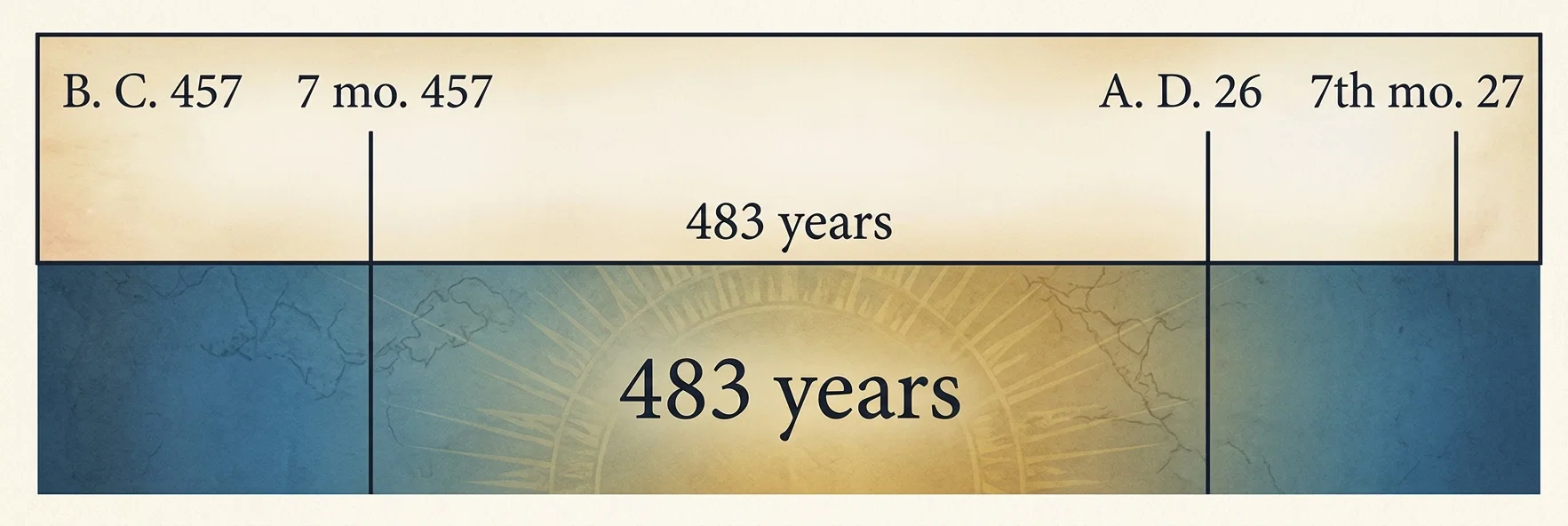
This, then, is the point of time at which the 483 years must properly terminate. So in looking for the beginning of this prophetic period, we are directed to the seventh chapter of Ezra, where we learn that the command to restore and rebuild Jerusalem went into effect in the year 457 B. C. See margin of verse 8. Reckoning forward from this date 483 years, we, of course, must ascertain the precise time when the anointing of Christ should take place. But as the 457 years before Christ do not cover the entire period of 483 years, we subtract these 457 years B. C. from the 483 years, and have twenty-six years remaining. These, as one readily sees, belong this side of the Christian era. But to insure accuracy, one other consideration is here necessary. It requires the full amount of these twenty-six years of the Christian era and the full number of 457 years before Christ to complete the 483 years, the end of which must mark the anointing of Christ, so that if the 483 years were to begin with the first day of 457 B. C., they would not terminate until the very last day of 26 A. D. As the work of rebuilding Jerusalem did not begin until the autumn of 457 B. C., it is manifest that the months lost from the count in the beginning of that year must be added to the close of 26 A. D., thus locating the time of Christ’s anointing in the autumn of 27 A. D. This is made plain by the following simple diagram:—
The chronological date in the margin of most English Bibles opposite Mark 1:10, wherein is recorded the baptism of Christ, is 27 A. D. Thus with unerring accuracy the words of the angel to Daniel are verified. In harmony also with the prophecy, our Saviour immediately after his baptism began preaching the gospel, saying: “The time is fulfilled.” He could have reference to nothing else than the prophecy relating to his own work and mission, and that is covered by the words of the angel to Daniel, just under consideration.
Having found sixty-nine of the seventy weeks to reach to the autumn of 27 A. D., the seventieth week must extend the time specifically allotted to the Jews or to the autumn of 34 A. D. It was at this time that the Jewish Sanhedrin cut their nation off from participation in gospel10privileges by the public execution of Stephen for adherence to Christianity. See Acts 8. Referring to this fact afterward, the apostle Paul said to the Jews of Antioch: “It was necessary that the word of God should first have been spoken to you: but seeing ye put it from you, and judge yourselves unworthy of everlasting life, lo, we turn to the Gentiles.” Acts 13:46. See also Rom. 1:16.
Having found the ending of the 490 years to be in 34 A. D., the remaining 1,810 of the 2,300 years have but to be added to the year 34 A. D. to reach the year 1844, when, according to the infallible words of the angel to Daniel, the great sanctuary cleansing must begin. And as in the type the annual cleansing of the earthly sanctuary was a time of deciding men’s cases either for or against them, so in the antitype; the cleansing of the heavenly sanctuary, which began in 1844, is a work of deciding the cases of men, once for all, for weal or woe.
It is indeed a solemn time to the people of the present generation, who must see the end of this heavenly work. That done, the Lord comes to receive his own,—those whose characters before the grand assize were pronounced in at-one-ment with the Lord of glory. To such he will surely say, “Well done, thou good and faithful servant,” and they will be forever happy in the presence of their Saviour. But if it should appear that any who are called to the marriage feast shall not be “chosen,” what agony will rend their hearts at the revelation of Jesus Christ. How much better to put away all sin, and be ready to say when he appears: “Lo, this is our God; we have waited for him, and he will save us. . . . We will be glad and rejoice in his salvation.” Isa. 25:9.