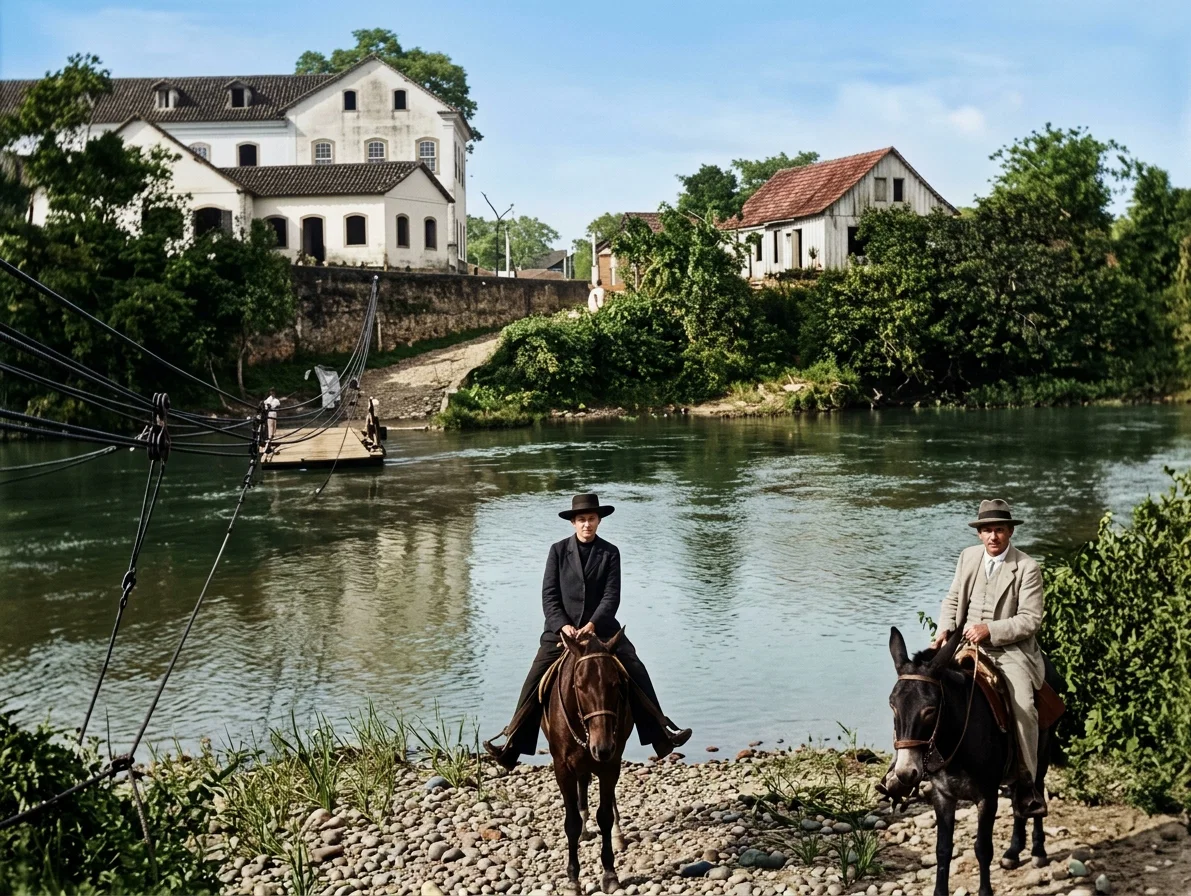
After returning from a general meeting at Blumenau, in the northern part of the State of Santa Catharina, we made preparations for a trip over land to the southern part of the same State, to hold another general meeting. As traveling here is far different than in the States, I will describe this trip in detail.
Owing to bad roads, it is impossible to make the trip by wagon, so we had to ride on mules or horses. Our company consisted of eleven persons. My wife, our daughter, ten years of age, and some of my former students accompanied me.
May 15 we left Brusque for Linha Torres, via Laguna, with twelve animals. It began to rain as we started, and continued almost all day. In the afternoon we had to climb a steep hill, by a road steeper than any I ever saw in the States. On account of the rain, the road was in a miserable condition. It was dark when we arrived at a small store kept by a Brazilian, where we stayed over night. Our beds were made on the floor. Some of us had to sleep on our saddle blankets, in a storeroom, in company with a number of rats.
Next morning before daylight we made preparations to go on. The second day was better, as we did not have much rain, and no steep hills. That night we stayed again with a Brazilian, some of us sleeping as we had the previous night, on our saddle blankets. Bread we could not buy here, and very few bananas.
The third morning we were compelled to ride a distance through a swamp. A stone path kept us from sinking. One step off this stone path could result in animal and rider losing their lives. The Lord kept us as we went through. It rained almost all day.
That evening we came to the home of a German family. There we got a good bed again, and a good warm meal, which we had not had since leaving home.
FERRY AT BRUSQUE
At every place we stopped, we held morning and evening worship. We sang, read the Bible, made remarks, and prayed. Our singing at this place brought many people together, and we hope we have prepared the way for a good work in the future.
Knowing that the worst part of our journey was to come, where little food could be bought, we purchased enough bread here to last for some time. About noon we had to climb a steep hill, and had to cross a river, after which we must ride through dangerous places. I remained at a dangerous place until the others had passed over. As my mule went on, he began to sink, and fell over on one side, throwing me into the water. One of my saddle pockets filled with water, and I got very wet. I managed to get the animal out again, and with the help of others we came ashore. I praised the Lord for his keeping, and that such an accident did not happen to one who could not swim. My wife or daughter, in the same position, might have lost their lives.
About twenty minutes later we came to a bakery, where I dried my books, clothing, etc., and bought some bread, after which we continued our journey.
On Friday before sunset we reached a small fisher village, where we concluded we would rest over Sabbath. We rented an old house, with three small rooms. There again we could have some warm food. We made our beds on the floor, on our saddle blankets. At this place we found souls hungry for the truth.
The Sabbath having begun, we sang, played the cornet, and read the Scriptures. Among the men who listened we found one who desired to come into close touch with us, so we held a Bible study with him and a few others. Though a Catholic, he expressed his faith in the Bible he had bought of a colporteur. One of our people who had passed through the village had given him a copy of the Arauto, our Portuguese paper, which he had read with interest.
Early Sabbath morning he came to us again with his Bible, hungry for the truth. Three times during the Sabbath we had Bible study with him and some others. It did our hearts good to see him drink in the truth. When we left on Sunday morning, he bought several tracts, subscribed for our Arauto, and invited us to visit him again. He said that he was our brother, and declared his willingness to do God's will. We do not know when one of our laborers will be able to visit him again. Few are the laborers, and great is the work, in Brazil. May God arouse some of our dear brethren in the States, who live in comparative ease and plenty, to consecrate their lives to God, and come over and help us to find in Brazil, under hardships and difficulties, hungry souls, and feed them with the bread of life.
On Sunday morning we must again cross a river. We took our saddles, etc., in a canoe, while our animals had to swim over. When, about noon of that day, passing through another village, we desired to buy bread, we were not able to do so. We made our dinner of oranges which we found, and some bread that we still had left. That night we stayed with a Brazilian fisher, a poor sick man who had not enough for his own family to eat. Eating the little we had remaining from our noon meal, we made our beds on the ground, in a shed, with dissatisfied stomachs, but with happy hearts, and after singing, reading, and prayer, retired. After a good night's rest, we went on the next morning, after our worship, with empty stomachs, expecting to be able to buy bread at the next village. But we hoped in vain. We had to take something else in its place. In the afternoon we arrived at Laguna, a city of about six thousand inhabitants, where we could get bread. It is sometimes difficult in this country to adhere to vegetarian principles.
On a small ferry, we had to cross a broad entrance of a lagoon, while the rain poured down. It was a dangerous passage. Happy we were at night to get a shelter in the house of a fisherman. We had bread and bananas for supper.
The next day it rained again. That night we could stay in a shed, making our beds on the bare ground, and having for supper some farina, made from a root called manioc, with some sugar and warm water.
The last was the worst day of our journey. It rained steadily. The roads were bad, and our stomachs were indeed dissatisfied, as we had to wait for food until about three o'clock in the afternoon. Cold, wet through and through, and hungry, we arrived at Linha Torres, where our people live, and a better time began.
Our journey lasted about eight and one-half days. I have given some details of this trip, that our brethren may14have an idea of the traveler's experience in Brazil, and how long it takes to go from one place to another. As we saw our brethren come from different places to attend the general meeting, we were glad, and forgot our difficult journey.