PROTESTANT missions in Madagascar date from the year 1818, at the close of which year the first missionaries of the London Missionary Society landed at Tamatave, the chief port of the east coast. Interrupted for some months by the death of most of that pioneer party, the mission was reopened in the year 1820, in the capital city, Antananarivo, in the interior highland, and was carried on with much success until the year 1835, when the persecuting queen, Ranavalona I, began severe measures against Christianity, and all the missionaries were compelled to leave the island. During that period of fifteen years of steady labor, the native language was reduced to a written form, the whole Bible was translated into the Malagasy tongue, a school system was established in the central province of Imerina, many thousands of children were instructed, and two small churches were formed. About two hundred Malagasy were believed to have become sincere Christians, while several thousands of young people had received instruction in the elementary facts and truths of Christianity. That was the period of planting in Madagascar.
The second period in the history of Malagasy Christianity was that of persecution, and continued for twenty-six years (1835-61), during which period persistent efforts were made to root out the hated foreign religion. But the number of the “praying people” steadily increased, and although about two hundred of them were put to death in various ways, the Christians multiplied about tenfold during that terrible time of trial.
In 1862 the mission of the London Missionary Society was re-established, and then began the third period in the religious history of the country, emphatically that of progress. From that date Christianity has steadily grown in influence, so that in 1895 about 1,400 congregations and more than 280,000 people were under the influence of its missionaries. These churches and adherents were found to some extent in all parts of the island, but were chiefly massed in the central provinces of Imerina and Betsileo.
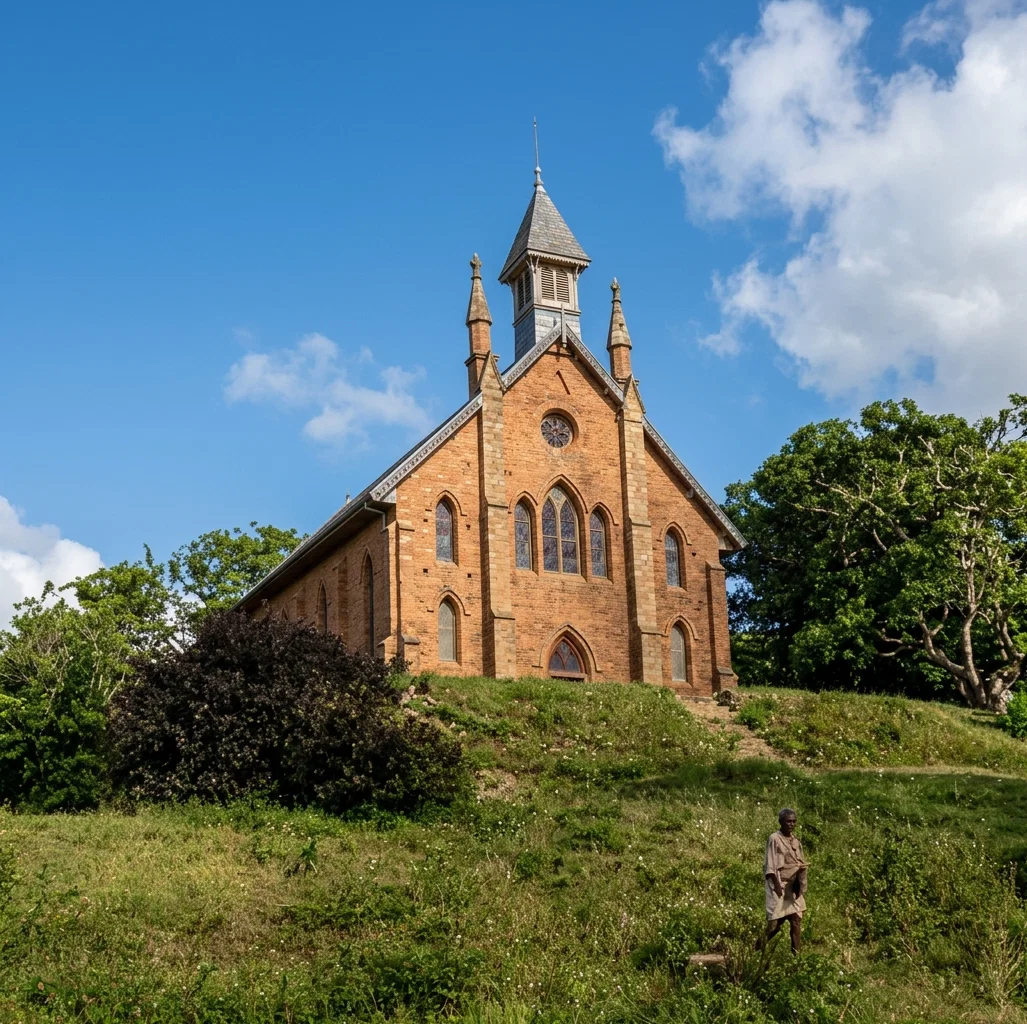
A VILLAGE CHURCH IN THE ISLAND OF MADAGASCAR
A great outward impetus was given to the spread of Christianity in the early part of 1869 by the baptism of Queen Ranavalona II and her prime minister, and the subsequent destruction of the idols of the central provinces, and still more by the personal influence of the sovereign in favor of the Christian religion.
In the year 1864 missions were begun on the eastern coast, both by the Society for the Propagation of the Gospel (Anglican) and the Church Missionary Society (Evangelical). The latter of these was eventually withdrawn (in 1874); and in the year 1872 the former society began work in the capital, and subsequently appointed a bishop to superintend its mission, its chief field, however, being still on the eastern coast.
Two years later (1866) the evangelical section of the Lutheran Church of Norway also began a mission in Madagascar, which was gradually increased, so that they have had no fewer than sixty missionaries, including ladies, in the country.
The last Protestant society to undertake work in Madagascar was that of the Friends (the Friends’ Foreign Mission Association). This was begun in the year 1867, and differs from the others in having formed no new church organization but in working in close connection and harmony with the London Missionary Society. To the Friends’ Mission is mainly due the support of the large medical mission of the two societies, with its spacious hospital, medical and nursing staff, numerous students, and dispensaries.
It will be seen from what has been already stated, that the London Missionary Society, to which the planting of Christianity in Madagascar is due, had previous to the French occupancy by far the largest number of adherents of any Protestant (or other) mission in the country; and it has naturally had the greatest influence upon the religious and social life of the Malagasy. But this large following has brought its difficulties and disadvantages; and the progress made has been greatly hindered by the large number of congregations under the nominal charge of one missionary, and the impossibility of exercising sufficient influence, in the way of leading and guiding large masses of ignorant people.
For many years the London Missionary Society has maintained a staff of from thirty-five to forty missionaries, including ladies, but not including missionaries’ wives. Of these, twenty were stationed in and around Antananarivo, ten in the Betsileo province, and the others in the Antsihanaka district, and on the eastern coast. And when it is remembered that most of these missionaries had on an average from fifty to sixty congregations to look after, and that many of these churches were scattered over a large extent of country, some at distances of three days’ journey from the station, and in a country where no wheeled vehicles were available, it will be seen how difficult it was to give these numerous congregations the help and guidance they so much needed.
To supply as far as possible the lack of European teaching, a college for training native evangelists was carried on for more than twenty-five years; and from this institution nearly three hundred men have been sent out, after receiving from three to four years’ training, including, in later years, a little medical instruction.
High schools, both for boys and for girls, have also been conducted for many years, and in the former of these, lads receive three years’ training as teachers, in order to supply the needs of the country schools, numbering many hundreds.
But it will probably be asked, What15are the spiritual and moral results of the work of so many missionaries laboring for so many years past? These are more difficult to gauge aright, and it is not easy to give a satisfactory answer to such a question. So much, however, may be fairly said: The idolatry of the central provinces, as regards any open practise of it, has been swept away, although it is quite true that at times of epidemic disease or any other calamity, there is tendency on the part of the more ignorant people to practise heathen customs more or less secretly, although all such are prohibited by the native laws. There is a vast advance in education and enlightenment. Probably not less than one hundred and fifty thousand people are able to read, and have acquired some familiarity with the main facts and truths of Christianity. Several editions of the whole Bible, besides large numbers of the New Testament, have been put into circulation, as well as a considerable amount of literature in the Malagasy language. Many hundreds of congregations have been formed, and meet regularly for worship, and while in all of these a considerable proportion are merely hearers, in almost every case probably there are a few earnest and sincere Christian people, and in the longer established churches these form a much larger proportion of the whole number of attendants.
A missionary spirit is being gradually aroused in the Malagasy churches, and from both the central provinces a number of men have been sent to the outlying heathen tribes as native missionaries. Every year more and more money is being raised for religious and benevolent objects, and considerable sums have been expended in erecting substantial (sometimes handsome) church buildings; and funds are not wanting to carry on orphanages, auxiliary Bible, tract, and temperance societies, as well as associations for supplying preachers to destitute and ignorant congregations. A number of young men have also received systematic training as doctors, and have obtained diplomas, and a number of young women have been taught scientific nursing of the sick. It has always been the aim of our missionaries to develop the self-help of the Malagasy Christians, and to train them to carry on their own church organization and work. For many years past the churches, both of the Imerina and Betsileo provinces, have been banded together in two strong and influential unions for the discussion of church matters, discipline, teaching, etc., and these larger unions, as well as the smaller organizations—a kind of presbytery—have gradually trained the Malagasy Christians to think and act for themselves.
Such are some of the many cheering features of our work, on account of which we have to thank God and take courage.—James Sibree, Missionary of the London Missionary Society, and Senior Tutor of its College, Antananarivo, Madagascar, in Missionary Review of the World.