The Meeting in Holland

8%

Review and Herald Publishing Association · Washington, D. C. · Oct 26, 1905

FromReview and Herald, Vol. 82, No. 43.

Read the full edition

The Meeting in Holland

GUY DAIL
To the lover of nature, no land is without its interest and attractions, and for those who are sent into the world with the great truths of the gospel for this time, no people is of little importance. Tidings of progress are read with joy by every true-hearted believer in the Lord’s soon return. Of Holland, it has been well written:—
“What land is this that seems to be A mingling of the land and sea? This land of sluices, dykes, and dunes? This water-net that tesselates The landscape? this unending maze Of gardens, through whose latticed gates The imprisoned pinks and tulips gaze; Where in long summer afternoons The sunshine, softened by the haze, Comes streaming down as through a screen; Where over fields and pastures green The painted ships float high in air, And over all and everywhere The sails of windmills sink and soar Like wings of sea-gulls on the shore?”
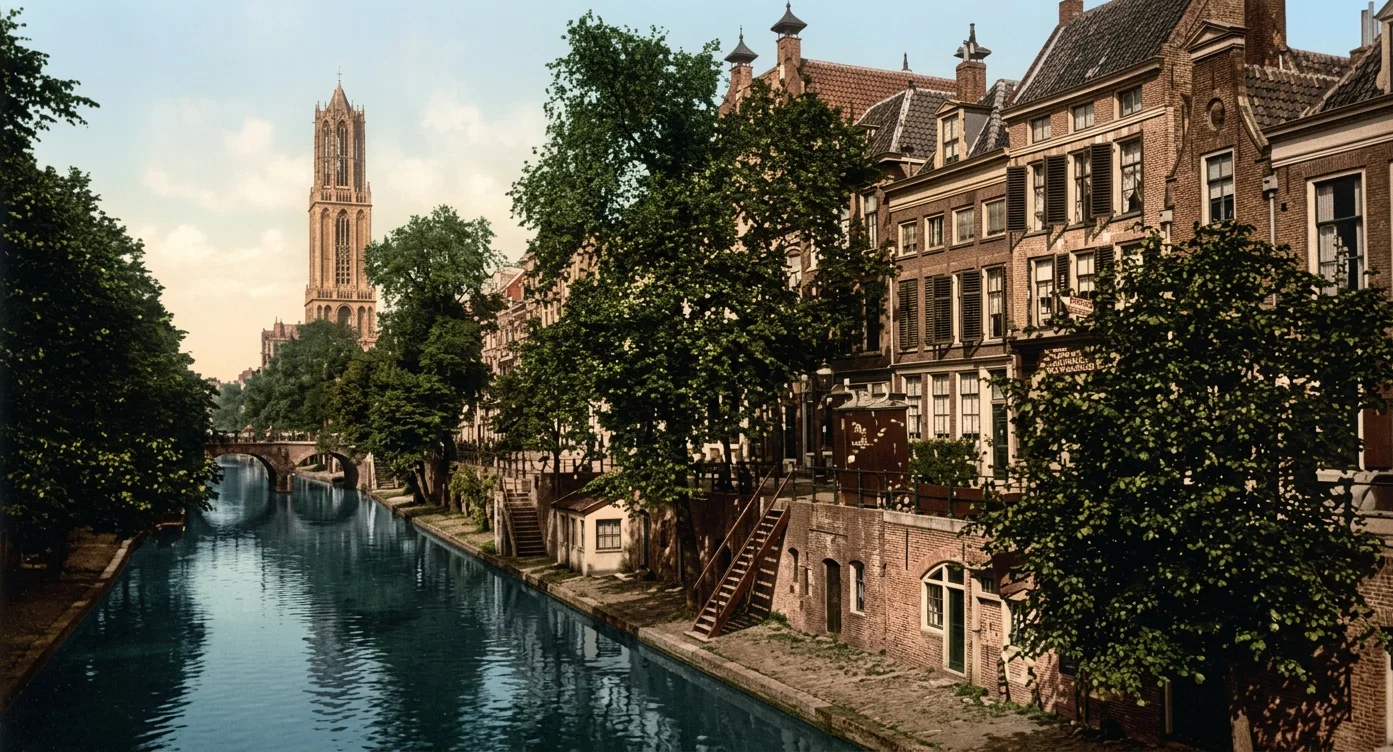
UTRECHT, HOLLAND
UTRECHT, HOLLAND
The city of Utrecht, where we have been having our yearly gathering, has been the theater of many important events since the Belgians were subdued by Julius Cæsar, and the Batavians (as the inhabitants of this morass-covered land were then called) became allies of Rome. In the fourth century the ancient Batavians disappeared, being merged into the Friesian tribes farther to the north. These Friesians were a rebellious people, and did not like the nominal rule established over Holland by the Franks; neither did they take very kindly to the Christian religion as it was then taught them; but Charlemagne conquered Friesland, to which Utrecht belonged (it was then called Trajectum ad Rhenum—the Ford of the Rhine), and after a great battle against the Friesians by Charles Martel, they submitted to the establishment of the new religion. The first Bishop of Utrecht was Willibrord, the Anglo-Saxon missionary who had been teaching the gospel to the people in Walcheren. The first Christian church in the land was founded in this city. The foundation of the Netherlands republic was laid here by the famous treaty of union between the southern provinces in 1579, and in 1713 the Treaty of Utrecht ended the Thirty Years’ War.
As to the city of Utrecht at the present time, one finds much to interest him in its canals, unique, because, unlike those in most Holland cities, they are considerably below the level of the houses. In Oude Gracht, as well as in some of the other leading thoroughfares, there are in reality two roadways on either side of the canal, the upper roadway forming a roof to the lower line of shops and vaults and storerooms opening near the water’s edge. The most noted building is the “Dom,” the cathedral erected, in the thirteenth century, on the very ground occupied by Willibrord’s church, which was built in the eighth century. The brick-and-stone tower is three hundred and forty feet high, and on a clear day one can see from its summit nearly the whole of Holland. The building was partially destroyed by a great storm in the seventeenth century, so the church and tower now stand at some little distance from each other. Of course, as one would naturally suppose, the city is clean and neat, for of all Europeans the Hollanders have the greatest reputation for cleanliness, which they have well earned, judging from the amount of time they spend beating their carpets, washing their windows, and scrubbing their floors and pavements. Many of the streets and shops have a modern appearance, and impress the stranger very favorably.
Our meetings were held in the Irene Hall, one of the nicest in the city. They began Friday evening, September 15, and close to-night, the 18th. The weather has been very nice indeed,—in this respect we could not have desired anything better,—and the Spirit of God has been with us. From the eleven churches and companies in Holland and Flemish Belgium, about sixty representatives were present. This is fifty per cent of our membership in the field. At the close of 1904 we had ninety-nine believers here, and now there are one hundred and twenty. Two were baptized this afternoon. The ordinances of the Lord’s house were celebrated this evening, Elder Erzberger presiding. God was near to bless.
The instructions of Brethren Schuberth and Conradi have also been to the upbuilding of the hearers. Special attention has been given to the simple truths of the third angel’s message, especially the sanctuary question, and care has been taken not to neglect any department of our work in planning for the future.
The officers chosen by the people are the same as those selected by the union committee at Friedensau, with one exception, where a change seemed best. They are: Director, R. G. Klingbeil; Secretary, J. Wibbins; Advisory Committee, R. G. Klingbeil, J. Wibbins, J. Wintzen, M. Arndse, P. Schilstra. One minister, two licentiates, and three Bible workers received credentials or licenses for the coming year. They have, in Holland and Flemish Belgium, 8,860,000 people to care for.
The tithe of the mission is increasing. Last year it was $625. The first six months of 1905 it has been $357, as against $322 for the first six months of 1904. There is also a more hopeful outlook for the canvassing work than heretofore.
Here is a field where the work goes slowly, if compared with some other fields; and yet the workers are of good courage, and seem to enter upon their labors for the coming year in better hope than ever before. Let our people remember their laborers in prayer to God, and do all they can to assist in spreading our literature among the Dutch-speaking people wherever they may be found. We are very glad to report that our health food store in Rotterdam is doing well this year, and will have a fair gain if things go on as they are now. Brethren, do not forget the work and the workers in Holland and Flemish Belgium.