British West Africa

3%

Review and Herald Publishing Association · Washington, D. C. · Nov 9, 1905

FromReview and Herald, Vol. 82, No. 45.

Read the full edition

British West Africa

D. C. BABCOCK
The colonies and protectorates in west Africa belonging to Great Britain are Gambia, Sierra Leone, Gold Coast, Lagos, and Northern and Southern Nigeria, and are found within the area of five to fourteen degrees north latitude and fourteen degrees east longitude to seventeen degrees west longitude.

Gambia

Gambia, the smallest of these colonies, derives its name from a large west African river, which empties into the Atlantic Ocean at a point fourteen degrees north latitude and seventeen degrees west longitude.
The colony and protectorate consist of the island of St. Mary, British Kombo, Albreda, The Ceded Mile, and McCathy's Island, situated between the falls Barraconda, and Bathurst, the capital, a distance of one hundred and fifty-three miles. The protectorate, however, extends up the river two hundred and eighty miles from the mouth.
While all these colonies are considered extremely unhealthful, yet it is remarkable to note the vast difference in their climate and temperature. Gambia lies about four hundred and fifty miles to the northwest of Sierra Leone. The temperature ranges from fifty-eight to one hundred degrees Fahrenheit, while in Sierra Leone it varies from sixty-seven to ninety-six degrees. The rainfall in Gambia is from July to October, and averages fifty-seven inches, while in Sierra Leone the rainfall is from one hundred and fifty to two hundred inches annually.
It is said that in Bathurst, the capital of Gambia, the temperature often varies thirty degrees in twelve hours. The rainy season in Gambia is considered very unhealthful, hence our work in that colony must be carried on from November till June.
April is regarded as the most pleasant and healthful month of the year. Gambia, though small, is a good trading point, and I am informed that there is plenty of money in circulation. We are anxious to send a good canvasser there as soon as one can be found. As the colony is almost surrounded by French territory, it will be necessary to handle some French books with our English.

Sierra Leone

This colony lies between six and ten degrees north latitude and ten and fourteen degrees west longitude, about four hundred and fifty miles to the southeast of Gambia. Sierra Leone has a coast line of two hundred and ten miles, and extends into the interior about three hundred miles. For many miles from the coast, back into the interior, the country is quite mountainous, often rising to a height of two thousand five hundred feet above sea-level.
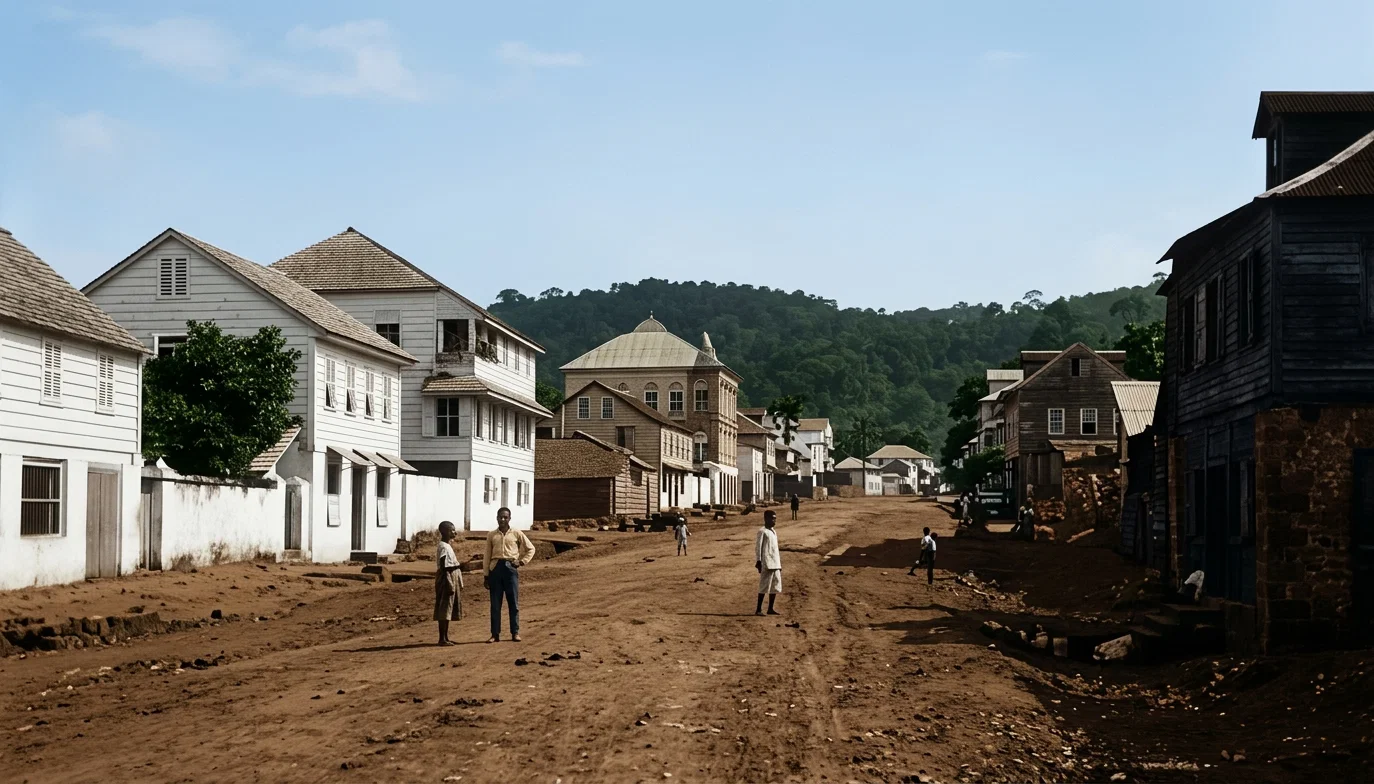
Freetown is the capital, and is situated at the foot of the mountain four miles from the mouth of the Sierra Leone River. It has the best harbor in west Africa, and presents a good appearance on entering. Miss Kingsly, however, says, “It makes the best appearance when one is leaving Sierra Leone.” There have been many decided changes since Miss Kingsly wrote her “Travels in West Africa,” and in many respects Freetown is far in advance of what it was at that time. There are many other towns and villages in the colony, among which we might mention Waterloo, with three thousand inhabitants, and Banthe on the island of Sherbro.
WILBERFORCE STREET, FREETOWN, SIERRA LEONE
I was much surprised to find the English language more generally spoken in Waterloo than in Freetown. There are some who speak very good English, and many who speak what is called “trade English.”
Sierra Leone has been occupied by the British for more than one hundred years, and the city of Freetown derived its name from the use of it by the British as a point to liberate the slaves, while the slave trade was being suppressed along the west coast of Africa. The government also brought to this colony many of the colored people from Nova Scotia, about the year 1792, and a Methodist church was soon after organized. Now religion of almost every form may be found in Sierra Leone. Of this we will say but little at this time, but Mohammedanism, Catholicism, Protestantism, and heathenism in many forms exist.
I was never more forcibly reminded of Paul's visit to Athens, recorded in Acts 17, than I have been since reaching this colony. Never had I felt so much the need of that power found only in Christ as I now feel. In America or other professed Christian lands, we may talk about the message, and mentally convince the people of this truth, but here in this dark continent we must know a present Saviour, his abiding Spirit, his love for perishing humanity, or our efforts will avail nothing. The city of Freetown has a population of about sixty thousand, and probably not more than twenty per cent of these profess Christianity.
From our mission house we can look across the Sierra Leone River, and see a country where no missionary society has been successful in bringing souls to Christ, although missions have been long established in this colony.
If I did not realize to some extent the power there is attending this message, I would ask the Mission Board to return us to our home land at once. If I did not fully believe that this work will finish with this generation, and not be continued in future generations, I would surely ask to be permitted to step aside, and not bear the heavy weight of this great work; but believing that God has providentially brought us to this needy field, that the work must be completed in this generation, that our God has every necessary means to carry forward this great work, and that he has entrusted that means to his dear people, we are sure there will be no lack as we begin to rear the banner of truth in this distant land.
As I take a view of the Great Sudan in west Africa, reaching from the Sahara Desert on the north to the Gulf of Guinea on the south, from the Atlantic Ocean on the west to Lake Chad on the east, not even halfway across the continent, and when I think of the millions in this densely populated region, containing more than half the area of the United States, and so few workers, my soul cries out, “Who is sufficient for these things?” The Lord has promised, “I am with you alway, even unto the end of the world.”
In a small way, we are opening up the work in Sierra Leone. We believe the Lord has directed in this, and we are much encouraged already, and can see the hand of the Lord going out before us. Efforts have been made in the past by Brethren Sanford and Hale, and others, but the climate has caused them to return home, and thus the work was greatly retarded.
I felt very sad as I read one letter from Brother Hale, in which he made reference to his earnest desire to see the work in west Africa go forward, and how he felt his health might have been spared if he could have had money to erect a comfortable mission house in which to live. The help was too late, but his life was mercifully spared.
We have every reason to believe that Sierra Leone will be the healthiest and most convenient place in west Africa tostart our work, that God will direct our steps in every undertaking to establish it, and that the Lord will open the hearts of our dear brethren and sisters in behalf of the work in this great field.
We have no time to waste; something must be done for this vast field, and the sooner we establish our work permanently, the better it will be. We have rented a suitable building for our present demands, in the very heart of the city, and on one of the best streets. The location is all we could wish for city work, but rents are very high. Our plan of work is to start at once a Bible training-school for young men and women, suitable for our field work. It is evident to me that our only hope in reaching this vast field is to prepare native young men and women to go into the interior, and bear the glad tidings to their own people.
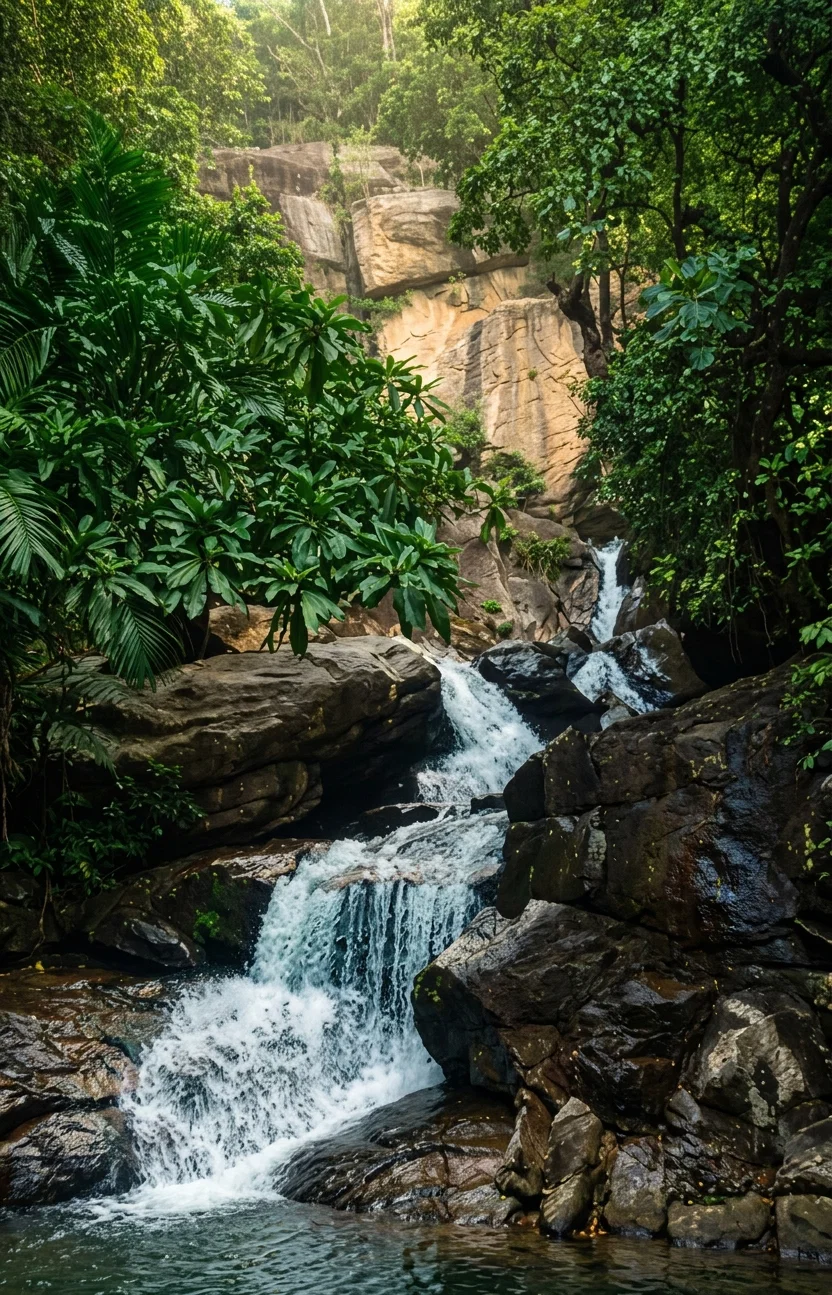
WATERFALL, FREETOWN, SIERRA LEONE
There are many reasons for this conclusion. The efforts our people have made in the past, in west Africa, proves that few from the United States or Europe can endure the climate of this coast, and the cost of transportation of laborers is high.
My prayer is that the work of training native laborers may not be retarded before the few foreign workers in the field are compelled to return on account of failing health. At the present our health is good, and we are deeply impressed that we should begin the training of workers at once.
Although we must begin in a very small way, by renting, as we have already done, we shall soon need increased facilities in the way of land in the country, and a suitable building for our work, so that expenses may be kept down and advantages gained in training workers outside of the city. The land will cost us very little, but building material is high. Pitch-pine lumber in the rough costs fifty-five dollars a thousand feet.
There are properties that can be secured, suitable for our work, out of the city. It seems to me that if we can get a place where we can begin work soon, at a reasonable cost, it will be better than to wear our lives out under a tropical sun and in such a climate as this by trying to build.
A property just outside the city has been offered by a woman who began building two years ago. She put up the walls of a large stone building, got the roof on, and for lack of means was compelled to stop. A property like this could soon be fitted up, and we could get to work. This is probably one of the unhealthiest fields in the world, and while our workers are enjoying health, no time should be lost in making proper provisions to raise the standard of truth, and at the same time preserve our present vitality.
I feared for Brother Hyatt when I first met him here. He looked as if his health was much impaired, but it has improved a great deal since we arrived, two months ago. Sister Hyatt's health is quite good. For this we are very thankful.
We greatly need the prayers of our dear people, that the health of the workers be preserved, and that the message may go with power in this dark field. In our next we will consider Gold Coast, Lagos, Northern and Southern Nigeria, and Liberia, which joins Sierra Leone on the south.
Freetown, Sierra Leone, W. A.