The New Zealand Maoris

7%

Review and Herald Publishing Association · Washington, D. C. · Nov 16, 1905

FromReview and Herald, Vol. 82, No. 46.

Read the full edition

The New Zealand Maoris

R. HARE
NEW ZEALAND was discovered in 1642, by Tasman, the Dutch navigator. It was surveyed by Captain Cook in 1769, and the first settlement of Europeans was established there in 1814. For a time the country remained a dependency of New South Wales, but in 1841 it became a separate colony.
New Zealand consists of three islands, known respectively as North Island, South Island, and Stewart’s Island. The islands lie north and south, and form a long, narrow, irregular portion of land. Its three divisions are separated by two straits, one eighteen and the other fifteen miles across. In length the islands measure over one thousand miles, while in breadth they measure about two hundred and fifty miles. The climate of the North Island is mild and warm, but in the South Island snow and ice are frequent.
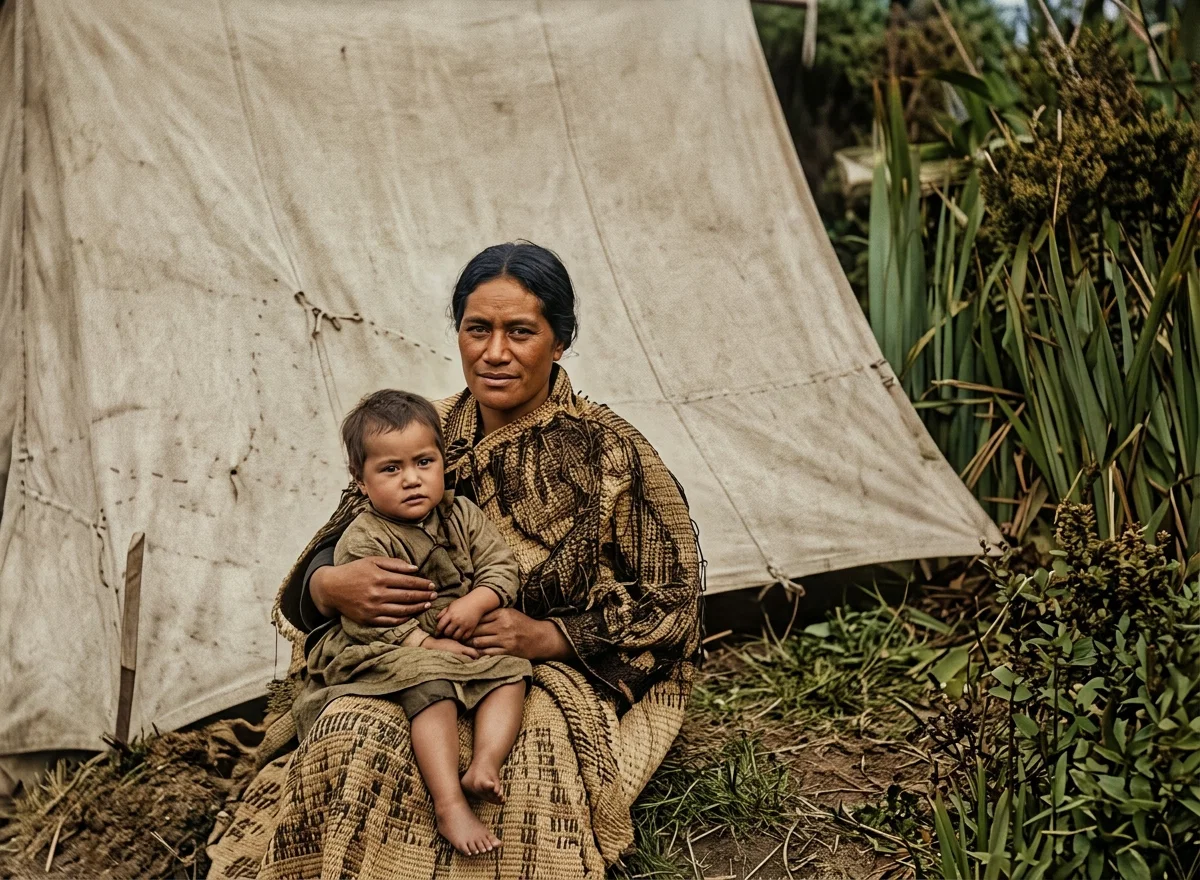
MAORI WOMAN AND CHILD
The New Zealand natives—a dark race called Maoris—are a strong, hardy people, well developed and muscular; and had it not been for the white man’s curse, they might still have remained an undiminished nation. At the time of the European settlement in 1814, the natives numbered one hundred thousand. They were then divided into eighteen nations, and these were divided into many tribes. The natives were thus almost constantly at war; for this seemed the only way they could maintain their territory, or avenge their wrongs. Nearly all the tribes were cannibals, it being customary for them to eat the men slain in battle, and also those taken as prisoners.
The Maoris are a branch of the Malayo-Polynesian family. Both their language and appearance indicate that relationship. They are of medium height, their hair is generally coarse and black, while the color of their skin ranges all the way from olive-brown to the negro blackness. A large mouth, dark-brown eyes, broad nose, and tattooed lips are striking features of the native face.
The original diet of the natives consisted of berries, fern roots, animals, birds, fish, and men, wars not infrequently being undertaken that they might secure either the living or the dead of another tribe for food. Their method of cooking was simple, but effective. A hole was made in the ground, over which a fire was built, and on top of the wood a number of large round stones were placed. As the wood burned, the stones heated, and, finally, over them some fern leaves were spread. On these leaves the food was laid, water was sprinkled to produce steam, the whole being covered by other leaves and a thickness of earth. After an hour in the primitive oven, the food would be served in small baskets of flax.
In 1814 the Church Missionary Society of England established a mission at a place called the Bay of Islands. Many of the natives were friendly, and remained loyal to the interests of the missionaries. In 1840 a treaty of peace, known as the Treaty of Waitangi—place of the crying waters—was signed by about fifty chiefs. By it the chiefs ceded to England the sovereignty of the islands of New Zealand.
But peace did not last, for in 1860 an insurrection broke out among the natives. This was due to the unjust treatment the natives received from unprincipled white men, who took away their land. This resulted in a war that lasted until 1866.
One tribe of natives, known as the Hau-Haus, inhabiting the interior of the North Island, have for many years observed the Sabbath. Their religion is a mixture of pagan forms and Christianity, but they still cling to the recognition of the seventh day.
The Maori race have decreased from one hundred thousand to their present standing of forty thousand. They are now rapidly dying. This is, no doubt, largely owing to the evils introduced by white men. About three fourths ofthe race profess Christianity. Most of them are adherents of the Catholic Church, and of late the Mormon faith has found many followers among them.
A very pathetic message was recently sent to the premier, Mr. Seddon, from the people of the Wanganui district. The message was sent as an appeal for the continuance of the village scheme. It read thus: “We are dying fast, and want you to show us how to live and work, so that we may not all go down to the grave.”
The natives of New Zealand, like the natives of all other lands, need just the light that the third angel’s message can give. This alone can show the true path to life at this time, and God has entrusted us with the heavy responsibility of giving that message to those who sit in darkness.
God’s last message must gather a people “from every nation, kindred, tongue, and people,” and among the redeemed there will be found some from among the dark sons of New Zealand. A few of them have accepted the message, but the field lies waiting, for the laborers are few. May God give his people courage and faith to carry his message to the dark places of every land.