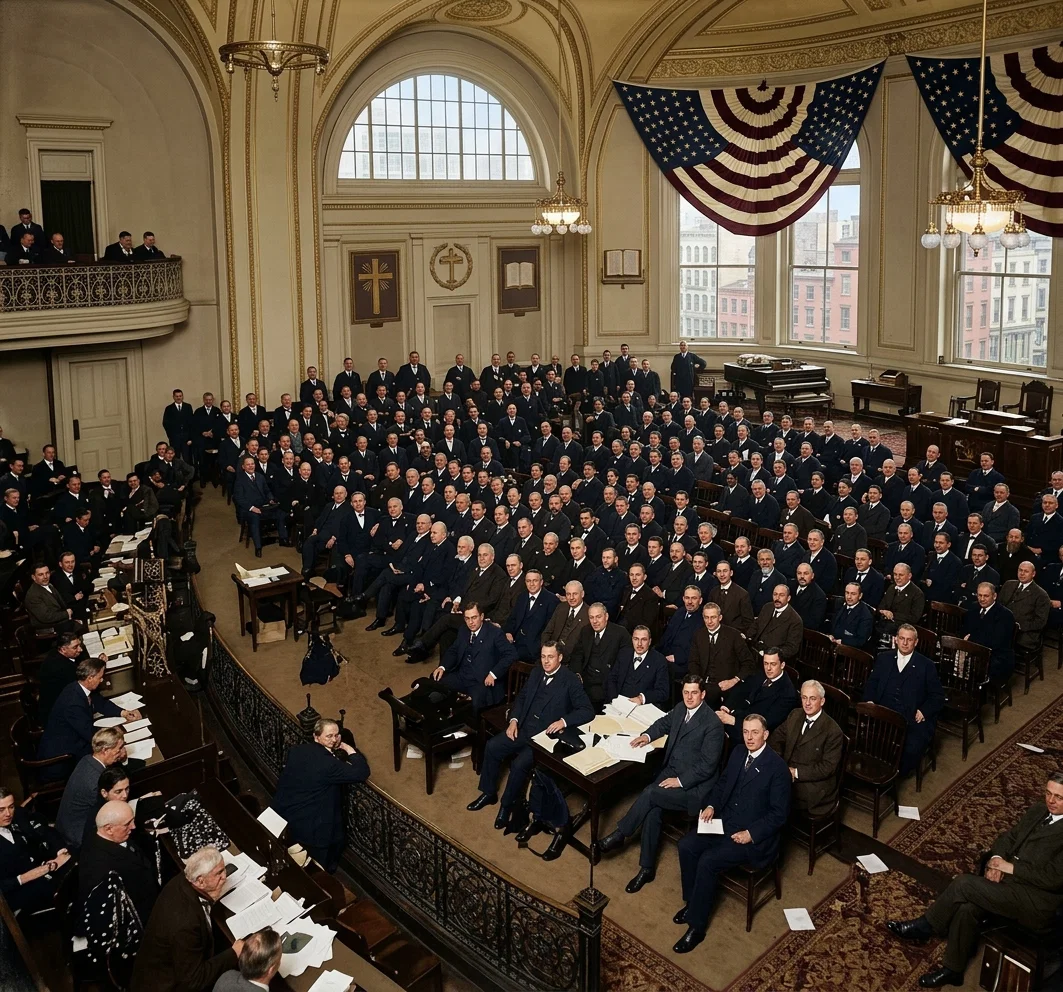
THERE has just closed in New York City probably one of the most remarkable conferences ever held in this country. If talented speakers and enthusiastic delegates could make a successful conference, surely this one was successful. That the promoters of the conference are delighted with the results is admitted on every hand, and so enthusiastic were they in achieving their ends, that they frequently burst out in the familiar hymns, “Blest be the tie which binds,” and “Praise God, from whom all blessings flow.”
The conference had its first inception in the work of local federations. This was first entered upon by certain clergymen, and laymen in New York City. The appalling needs of the great city hung like a terrible cloud over their souls, and they began to plan some way in which the city might be evangelized. First they corresponded with the clergy of the city, and laid before them the moral conditions as they appeared, with an appeal for unity, or federation, in this work of evangelization. A few of the clergy, at first, manifested a slight interest, while many looked upon the plan with distrust. From this small beginning, May 13, 1895, the movement to federate all the churches, Christians, Jews, and Catholics, has grown till it is confidently expected that by Jan. 1, 1907, the entire city of New York will be districted, and each district will be put under the general oversight of some clergyman, who will be held accountable to see that every family in his district is visited, and invited to attend some church service.
It should be observed that in this suggestion there is, on the face of it, no sign of coercion, nor anything but the great desire to help evangelize the wicked city. We can not even question the genuine sincerity of the gentlemen who are at present trying to perfect this plan, and yet we can not unite in their plan of federation.
From New York City the idea went to several neighboring States, where the plan of church federation was instituted, and a practical application of the principles was made.
The State federations proved so successful that a great national federation was planned. This plan was presented to nearly all the great religious bodies of the United States, with the request that delegates be selected by them, and that they be sent to counsel as to whether or not such a federation could be brought about. This council was called to meet in New York City, November 15-21, at Carnegie Hall, one of the largest auditoriums of the city.
To this appeal for delegates thirty-two denominations responded, and the following are now considered as members of the federation:— The Baptist Church (North), Baptist Church (South), Free Baptist Church, Negro Baptist Church, Christian Connection,7Congregational Church, Disciples of Christ, Evangelical Association, Evangelical Synod, Friends, Evangelical Lutheran Church (General Synod), Methodist Episcopal Church, Methodist Episcopal Church (South), Primitive Methodist Church, Colored Methodist Episcopal Church of America, Presbyterian Church in the U. S. A., Cumberland Presbyterian Church, Welsh Presbyterian Church, Reformed Presbyterian Church, United Presbyterian Church, Protestant Episcopal Church, Reformed Church in America, Reformed Church in the U. S. A., Reformed Episcopal Church, Seventh-day Baptist Church, United Brethren in Christ, United Evangelical Church, Methodist Protestant Church, African Methodist Episcopal Church, African Methodist Episcopal Zion Church, Mennonite Church, Moravian Church.
A most elaborate program was prepared, and interesting subjects assigned to the most distinguished clergymen and orators of this country. Among those assigned a part in the program were twenty-five bishops from the different Protestant churches; the presidents of the following-named universities and colleges: Andover Theological Seminary, Brown University, Dartmouth College, Hillsdale College, Missouri Valley College, Oberlin College, Princeton Seminary, Union Theological Seminary, Ursinus College of Theology, Washington and Jefferson College, Wesleyan University, and the Episcopal Theological College. Professors from the following-named colleges took an active part in the program: Bryn Mawr College, Cobb Divinity School, Drew Theological Seminary, Theological Seminary of the Reformed Church, University of Chicago, Wittenberg College, and Yale University; also others, seventeen of whom bear the title of “LL. D.,” forty-nine of “D. D.,” and five of “Ph. D.”
Editors of the following religious journals were also included in the program: The Cumberland Presbyterian Church, The Evangelical Messenger, The Methodist Protestant Recorder, The Christian Advocate (Methodist), The Examiner (Baptist), The Methodist Review, and The Sabbath Recorder (Seventh-day Baptist).
Besides a letter of indorsement from President Roosevelt, Justices Harlan and Brewer of the United States Supreme Court, Judge Grosscup of the United States Circuit Court, and the Lieutenant-Governor of New York gave stirring addresses.
We have given this long list of speakers that the reader may see the scope and magnitude of this movement, and the powerful influence it is bound to exert.
It will be noticed that this conference was not a legislative body. It had not the power to legislate for any one. The delegates were sent to the conference empowered simply to counsel as to the desirability and expediency of confederating. This they did, and not only decided it advisable, but actually federated together for the sole purpose of “establishing the kingdom of God on this earth.”
This, then, launches in the United States a movement more gigantic than any movement, we believe, since the great movement of the fourth century; and just as surely as that one developed into the “beast,” so this modern one will develop into the perfect “image to the beast.”
Next week we will present the reasons why this is so, and the basis of the “federation.”