HUAHINE is the fourth island in size in the Society group, and lies in the leeward division, about twenty-eight miles across from Raiatea and Tahea. Instead of being one island, it is really two, but separated by only a narrow, shallow strait, across which people can easily wade. As viewed from the sea, it appears to be all one island. While Raiatea is larger and more compact, the surface of Huahine is very irregular, divided and broken, and it has a number of very deep bays. There is not nearly so good a supply of fresh water as on Raiatea and Tahiti.
THE NATIVE VILLAGE OF MAEVA ON HUAHINE
We came to Huahine four weeks ago, and as the Lord has opened the way for us all along, in helping us to get here, in furnishing us a comfortable house to live in, and in giving us the good will of the people, we believe that he surely has a work for us to do, and we are glad that we are here. These people have more simple manners than do the natives of some of the other islands, and do not appear so proud. There is but little prejudice. We need wisdom and grace to so present the truth to them that some, at least, may see its importance and be constrained to obey.
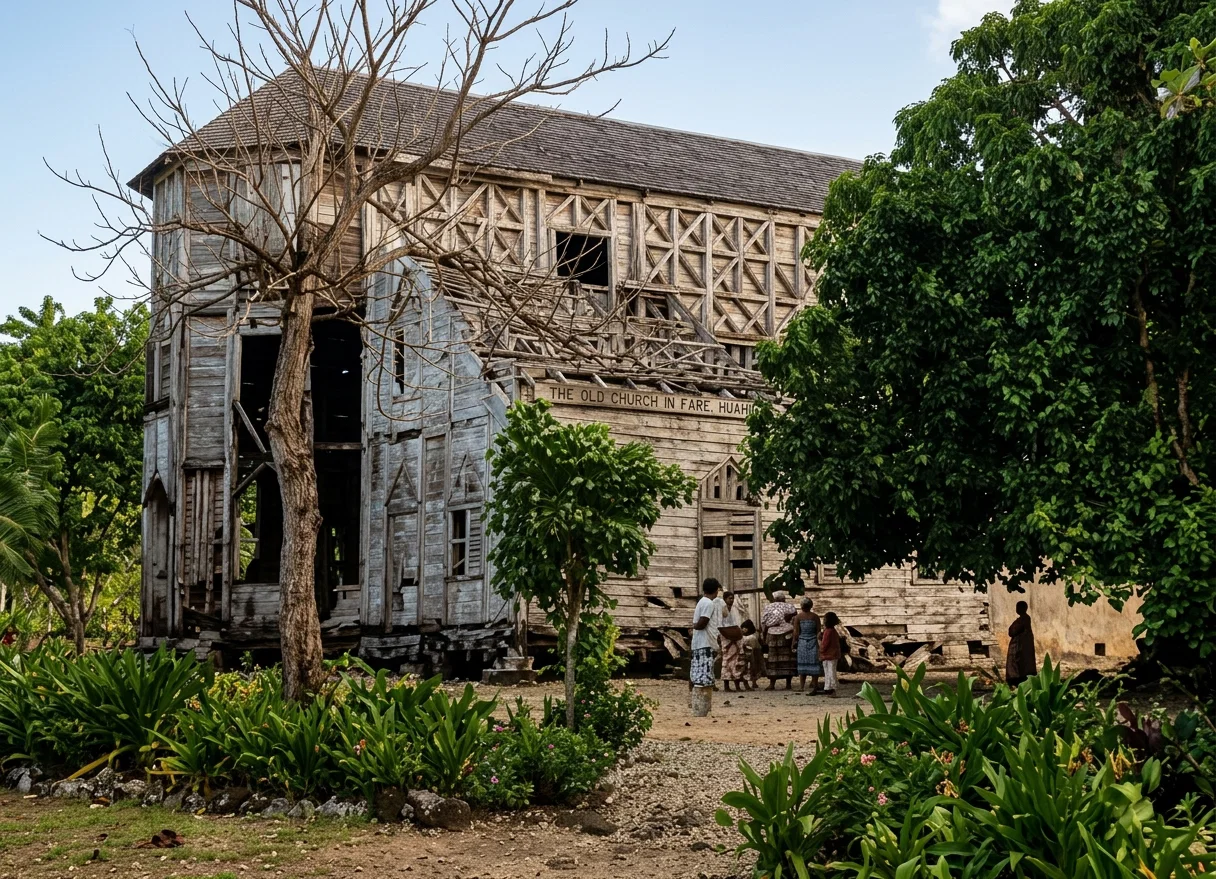
THE OLD CHURCH IN FARE
Huahine boasts of eight church buildings, erected to accommodate the people in the various districts, not the different denominations, for as yet there is but one religion here strong enough to have a church. The natives know nothing of the Presbyterian, Episcopalian, and Congregational creeds.
In these islands, no difference is made between these religions; they are only designated as Protestant. The present leaders of this people are missionaries of a society in France, and they call their church the Protestant, to distinguish it from the Catholic, which religion was early introduced into Tahiti by the French. The church in this town of Fare, which is the principal settlement, is shown in an accompanying picture. It is large, and was once a fine building, but is now in an advanced state of decay. Though the thatched roof has decayed and fallen in in many places, leaving the rafters bare, and letting the sunshine and rain in, they still use it for their meetings, and have no other building for that purpose.
There are two ministers, one for each division of the island, with many deacons to assist them. We have had some interesting visits with the minister in Fare. It has been only a few months since he came from their ministerial school in Tahiti, where he has spent four years. He has treated us very kindly, and, like his people, he thinks our religion is the same as theirs, the Sabbath being about the only difference. We invited him to come and study with us the points of religion upon which we differ, so he appointed a certain evening at seven o'clock. As he wished to be able to discuss these matters unmolested, and so did not want a crowd of curious spectators, we sent many away that evening while waiting for him to come. We waited till after nine o'clock, and thinking he would not come, retired. Soon after, I was awakened by a rapping on the door, and upon opening it, found the minister and his wife, and two of their relatives. He had come at this late hour to fill his appointment. We talked with him until after midnight, showing to him from the Bible that we are living in the last days of this world's history, and also that Saturday is the Sabbath of the Lord, and the day he would have us observe. In a mild way, he took the position that we were wrong, but all he could say in regard to this not being the time of the end was to ask repeatedly, “Where is a text that says that this is the time of the end?” We told him that the Lord does not name the year, but only gives many signs by which we may know that we are near the end, and we read him scripture after scripture describing conditions which now exist on the earth, and which the Lord plainly stated would be in the last days. He also took the stand that Sunday is the seventh day. The Tahitian name given by the early missionaries to Sunday means Sabbath, and they have no other name for the day. According to the names given at the same time to the other days, Thursday is the fourth day, Friday the fifth day, and Saturday the preparation day. So this man claimed to believe that Sunday was the real seventh day, although the leader of his church, in a book he has edited in the native tongue, calls Sunday the first day, and says they keep it because Christ was raised on that day. We hope to have more talks with this minister.
The native people have very little order and system. They can lie down and sleep anywhere and at any time, neither do they have regular times for eating. We have company at all hours of the day, and sometimes they come before we get out of bed in the morning. Our most frequent visitors are the children. There is no school for them just now. In fact, they have only a few weeks of schooling during the year. And as they have no training at home, they are left to grow up as they may. We often feel impressed with the thought that they are indeed as sheep without a shepherd, and our hearts go out in love and pity for them.
We are trying to sow the seeds of truth at every opportunity, for we know not where it might find a lodgment in good soil and grow and bear fruit. It seems as if there must be some honest hearts on Huahine, and we purpose to do our part of the work, trusting that God will give the increase.