For the first time in our experience as a people we have been able to hold our general meeting in St. Petersburg, the capital of the great Russian empire. The question had come up as to whether we should assemble in our usual place of worship (the spacious dwelling of Brother O. Wildgrube, on the third floor), or whether we should attempt to secure a public hall in the city. One of our brethren had asked a Russian general who owns a large assembly hall in St. Petersburg, about the matter, and this gentleman offered us his hall (which would seat about four hundred persons), free of rent, we being requested to pay only for the lighting and other service; but before we could accept this, we must secure the mayor’s permission to hold our meetings. Fearing that any demand upon him might hinder our coming together, we thought it best to be content with our old quarters. St. Petersburg was at the time under the dictatorship of General Trepoff, who had divided all Russia into special districts of dictatorship, had sent many thousands to prison through the “administrative process,” and for ten months had tried to suppress the freedom of the press. On the thirty-first of October the chief editors of St. Petersburg asked Mr. Witte to depose the dictator, and on the tenth of November he retired, and was then placed in military command of the palace.
This general meeting was for the North Russian Mission, which thus far has included the Baltic provinces, and Poland and Volhynia, with a population of twenty million. In the dwelling where we met there were three rooms opening into one another, one rather small. Our attendance during the day was about one hundred, and at night as many as one hundred and forty were present. The capacity of the house was crowded to its utmost. Delegates from most of the twenty-five churches and companies were able to be there, among whom were two Russians from churches in the government of Kief. By far the larger number of brethren are German-speaking, and live in Volhynia; but there are now also quite a number of our members who speak the Estonian or the Lettonian, and the work is just opening among the Poles and Jews. Under the circumstances, there had to be three translations: in one room from the German into the Russian, in another13into the Lettonian, and in a third into the Esthonian. In spite of this difficulty, the Spirit of God united our hearts, for, although the power of the word was somewhat lost through so many interpreters, yet we could see that God was present to add his blessing to the proclamation of the message. We freely sang and spoke, as the house is situated on a large open court, and does not face the noisy street. About forty families have windows opening onto that court, and there were many people going in and out who knew what was going on; but no one troubled us. In fact, the local police knew of the meeting. There were quite a number from the so-called better classes of society with us. I had a good conversation with a secretary of a legation, and his wife, as well as with a business man who owned a factory, and secured “Steps to Christ” in Russian for his employees.
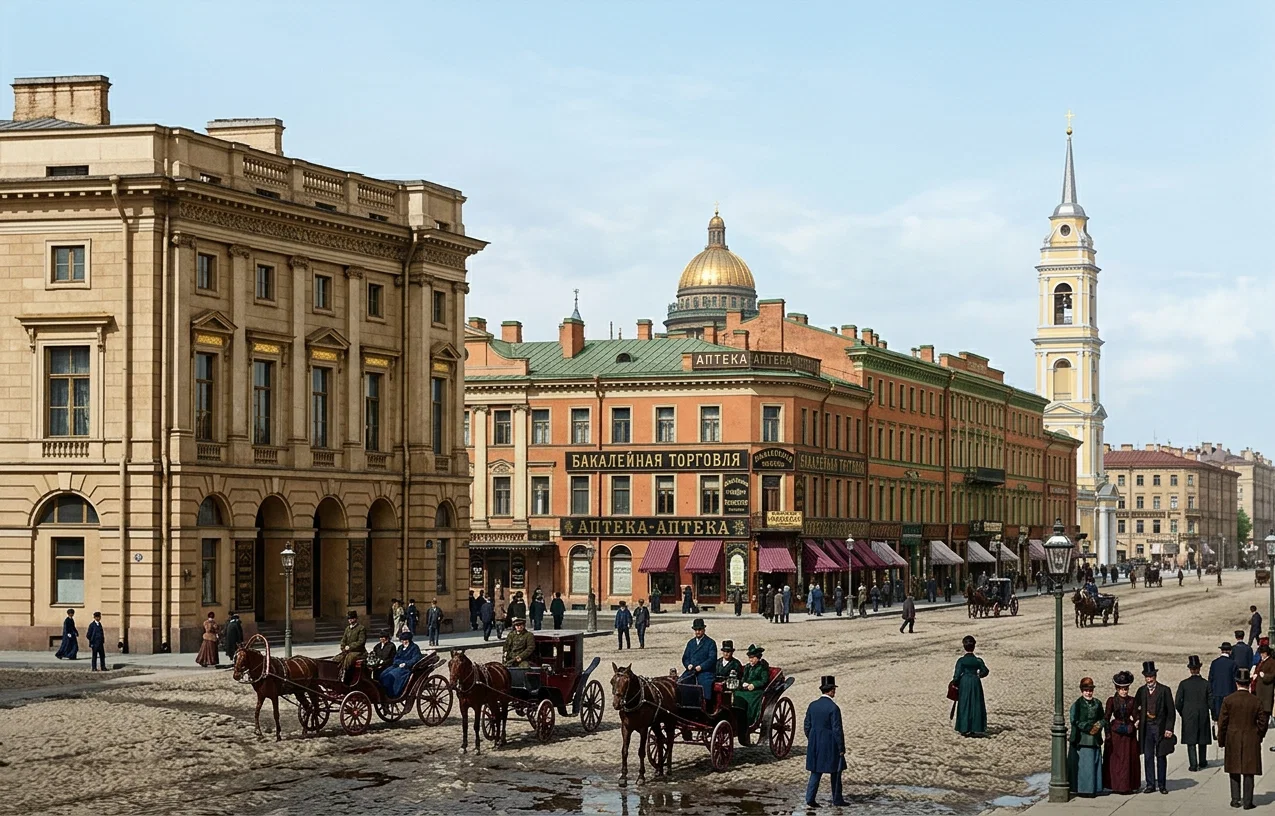
MAIN STREET, ST. PETERSBURG
In the resolutions passed, our brethren expressed their gratitude to the czar for the liberties granted them.
According to the new division, which takes effect Jan. 1, 1906, the city and the government of St. Petersburg will hereafter belong to the Middle Russian Mission instead of to the North Russian field. There is a German church in St. Petersburg, numbering about fifty, and a Russian church of about twenty members. The brethren in the capital city will prove a great strength to the work of the Middle Russian Mission, whose members will be mainly among the native Russians.
Considerable stress was laid upon the importance of faithful tithe paying, that this field, which contains already five hundred and twenty-eight members, might soon develop into a self-supporting conference. Brother D. P. Gaede was again unanimously accepted, in harmony with the suggestions of the union committee, as director for the coming year. Their laboring force for the immediate future will be two ordained ministers, three licentiates, one Bible worker, one nurse, and five colporteurs. We were glad to meet one of our Friedensau nurses at this meeting; she reported favorably of the work she has been able to do.
We hope for much greater prosperity in our canvassing work, now that we are getting more literature in the various languages. “Steps to Christ” has lately been translated into the Russian, the Esthonian, and the Lettonian. We are now getting out “His Glorious Appearing” in the Russian, and also publishing a number of tracts in that language.
During the four days of the meeting, I went down-stairs only once, when I was invited out to dinner. But the German Union secretary, who came here from Hamburg, saw a number of students parading with red flags through the streets of the city, the Cossacks watching from a distance that there might be no excesses. Everything seemed quiet, it was a lull before the fury of the oncoming storm.
Sabbath and Sunday we had most excellent meetings. Twenty stood up for prayer; several of these will soon unite with us. Sunday, as I spoke about our First-day offering system, and the mission work in German East Africa to which these donations are dedicated, much interest was awakened, and the collection for that mission amounted to about twenty dollars.
Brother Schankow will continue to labor as Bible worker in the city, which has about 1,440,000 inhabitants; but as there are about 120,000 Germans in St. Petersburg and its vicinity, we surely ought to supplement the Russian laborer by sending thither a good German city worker. Several German farmers from surrounding German colonies were also at the meeting, having lately embraced the truth. These colonies were settled by Germans in the time of Kathrine II, nearly two hundred years ago. This makes it all the more important that we have another German worker in this neighborhood soon, to continue the interest already awakened, as Elder Wildgrube, who had formerly been able to act in this capacity, now has charge of the great native Russian work, with about sixty millions of people in his territory.
Everybody praised the Lord for his wonderful care over us, and the great blessings we had all enjoyed during this, our first general meeting in the capital city of Russia.