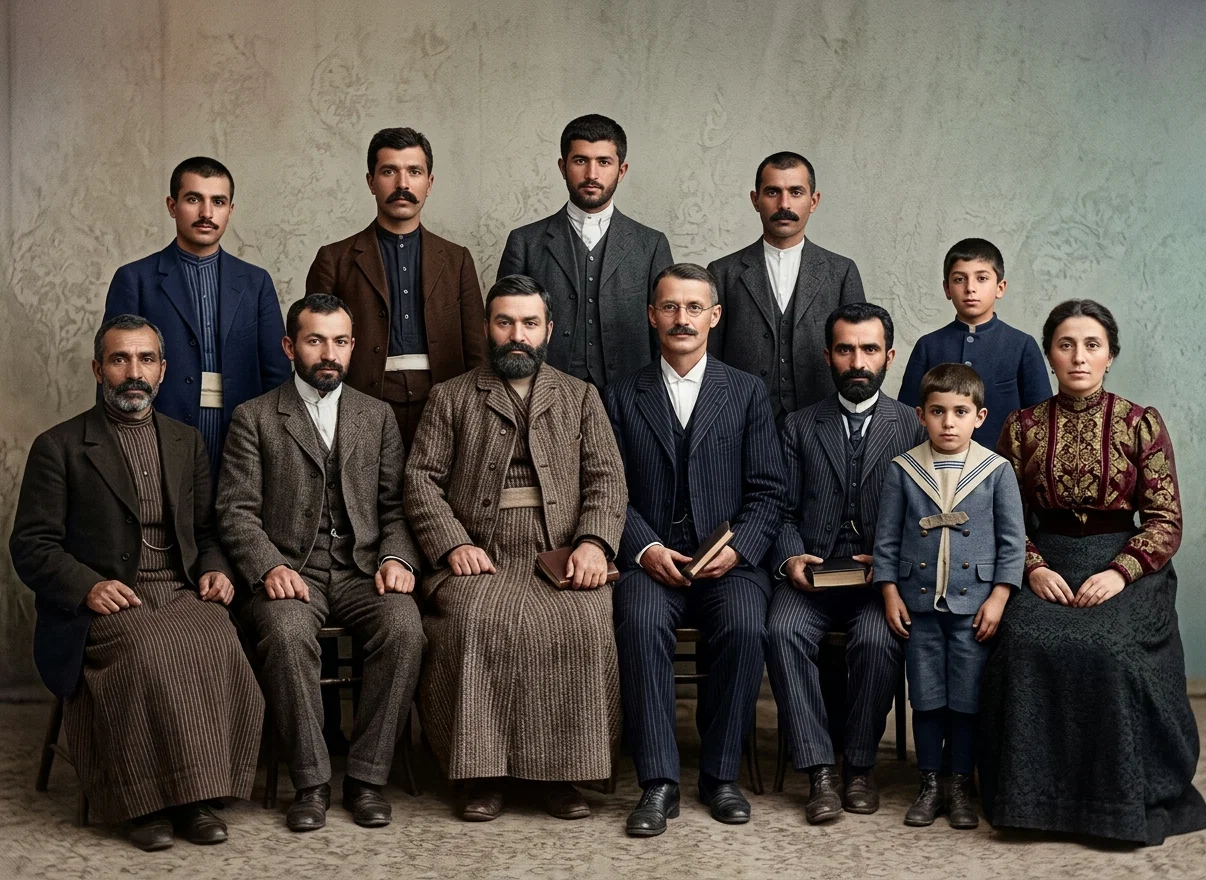
Knowing that many of the readers of the REVIEW are watching with intense interest the movements of the message in the Oriental mission field, I take pleasure in submitting the following report of my visit to the dominions of the sublime porte. And as quite a number of secretaries have asked me to write a letter to their missionary societies, I beg leave to suggest that each regard this as a personal missionary letter to his society.
ARMENIAN WORKERS. ELDER W. H. WAKEHAM IN THE CENTER. BROTHER Z. G. BAHARIAN AND FAMILY AT THE RIGHT
For some time I had been planning a visit to our Armenian workers in Turkey, but found no opportunity until after my return from the General Conference. Conditions seeming favorable for such a trip, in October I boarded the French steamer “Niger,” at Port Said, Egypt, and sailed for Beirut, Syria, a short voyage of about eighteen hours.
At this place we were detained twenty-four hours in quarantine, and considered ourselves fortunate that it was not a much longer period, as sometimes it is from seven to fourteen days. During the summer months, all boats from Egypt are subject to quarantine regulations before entering any Turkish port. Most of the time this precaution is useless, and it puts a serious embargo on general traffic. We were landed by the steamer’s boats, and taken into quarantine quarters, which, while very plain and primitive, were clean and airy. The people who look after these quarters, however, are not in the business for their health.
One has his choice of sleeping out of doors on the ground, or paying eighty cents for a bed in a very poorly furnished room, with several other persons. If he wishes food, he must pay an equally modest sum. The exorbitance of this will appear when the reader is informed that after our release we secured excellent accommodations at the Hotel Victoria—large, airy, well-furnished rooms, including full board—for one dollar a day. This was vastly different from the expense of living in Egypt.
Having to wait in Beirut two days for another boat, I hunted up Brother and Sister Haussmann, a German family, and the only Sabbath-keepers living in the city. Here also I found our Syrian worker, Brother Elias Zarub, who had come in from his village, about two days distant, to meet me. These brethren seemed of good courage, and we had a profitable season of prayer and Bible study together. While here, we laid plans to spend some time, after my return from Asia Minor, visiting some scattered brethren in Syria.
Leaving Beirut October 10, we started on our journey. But as our boat was a cargo boat, it not only traveled slowly, but went in a very roundabout way, and called at various ports, stopping from twelve to eighteen hours at each place. Our first stop was at Larnaca, one of the chief ports on the island of Cyprus. I called to mind the experience of Paul on this island with the deputy of the country, also with the sorcerer, Bar-jesus. See Acts 13:4-12. The third angel’s message has also reached this island. Two Sabbath-keepers, Armenians, live here, the result, in part at least, of Brother Baharian’s efforts some years ago. One of these has been baptized, and the other has been waiting for some time for some one to administer to him the sacred rite. Some time soon I hope to visit this island with an interpreter, Turkish and Greek being the languages spoken, and develop the work there.
Our boat next stopped at Mersina, near the city of Tarsus, the birthplace of Paul. And finally, on Friday evening, October 13, I landed at Alexandretta, the chief port in this part of the country. On landing, my baggage underwent a most thorough overhauling. Every bundle and package, every book and tract, was carefully examined, and I was made to realize that I was under the government symbolized by the star and the crescent. Fortunately, I had no contraband articles nor compromising literature, having been forewarned. So I could preserve a serene, and even smiling, countenance while my goods were being literally ransacked, and questions were being asked that in America would be considered impertinent. It came to an end at last, and I was “passed.”
At this place I found one family of Sabbath-keepers, the father of whom had been in the truth about eight years. His son, Brother Enoch Ayvazian, one of our workers who was imprisoned with Brother Baharian, met me at the boat landing, and found for me a lodging-place in a hotel. I remained here over the Sabbath, and held services with this family in their humble home, though I could do but little in the way of instructing, except to point out passages of Scripture and let them read in their own language. Brother Enoch knows but little English, and my knowledge of Turkish is nil. However, we managed to get along very well, and they were encouraged. They do not often see a minister, or others of like faith.
Before leaving Alexandretta, I called on the American consular agent, and was very cordially received. I learned from him some of the “ups and downs” of missionary work in Turkey. He told me that I was free to go where I wished, and preach any doctrine, without fear of personal injury, but that Turkish subjects might be fined and imprisoned for listening to me, thus effectually hindering any missionary effort of that character. He related an incident where this method had been pursued, and more than twenty persons put in jail for the crime of listening to a missionary.
On account of heavy rains, we did not start from this place until Monday, when, having secured a comfortable closed carriage drawn by four small horses, we set out for Aintab, a four-days’ journey, accompanied by Brother Enoch, as our guide and interpreter. In another carriage bound for the same place were three Mormon missionaries,13two of them recently from Utah. Though mere boys—the leader being but twenty-one—they called each other “Elder,” and had thoroughly learned their “testimony,” and recited it well. We had many conversations on the way, and hope that seeds of truth were sown in their hearts. The leader is a bright, genial youth, who has made good progress in the Turkish language for the short period—two years—he has been here. But from infancy his mind has been so molded by the narrow theology of Mormonism, that it seems difficult for him to understand that there is any truth outside of the Mormon church. They supposed that none but Mormons taught that the gospel was preached to Adam, and he seemed much surprised when I stated that it was, and wished to know where and how I had learned that truth. One of them finally admitted that I had many truths.
These young men leave their homes, come to this far-away land, brave dangers, suffer privations, struggle with a difficult language, with no salary, their actual expenses only being paid, for the purpose of propagating a stupendous system of error. And these are but samples of hundreds of their missionaries in various parts of the world. Where are the young men, hundreds of whom have been educated in Seventh-day Adventist schools, who will do as much for the glorious truths of the third angel’s message? Some of them are in the field, doing splendid service; but hundreds more are needed. Who of my readers have given themselves to God for service in these most needy and most difficult fields? May the Lord of the harvest send out consecrated workers to every part of the world.
Arriving at Aintab, we were given a most hearty welcome—men, women, and children coming to meet us on the run, as our carriage rolled into the city. We were taken to the home of Brother Baharian, where we found comfortable quarters, and a few faithful souls whose hearts God has touched. Here are men who have endured for years the most bitter persecution—men who have spent long, weary months behind prison bars, separated from all dear to them on earth—all for the truth—and who yet are as free from complaints, as full of zeal and courage and determination in the Lord’s work, as any I have seen anywhere in the most favored countries. And though they look up to me as their instructor, I feel that I can learn many things from them.
Assembled here at Brother Baharian’s house are four of our Armenian workers, besides Brother and Sister Baharian. These, with two or three other Sabbath-keepers, who attend more or less irregularly, constitute the members of the Armenian Workers’ Bible Institute, the first of its kind ever held in this part of the country. Our daily program is as follows:—
Rising ........................ 6:00 A. M.
Devotional exercises .......... 7:00 A. M.
Breakfast ...................... 7:30 A. M.
Bible study .................... 8:30 A. M.
Health lesson ................. 10:30 A. M.
English ....................... 12:30 P. M.
Dinner ........................ 2:00 P. M.
Visiting and study hours 3 to 7:00 P. M.
Bible study .................... 7:00 P. M.
Occasional inquiry meetings are held at the close of the Bible study. This gives our workers opportunity to do personal work with those who may be interested in the truth.
The outside attendance at the evening meetings and the Sunday services ranges from twelve to thirty; and the services at these times are adapted to meet the needs of those who may attend. The Lord is blessing us greatly in this school, and we believe the workers will go from here greatly strengthened for the conflicts of life.
It is very difficult for one who has not been here to appreciate the difficulties under which our brethren are laboring in this country. Seventh-day Adventists are practically outlaws in Turkey. They have no legal standing. They can not marry, can not be born, can not even die and be buried legally. They can not travel from one village to another without liability to arrest and imprisonment. They can not hold any public meetings. They can not get permission to do any of these things, because the head of the so-called “Protestant Nation” in Turkey refuses to recognize them as Protestants. They are continually at the mercy of their enemies. Our meetings here are liable to be closed at any time, and every one in attendance to be arrested and imprisoned. This, of course, does not apply to the writer, as citizens of other nations are exempt from such restrictions. Since our meetings here began, Brother Enoch has been arrested, because he had no passport, and he was released only on the guarantee of one of the business men of the city that he would come before the officials whenever he was called. But notwithstanding these difficulties, the everlasting gospel is again being preached on the old battleground of sin where Paul and Silas suffered and died; and the laws were worse then than they are now. Nothing can hinder God’s work.
On the second Sabbath of our meetings, the rite of Christian baptism was administered to a brother who had come all the way from Iconium, about twelve days’ journey by wagon, and in the afternoon we had a blessed communion service together. This brother has been keeping the Sabbath for five years, and had never before seen an Adventist minister. He reports five other Sabbath-keepers in his village, who desire baptism. These are largely the fruits of his efforts. Thus the truth is finding its way to the honest-hearted, even in this land of great difficulties.
On Sabbath, December 9, the Lord came especially near, as we tried to present the exalted calling of the gospel worker. In the evening Brother Alexander Buzugherian was ordained to the work of the ministry, and the manifest presence of the Holy Spirit confirmed the action of the church. May God bless the workers as they go forth from this institute, and make them mighty, through him, in pulling down strong-holds of sin.
It will be of interest to our readers to know that Aintab is but a short distance from the Euphrates River. A little further to the east and south is Haran, where Abraham stopped on his way to Canaan.