Malaysia

5%

Review and Herald Publishing Association · Washington, D.C. · Dec 22, 1904

FromReview and Herald, Vol. 81, No. 51.

Read the full edition

Malaysia

R. W. MUNSON
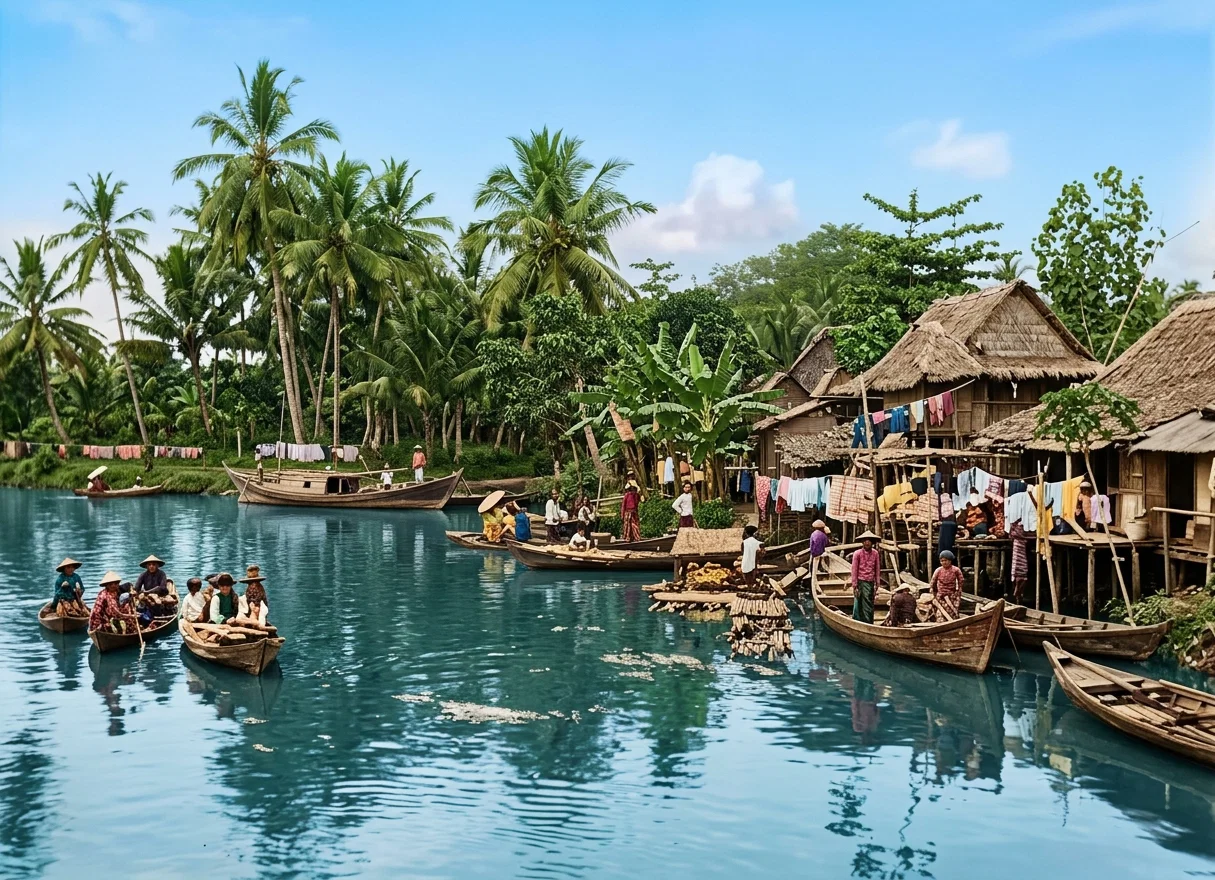
When we come to the flora of this region, human speech ceases to be adequate to the task of telling the wonders that abound here. God has lavished upon the vegetation of Malaysia the most varied and delicate shades of green, the like of which can be found nowhere except in the seas that enclose these islands. The brightest colors of the rainbow are employed to paint the giant flowers of the jungle or the blossoms of the forest trees.
A RIVER SCENE IN JAVA
The density of foliage, the infinite variety of forms, the contrasts presented, the delicacy of foliage, all submerge the newcomer especially, in overwhelming waves of delight. He involuntarily exclaims, if not too sordid or prosaic, “This must have been the site of the garden of Eden.”
The cocoanut palm is the most conspicuous of all the larger plant life of the Indies. It is both fruitful and abundant. There is a dignity and royal bearing about this tree that never fails to impress the stranger, and that ever grows upon the man who comes to stay. It is stately, it is beautiful, it is graceful, and it is eminently useful. I have spent many years in the tropics, yet my love for the palm increases with the years. I can never be happy away from it. Its fascination constitutes one of the important elements of the charm which this land has for me. If it please God, I shall never leave this land where it flourishes, or remain long away from it. If the Lord tarry so long, I hope to be buried beneath its shade. If I live until the Lord comes, I hope to gaze upward through its green fronds, and see my Saviour coming in the skies.
Do not imagine that all this is mere fancy or false sentiment. God pity the missionary who does not feel just this affection for the land to which the Lord has called him, and not for the land only, but for the inhabitants. To the man truly called and sent of God, there is a true love for the people of the country, their language, their faces, and their dress: this is necessary to his happiness. I see the love and wisdom of the Creator here in the luxuriant and sunny tropics as I never saw them in the more barren fields and forms of my native land. God evidently designed me for this land of perpetual sunshine, of gentle seasons, and mild-mannered people. Not a day passes that I do not feel welling up in my heart the profoundest gratitude to God for his great love in calling me to this work and this ‘garden of the gods,’ to devote my life to the work of telling these poor enslaved victims of Satan, of Jesus and his love.
I feel a kind of disgust whenever I read, as now and then I do, expressions of sympathy for missionaries for having exiled themselves ‘from home and friends and all that life holds most dear,’ in order to come to these benighted lands of the Orient. Of course, we love our kindred and country, and it cost us a struggle to decide to leave them, but the joy we felt and still feel in relinquishing what the world ordinarily prizes in order to do the Father’s will, the sweetest thing in heaven or earth, is a thousandfold greater than the joy of seeing our friends or enjoying the conveniences or comforts of life in a country like England or America.
I would to God that I could impress upon the minds of all God’s dear children that where God is, there is paradise, no matter if it be on the burning sands of Arabia or the frozen icebergs of Greenland. Circumstances can not make a man happy. Only those who gladly renounce self and all its ambitions, and sink their own will in the will of God, are truly happy. But happiness, after all, is not what we are after. We can not always be happy, and it does not signify very much whether we are or not. To be right with God and in harmony with his will for us is the great question. How I bless God that we have found this secret of true happiness! It lies in seeking the happiness and welfare of others rather than our own. When a man becomes supremely reckless about his ‘own interests,’ and literally gives himself away for Christ’s sake, then it is that he finds the true joy of living.
But I have wandered from my theme, because I could not resist the temptation to give vent to my feelings concerning the beauty and charm of this country and this work. There are many trials and discouragements, but we thank God for grace to endure the one and overcome the other. In the midst of our sorest difficulties we have had the sense of God’s presence, and have been able to rejoice in the Lord, and to go on our way without losing heart or courage.
One of the most interesting and gratifying features of life in this land is the abundant supply of wholesome and nutritious as well as palatable food available. In some respects it is a paradise for vegetarians; for we have a good variety of excellent foods that are cheap enough to render it possible to live quite economically upon little else than native products. The fruits are very nice, there being in every season of the year some fruit that is plentiful and cheap; and there are bananas the year round, besides pineapples a good part of the year.
The mainstay of the population is rice, that incomparable cereal, so cheap in price that a family can be fed on it for a few shillings a month, so nourishing that little else is needed, so easily digested that dyspepsia is almost unknown. There are many kinds of rice. There is the cooking rice, for the mainstay of the meal, and there is another highly gelatinous kind that is used chiefly in making the puddings or pastries of which the natives are so fond.
The cocoanut enters very largely into the diet of both Malays and foreigners. There are a dozen varieties of bananas, also the pineapple, jack-fruit, papaya, mangosteen, ramutan or ‘hair-fruit,’ sour orange, sweet orange, lime, custard apple, alligator pear, and the notorious as well as famous durian.
I can not pass the durian without something more than a word of description; for it is far famed as the fruitwhich is delicious to the sense of taste, but intolerable to that of smell. It is a tall, elm-like tree, and bears a fruit varying in size from a small muskmelon to a six-quart pail. It is rather oblong, and covered with strong spikes, or thorns, thickly spread over its surface. These thorns, from which the fruit takes its name, are broad at the base, but sharp at the extremity, and make them uncomfortable things to handle except by the stem. The interior is always divided into five pod-like pockets similar to the interior of a pea pod. These pods are of a rich satiny white, and are each filled with an oval-shaped seed covered with a thick cream-like pulp. This pulp is the part of the fruit that is eaten, and constitutes only about twenty per cent of the entire mass.
Wallace describes this pulp as follows: “A rich, butter-like custard, highly flavored with almonds, gives the general idea of it; but intermingled with it come wafts of other flavors that call to mind cream cheese, onion sauce, brown sherry, and other incongruities. There is a rich glutinous smoothness in the pulp which nothing else possesses, but which adds to the delicacy. It is neither acid, sweet, nor juicy, yet one feels the want of none of these qualities; for it is perfect as it is. It produces no nausea or other bad effects, and the more you eat of it, the less inclined you feel to stop. Indeed, to eat durian is a new sensation worth a voyage to the East to experience.”
I care little for it, although I like its taste, because it is too difficult of digestion. The most remarkable thing about it is its pervasive, and to newcomers, offensive odor. Mark Twain said that eating durian was “like eating Limburger cheese over a London sewer.”
Besides the foods and fruits already mentioned, we have potatoes, both the Irish and sweet; flour from California and Europe; canned biscuits; California fruits, both dried and canned; and a great variety of canned vegetables. Ground, or monkey, nuts are plentiful, and quite as cheap as at home. White beans are abundant, and form a very important part of our diet. Sugar is cheap, and is a dark kind made from a species of palm that closely resembles in flavor the maple sugar so popular in the States.
So you see we do not go hungry or lack the comforts of life in these ends of the earth.
(To be concluded)