The Situation in Korea

7%

Review and Herald Publishing Association · Washington, D. C. · Dec 29, 1904

FromReview and Herald, Vol. 81, No. 52.

Read the full edition

The Situation in Korea

F. W. FIELD
My previous report from Korea was written the day after I arrived at Chinampo. The next day we started to make the tour of the places where the truth had been presented. Brethren Lim Ki Pan and Kang Chang O accompanied us, as they had been with Brother Kuniya from the first. We remained over Sabbath at the village of Sondol, and organized a church of thirty-two members. Of these, eighteen had already received baptism, seven were baptized at the time, and the remaining seven were received subject to baptism. The organization was completed by the selection of a full complement of officers. Brother Lim Ki Pan was chosen as one of the elders.
The believers at Sondol were formerly members of the M. E. Church; but when present truth was brought to their village, nearly the whole church accepted the light, and began the observance of the true Sabbath. A few rejected the light; and the American missionary in charge declined to allow the Sabbath-keepers to use the little chapel for their meetings, although they had furnished about nine tenths of the means with which to build it. So our members peaceably relinquished all claim upon the church building. Then they selected a building committee, and started a building fund. We regarded it as a privilege to aid them in this effort; for, although the estimated cost was only seventy-five dollars gold, or one hundred and fifty Japanese yen, equal to three hundred Korean on, yet this amount in the depreciated currency of Korea would doubtless mean as much to these people in their poverty as three hundred dollars would to people in America. The little native chapels arebuilt much like their houses, with plain earth floor, mud walls, and thatch roof. In the little church at Sondol, a white curtain divides the room into two unequal parts; the larger, for the men, contains the pulpit, and the smaller is occupied by the women.
From Sondol we went to Kangdemuro, a small village on the Tadong River, about fifteen miles from Chinampo. Here we met with the believers, and the next day went up the river to Pyeng Yang, the former capital. We saw many interesting sights in this ancient city; also observed the dwellings, churches, schools, and hospitals belonging to the missions that have work centered there. We were informed that the native believers in Pyeng Yang number over four thousand. Our brethren met with a number of their friends, and presented the truth to them. Some opposed, but several became deeply interested.
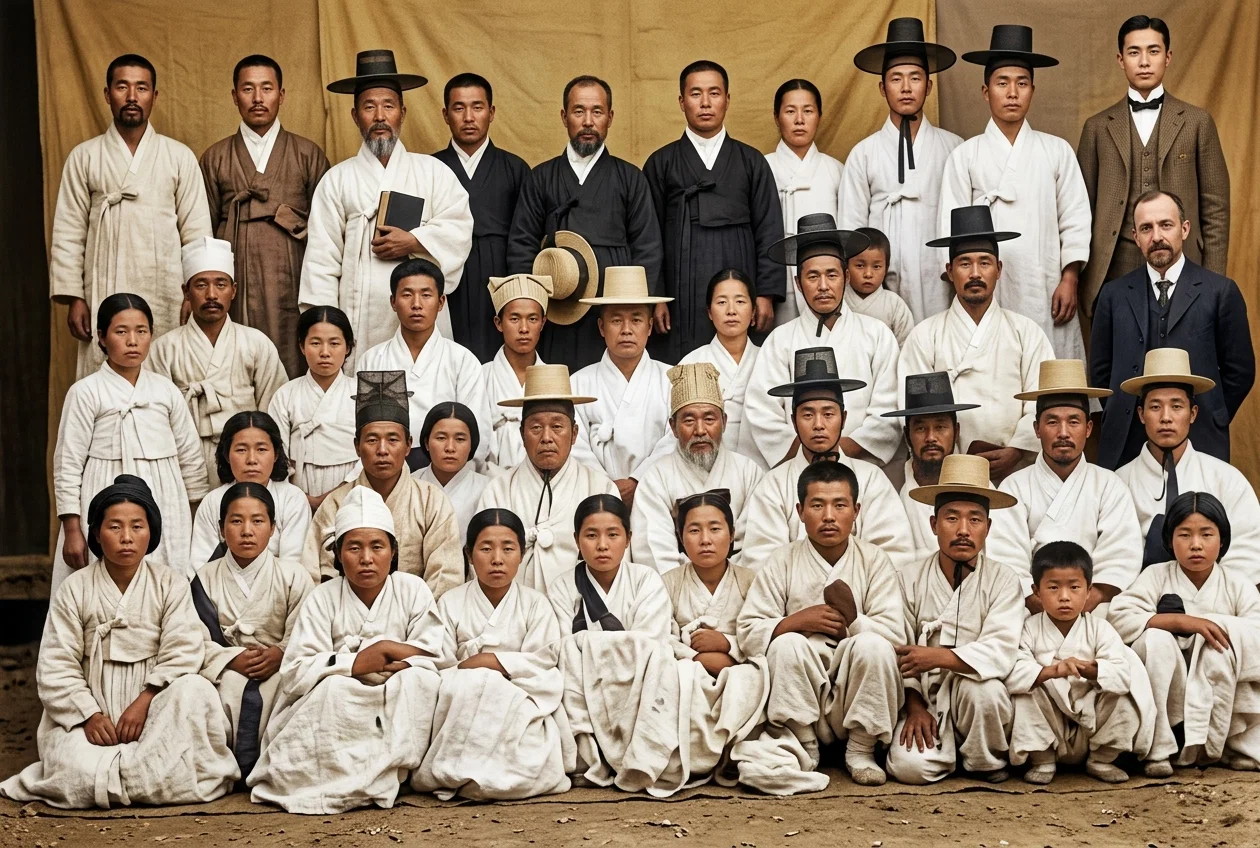
A GROUP OF KOREAN BELIEVERS
We remained at Pyeng Yang but one full day, and then returned to Kangdemuro. While here, we organized the little company of believers at this place. Two were baptized, and one other was received subject to baptism. This little church of twelve members chose an elder, a clerk, and a treasurer. The names of twelve others who have begun to observe the Sabbath were considered; but as all these live at some distance, no action was taken till their standing can be better known.
From Kangdemuro we returned toward Chinampo, and stayed over Sabbath at Rondon, which is not far from Sondol. At Rondon we organized a church of fourteen members, with one subject to baptism. Three others have begun to observe the Sabbath, and may be received later, when they have learned the truth more perfectly. A full complement of officers was chosen, a church building committee selected, and a fund started. Rondon is considerably larger than the other villages mentioned, and is a promising field of labor.
From Rondon we returned to Chinampo, where we had appointed a general meeting for Tuesday, September 27. We planned to celebrate the ordinances, to give further instruction, and to lay plans for the future of the work. Representatives were present from each of the three churches, also a number who had not yet been included in any organization. At 4 P. M. we held an ordinance meeting, at which over twenty were present. Our communion table was a foot square and five inches high. We made the wine from grapes brought all the way from Pyeng Yang. At the evening meeting over thirty were present.
We laid before them our plans for the work, all of which received their hearty approval. Brother Lim Ki Pan was left in charge of the work, the Japan Mission being responsible for his support until some other provision can be made. Brother Kang Chang O was chosen to act as a general treasurer, that the tithe from the churches may be brought together. He will also act as general secretary or clerk, and keep us informed concerning the progress of the work.
Next morning we held another ordinance meeting for the sake of the Sondol brethren who had been detained the day before. Then all assembled in front of the house where we were staying, and the picture accompanying this report was taken.
Among those who attended this general meeting were two men from the village of Pamegi, near Kangdemuro, but on the opposite side of the Tadong River. They brought word that the entire company of Christians in their village or vicinity; numbering over thirty persons, had learned about the true Sabbath and kindred truths; and then they put in an urgent request that we visit their village, instruct the people, and organize a church. We learned that these people had received their first knowledge of the truth from the believers at Kangdemuro, and from a young man living near, who had heard the truth near Chinampo. Thus the truth spreads.
Our boat was to leave Friday, and it was now Wednesday; but we decided to go. We started about noon, and it was after dark when we reached the village after a tramp of about fifteen miles. We held an inquiry meeting that evening in the little church, and it was midnight when the last had departed, and we lay down to rest. Very early next morning the people came again. As the truths of the message were presented, some were not so anxious to identify themselves with us as at first, though no opposition was shown. Eleven were accepted and baptized. The young brother who had brought the truth to them united with them to form a little church. The usual officers were elected. Then the names of twenty-five other persons were presented. These persons were members of the same church, and had all learned somewhat of present truth, were all favorable, and wished to learn more. But as they lived in neighboring villages, we had not time to see them; so the work had to be left to be finished up later by the native workers. We returned to Chinampo that afternoon; and the next day we bade farewell to the believers there, and took the boat for Kobe.
The preceding is a recital of the barest facts, many interesting experiences being left out for the sake of brevity. A summary of the apparent results may be of interest here. The whole number baptized from the time Brother Kuniya began the work was seventy-one; of these, sixty-three are included in the churches here mentioned; the remaining eight will probably unite at Chinampo when a church is formed there. Nine were received by the churches subject to baptism. And the names of fifty-five others were reported as having begun the observance of the Sabbath. Of these, at least five made their decision at Chinampo about the time of our general meeting. And since we left, the brethren have written that two more have decided to obey. From all this it appears that nearly one hundred and forty souls have accepted the light in Korea, as far as they understand it.
“The most needy fields” is a common phrase among our people. What do we really mean by it? I submit the following definition: The most needy field imaginable is one in which the opening providence of God has introduced present truth, leading people freely to accept it, but for which no provision of workers or of means has been made; and by way of illustration I may add,—Korea. The facts here given are more eloquent thanany rhetorical appeal I might write, and we have full confidence that Korea’s need will not long be left unsupplied. We have communicated full particulars to the Mission Board, and any desiring further information may address the secretary at Washington. We are hoping that laborers may be sent by the close of this coming winter, so as to reach their field by the opening of spring.