Beginning in Portugal

6%

Review and Herald Publishing Association · Washington, D. C. · Jan 5, 1905

FromReview and Herald, Vol. 82, No. 1.

Read the full edition

Beginning in Portugal

C. E. RENTFRO
I WILL now give my first general report for Portugal, more especially for Lisbon. We landed in Lisbon the twenty-sixth of September, and though the language was strange to us, the first few days in our new field, as well as our entire journey, were marked by many blessings from our Heavenly Father.
We found our present house, after two-days' search, just across the street from the home of the man who owns it—Portugal's prime minister. We pay only a little more than six dollars a month, but must pay for six months in advance.
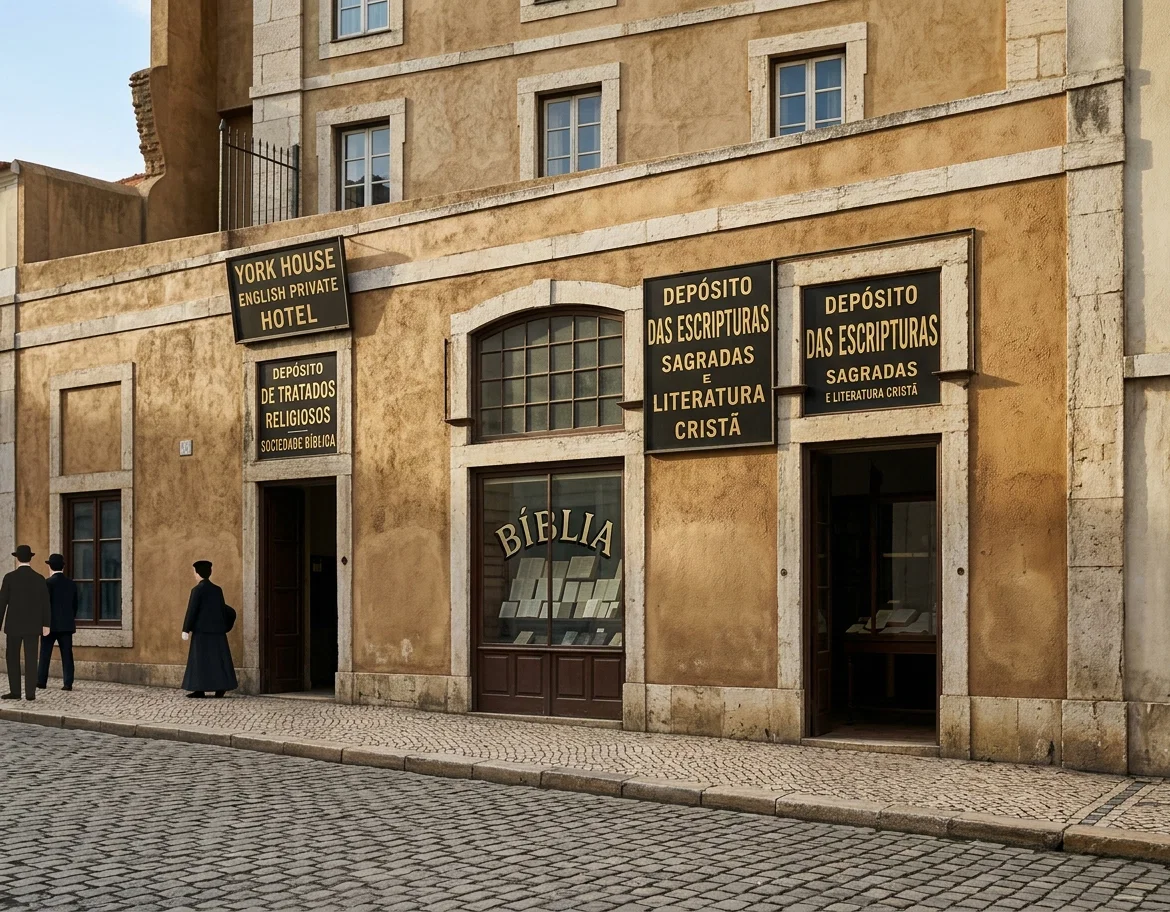
DEPOT OF THE BRITISH AND FOREIGN BIBLE SOCIETY, LISBON
This is indeed a very needy field, where ignorance and almost heathen darkness reign supreme. The inhabitants number about five million, with fewer Protestant missionaries than has India. The former country, I understand, has one worker to one hundred thousand people, and Portugal does not have that many, so far as I can learn.
The British and Foreign Bible Society has done much toward the evangelization of this field. A short rehearsal of its work may not be out of place. In the year 1809 the first edition of the Portuguese New Testament was published, in the D. Almeida version. In 1811 Mr. Henry Hartin advocated the cause of the Portuguese, and the result was the first edition of the New Testament in the Figueiredo version—a translation by a Catholic priest, this fact making for it a ready acceptance among Catholics. About 1819 to 1821 appeared the complete Bible.
In 1864 the Society sent Mr. W. P. Tiddy to this city to open an agency. F. H. Roughton had charge of the office until 1870. Then J. E. Tugman looked after the Bible interest for six years, when he was succeeded by Mr. Robert Stewart, who held the place twenty-six years. The agent for the peninsula is Mr. Robert O. Walker, of Madrid, while his sub-agent here is Mr. Robert Moreton, who is a noble young man of great capabilities. We made his acquaintance, and found him a friend in time of need, and are indebted to him for much valuable information, and for papers, from which I cull the facts here given. The Bible office now occupies a goodly portion of a large convent erected over three hundred years ago, from which place the friars went out to bless the Spanish Armada before its destruction.
About twelve years ago the government sold the convent to the Presbyterians, who, in turn, about five years ago sold it to the Episcopalians. The latter hold their services in the large chapel. This is rather strange, as the penal code declares that Protestants shall not have an exterior form of a church, but may have one in an out-of-the-way place. Yet the Episcopalians have raised the cross to the top of the building, which the Presbyterians
had torn down, they believing it best to sail under colors so closely resembling those of the mother church that they can easily capture the people.
The accompanying picture is of the front entrance to the Bible office, and shows a small shop, where Bibles are sold to the general public. This is the lower floor. The convent occupies a well-space almost equal to a block, or square, in some American city.
The total output of copies of the Bible or portions of it, from 1804 to 1903, was nearly 1,500,000. They employ seven colporteurs in Portugal. The selling of the Scriptures is not without trials; for in July of this year, in one of the outlying provinces of this country, a Catholic priest seized the entire outfit of a colporteur, and cast him into prison. Thus Rome does when she can find a convenient opportunity, even while keeping up a respectable front. We can see that Portugal is ready for the last warning message to a dying world. The Bible Society will receive its reward for the circulation of the Word of God.
We are making fair progress in the language, and hope soon to be able to do active work by selling literature. I have made two attempts to sell the Brazilian paper and tracts. While I sold a few, I found I needed a better vocabulary.
I recently learned that the Seventh-day Adventists are being advertised by some continued articles in a small religious Portuguese publication. These have the usual Scripture texts for argument against us. Also the book "Seventh-day Adventism Renounced" has found its way here, in English, however. Altogether, we feel glad for being helped in this way, even before we can talk in the strange tongues; for they can do nothing against the truth.
If any one wishes to give a donation through the usual channels, for the purpose of getting out more literature in the Portuguese bearing on present truth, it would be acceptable.
By the time this reaches you, the people of God may be in unison praying for the advancement of the Lord's work. Our prayer will continue to be, God bless his cause, his people, the great sin-cursed world, and may he hasten the day of the reign of King Emmanuel. Remember this needy field in your prayers.
Lisbon, Portugal.