ONE year has swiftly glided by since we arrived in China, and we are glad to report that at this time we have four mission stations in Honan, instead of one.
THE SHANG-TSAI HSIEN MISSION
Until the first of September, 1904, we remained at Sin-tsai Hsien, where we were engaged in the study of the language, devoting a portion of our time to examining and treating the sick, and conducting a few meetings during the last three months.
Owing to our small corps of workers, and the large number of cities yet unentered, we decided that the time had come when we should open other stations, dividing our force. We would thus be able to occupy two new stations. “There is that scattereth, and yet increaseth.” What we regret most is that there are so few in this field to scatter. At present we have only two workers in a station, and are able to supply only four cities. If we had a hundred workers, and placed two at each mission station, we could not supply every city of Honan, with its twenty-two million inhabitants. And Honan is only one of the eighteen provinces of China. We have simply begun work in China. Enlarged plans must be laid for carrying the gospel to this great empire, which holds one fourth of the population of the world.
While conditions are most favorable for missions in China of any time during the last half century, still for us to find a suitable location in a strange city was not an easy task. And should success depend on our efforts alone, the result would be failure. But we have the same merciful God here to help us in time of need.
In the first place, there are very few houses for rent, as China is very densely populated, there being four hundred and fifty people to the square mile in this section. Another difficulty is to find the real landlord, as nearly every piece of property belongs to three or four persons, and as many more claim an interest. It is important that the renter secures the consent of all, else the slighted will have what the Chinese call Seng-ki, which means that the so-called injured party would station himself in front of the renter’s place, in the most conspicuous location, where he would remain for a day, or until taken away, and at the top of his voice be heard reviling and cursing the landlord and the renter, and making numberless threats. Such an affair would certainly be avoided by a missionary.
To this is added the difficulty of dealing through middlemen, which are about as numerous as the landlords. A Chinaman will seldom do business face to face. Therefore, he has a spokesman, who communicates his terms to another middleman, who is supposed to be the spokesman of the renter, the renter, in turn, communicating his terms to his middleman. In nine cases out of ten, these middlemen will misconstrue the statements, in order that a small purse may fall to them. Our being even yet hampered in the language, would give the men a good opportunity to attain their object. And it is safe to say that a Chinaman almost always takes the chance.
Of the few places for rent, only a small number can be secured by a foreigner, as in a place which foreigners have not entered, the natives are very superstitious. If there happens to be a grave of an ancestor on the property, it is impossible to rent, buy, or lease. So what the foreigner usually finds at his disposal is the property of an opium-smoker, who has sold every available article and made no repairs, and, in order to get more money, will rent to a missionary. But such places are usually undesirable.
A captain can not steer his vessel in a storm unless it is in motion. God asks us to move, and he will direct. Leaving our Sin-tsai station, we traveled seventy-five miles northward, through the most densely inhabited portion of the Great Plain. On account of the extreme heat, we did most of our traveling at night. Arriving at Shang-tsai Hsien, the teacher we had sent before met us, accompanied by a friend who is a native of this city. He had called upon me several times at Sin-tsai Hsien, where we first became acquainted with him. He expressed himself as greatly delighted with the idea of having a mission in his home city, and said he knew of a place which could be secured.
Mrs. Miller and I were much pleased with the city, as it was located in a region densely populated; and, being only twenty miles distant from the railroad, we shall be enabled to transport our supplies much more cheaply than formerly, which will be quite an item when we are enabled to start the printing work. Considering it from all standpoints, the location and city met our expectations.
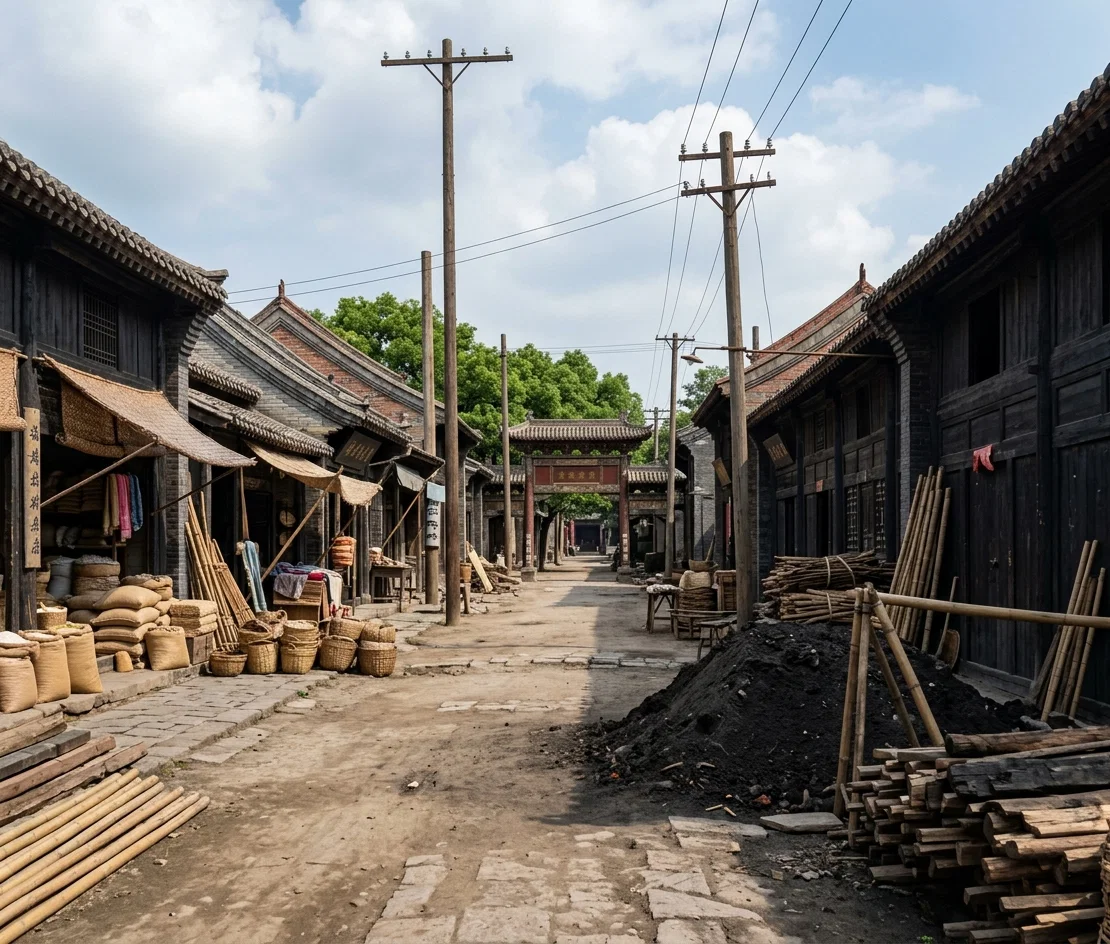
A STREET SCENE IN SHANG-TSAI HSIEN, LOOKING NORTH
FROM THE MISSION
I told the teacher and his friend that we would go with them and look at the place which they had found, as our past experience has convinced us that a Chinaman’s and a foreigner’s ideas of a suitable location are often at variance. But they quickly replied that it would be a mistake for me to look at the place; for then the landlord would learn that I wanted it, and they were afraid he15would not be willing to rent to a foreigner, and if he were, would ask a large price. Then they suggested their plan, which was for them to rent the place, and after the contract was signed, turn it over to us. They would state the terms to us as the landlord stated them, and we could decide what we would do.
These men seemed very sincere, and to them this was the best plan, as the Chinese idea of a business contract is after this order. Unless a contract is as crooked as a serpent, it is not Chinese legality. We informed them that securing a place in which to live was not our principal object in coming to Shang-tsai, but, instead, to gain the people’s friendship. Moreover, we told them that if our God desired us to locate here, he would give us the place by all fair means, and we wanted it on no other terms. Their countenances changed, as they could not understand how God could change the heart of the owner.
We then asked them to go to the owner with the message that we had come to this city to establish a mission where the sick could be treated, and where the gospel would be preached, and if we should rent his property, it would be used for that purpose. The landlord replied that our being foreigners made no difference to him, and that we should come and see the property, and if we desired it, it was for rent.
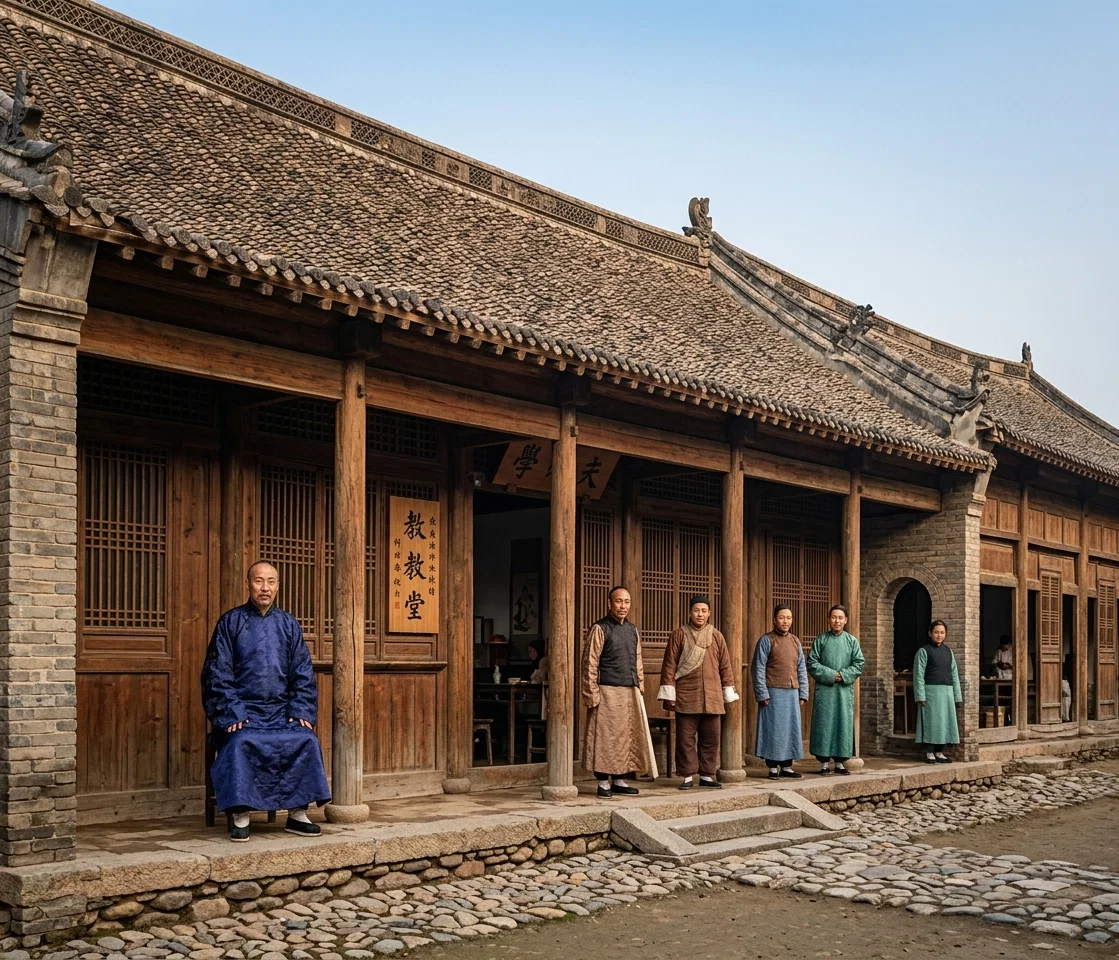
On looking over the compound, we were surprised to see how well it was adapted to our work. It had a large five-room front facing on the principal street, a picture of which we enclose. Two of these apartments would make excellent rooms for a dispensary, and the other three for a street chapel. Just back of this building, and extending at right angles to it, are two rows of buildings similarly constructed. The foremost rooms on either side will answer nicely for a boys’ and girls’ school. These rooms are the same size—fourteen by thirty feet. To the rear of these are good living-rooms for two or three families, besides room for the printing-press.
The houses are all of brick, except one. And it will not require a large amount of repair to put them all in order. We were able to rent this place for fifty dollars a year, which was less than we had hoped for. We have the privilege of renting it for ten years. The landlord pays for part of the needed repairs. He also expressed himself as glad to have this property put to such use, and desired to attend our meetings.
The fact that the property was vacant, and that we were able to do business with one man, and that directly, and the rapidity with which we secured it, were marked evidences to us that God had gone before and prepared the way; and we are glad to take charge of the mission in this new field, knowing that so far God has led. We pray that as the work goes forward here, we may continue to see the hand of God leading in a clear and definite way.
Since moving here we have been living in one room, while the remainder of the compound is being repaired. We have had inquirers calling on us daily, and the meetings held have been well attended. On every hand we have seen nothing so far but a friendly spirit from the officials, business men, and citizens. There is a demand for a boys’ and girls’ school at once; and we should soon set our printing-press in operation. To accomplish this, we need more workers. The very fact that God has prepared a place to receive new missionaries is evidence to us that more are coming soon. One million a month are going to their graves without a knowledge of the true God.