Our native training-school and orphanage are located at Karmatar, about one hundred and seventy miles from Calcutta, on the East Indian Railway. Leaving Calcutta at half-past ten in the evening, one reaches Karmatar at six o'clock the next morning. The train passes the mission house, where usually a crowd of happy children rush to see the event of the day, the in-coming train. It is really very interesting to watch the children at their work or play, and see their simple and free manner in their country home.
Miss Knight and Miss Whiteis are working very hard to make the school and the home life what it should be; and many things indicate that they are really getting a work established that will mean much for the native work in India. In the training-school there are some noble young women, who will, by God's blessing, develop into capable workers. One who has spent some years in educational work in India describes the Bengali girl as “gentle and quiet, pleasant and graceful in manner, and lovable on the whole.” This really describes the character of our Bengali girls in our training-school. They are quick to learn and very studious; and in the work in the home they take hold most nobly.17
The medical work is a very strong feature in their school work; in fact, this is a part of their training, and they are required to give some time each day to this special line of work. At this time of the year there is considerable illness in the villages near Karmatar, and every day many people with ailments of different kinds come for help.
The mission home is located on the cart road leading to some of the large cities of India. Many pilgrims pass each day on their way to shrines, where they are going to do penance. Many of these travel hundreds of miles, and it is not an uncommon thing for some to die on the journey. While we were there, a poor man was trying to get back to his home. Many miles of his journey were still before him, and he was already greatly emaciated from fever, which he had contracted during his trip. He was given some simple treatment, and a tract and a gospel leaflet containing words of life in his own language, with a few pice to buy food as he journeyed. This poor man was seeking to save his life by his long pilgrimage, and yet in the very attempt he may lose it. It is to be hoped he received some word that would help him to learn a Saviour's love. This is only one of many cases that are continually appealing to our sympathy.
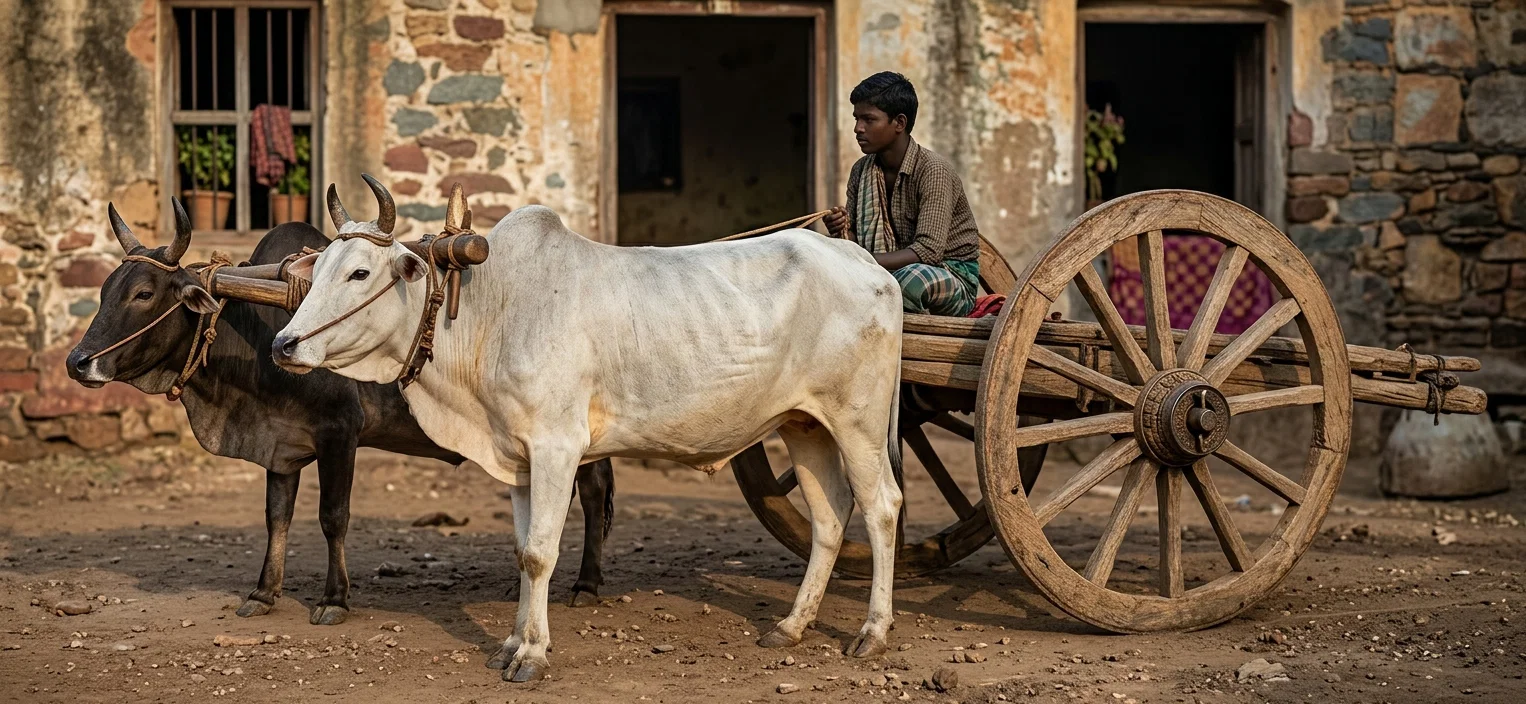
OXEN AND CART
It is quite a common thing to see some of the medical workers start out on an ox-cart, to visit the sick in the native villages. One evening we went with them on one of these trips to a village about two miles from the mission house. Toward the last of the journey the road became so bad that it was thought impossible to take the oxen farther; so some of the party went on ahead, going through water and mud over shoe tops, to see the poor sufferer, who was a little child about four years old, badly bloated from his head to his feet. The workers proceeded to give some simple water treatment in the open yard, surrounded by scores of natives, who were anxious to see what seemed to them strange sights. After an hour's treatment, Miss Whiteis gave instructions for them to bring the child to the mission home the next morning, where it would have further treatment. Though the poor mother had cried bitterly all the time the little one was being treated, evidently she was impressed that it was good; for every day he was brought to the mission house and carefully treated until he had quite fully recovered from his illness, which at first seemed so serious.
In the orphanage there are some very interesting children. I must tell you about a little fellow who was brought from the famine districts a few months ago. He is a bright little Hindu. His father, mother, and sister all died of cholera within a week, leaving him without friends or home. His Hindu name is Tulsi, and he is between five and six years of age, an active, happy little fellow, naturally of a very loving disposition, and very grateful for every kindness shown him. Tulsi's idea of obedience was foreign to all ideas of reason when he first came to the orphanage. When passing to and from class in school, he thought nothing of giving a little spring, heels over head, never imagining he had done anything out of the way. For a time he held to his heathen customs, and the first time food was given him, he took it with great fear lest some of his caste should see him, and he would have to suffer for it. For a Hindu to take food from one not of his caste, means breaking his caste; and separates him from his family and Hindu friends to wander an outcast in the world alone, and receive the displeasure of the gods. These things are taught the children when they are only babes in their mother's arms; and when in their own homes, it is seldom that they can be prevailed upon to break their caste, preferring rather to suffer hunger.
Our orphanage children represent only a few of the many homeless children there are in India; for of the three hundred millions of people, one hundred and seventeen millions are boys and girls. Indeed, if these children all stood in a line, shoulder to shoulder, and a great bridge were made across the sea for them to stand on, they would reach round the world! They'd make an immense ring twenty-five thousand miles long. And only ten children in each mile of that big ring have ever heard the name of Jesus.