A Visit to Burma

8%

Review and Herald Publishing Association · Washington, D.C. · Feb 16, 1905

FromReview and Herald, Vol. 82, No. 7.

Read the full edition

A Visit to Burma

J. L. SHAW
A TRIP to Burma, across the Bay of Bengal from Calcutta to Rangoon, during the monsoon season, is not a most enjoyable one. During the season, which lasts from the middle of June to the first of October, the monsoon winds blow continually from the southeast across India and the Bay of Bengal, proving a great blessing to India by bringing an abundance of rain to cheer the millions of Indian farmers, but lashing the bay into a boisterous foam, making travel by sea hard, and often perilous.
We had a trustworthy boat, and, being a mail steamer, it made the journey of nearly eight hundred miles in less than three days. It had been over two years since we last visited Burma, and we naturally looked forward with pleasure to meeting the little company of Sabbath-keepers in this new field. There is something encouraging and inspiring about the Burmese people. They are cheerful and contented, and are remarkable in this part of the Orient for their independence of character. Aside from the several English-speaking Sabbath-keepers, we have, in Burma, six natives who are keeping the Sabbath. All of them have had more or less trouble and persecution by their fellow countrymen since accepting the truth. One brother—Maung Maung, by name—especially, gave up a lucrative position in the government, against the advice of friends and family, and has really suffered privation and hardship for the cause of present truth. For two years he and his faithful sister, Ma Ma, have stood stanchly for the truth, and, while being condemned as heretics, have used the larger portion of their time in telling their fellow Christians of the true Sabbath and the near coming of Christ.
These dear friends are very anxious to get the truth before their countrymen, and again and again they have earnestly pleaded that a minister be sent to them to learn the language and join with them in laboring for the Burmese people. There certainly is an open door for such a worker, and we know of no work more interesting and encouraging. It will be joy to us and to the native brethren there when a minister goes to that field to throw his heart and soul into the work.
The people are by no means illiterate. It is their pride that all the men and women are able to read and write their own language. This being true, it is very important that we have tracts and leaflets printed in their tongue as soon as possible. Brother Maung Maung has written a tract entitled “The Law of God Written in the Heart.” On the outside he has the picture of a heart, with a hand writing upon it the law of God. Brother Myat Tun has translated one of our tracts on the second coming of Christ, and has it ready for the press. These brethren have done this work so far at their own expense, and it is only now that they are asking if the mission will not share the expense of printing. There is no question about our duty to help them in this. We must lose no time in getting our literature into their language. As fast as funds are available, we should have tracts on present truth translated and published. It costs two dollars to print one thousand eight-page tracts, and one dollar to print one thousand four-page tracts. How providential it is that printing is so cheap! Even a few dollars goes a long way in publishing the message in this land.
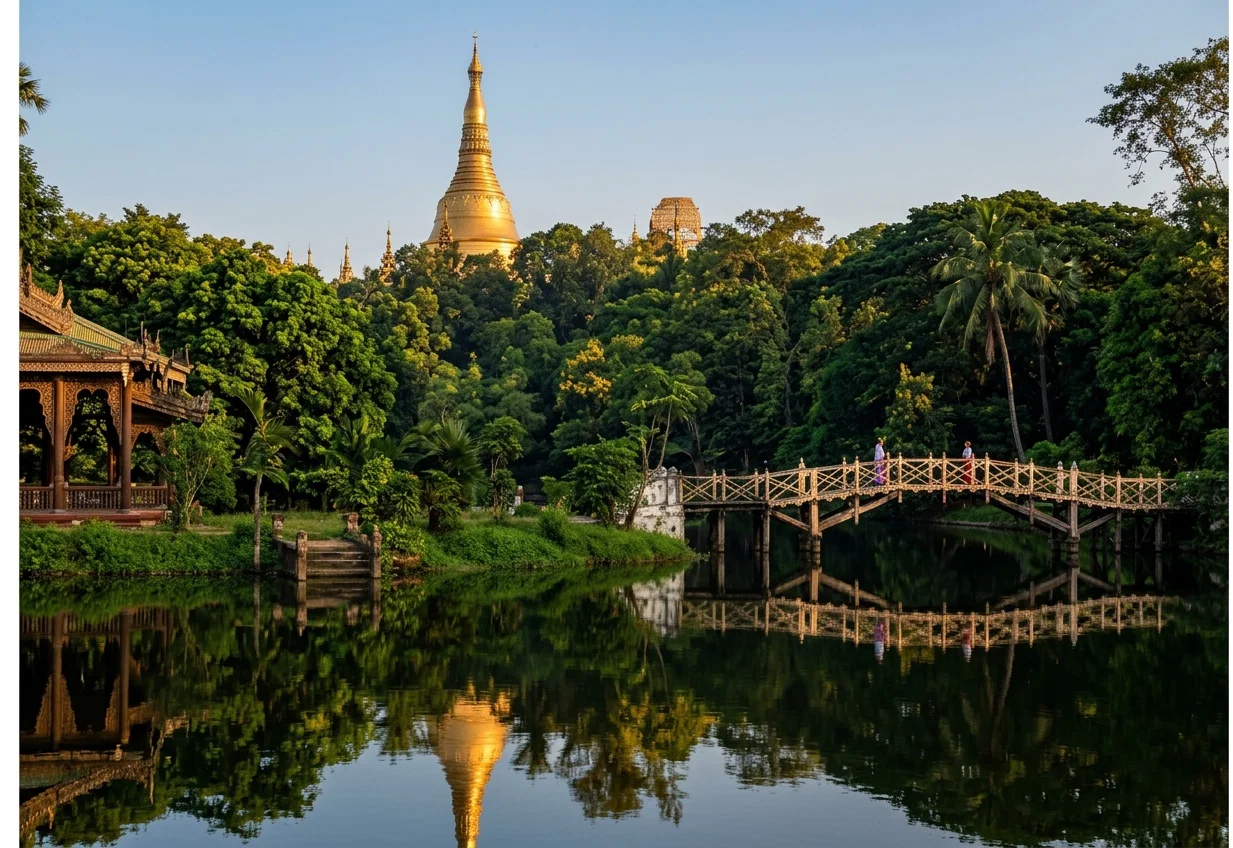
SWAYDA GONG PAGODA, IN THE DISTANCE
We held a number of meetings while in Burma, but, living apart, it was difficult to get all our Sabbath-keepers together at one time. We managed, however, to have one such meeting. The occasion was of profit to all. Brother Maung Maung interpreted to his countrymen what was said, and at the close of the meeting, after several songs in Burmese, the company broke up.
For nearly two years Brother and Sister Meyers have been working in Burma. Through their efforts and the efforts of those who have worked with them, our literature has been having a wide circulation among the English-speaking people in various parts. The Oriental Watchman has a good circulation. Our health books have taken well, and many have been sold in different parts of the field. Brother Meyers has also held public meetings, and conducted many Bible studies in the homes of the people, so that a large number have heard the truth.
The Burmese, as a whole, are contented and happy. They live in a productive country, and, not wishing to accumulate wealth, live an easy-going life. Their religion teaches them to be very hospitable, and it is said that a foreigner can go from one end of Burma to the other and never want for food. Their liberality is particularly shown in their temple service. Pagodas to the memory of Buddha are to be seen in many places. These are relic shrines which have been built as monuments wherever some of the supposed remains of Buddha or articles belonging to him are to be found. In the foundation of one, the guide will tell you, is said to be found a tooth of Buddha; in another, a lock of hair; and in still another, some article that once belonged to him.
Many of these pagodas are very high, and have their domes covered with gold-leaf, which glistens in the sunlight. Swayda Gong pagoda, whose dome can be seen in the picture, is one of the largest, and its dome is wholly covered with gold-leaf. It costs much to make thislarge display of gold in honor of Buddha; and putting it on as they do, in time it wears off, and has to be renewed. But the people have been taught to give in a remarkable way. One pagoda we visited had a large chest placed in a conspicuous place. The chest is covered with gold, and on one side there is an opening for contributions. Judging from the elaborate display of gold on every hand, the contributions received in this box must be enormous; and the exceptional size of it is also an evidence that large giving is expected. If the stream of wealth that pours continually into this and other heathen coffers in Burma could flow into the cause of Christian missions, what a work could be done! Though the gold is yet tenaciously held for the service of Buddha, the object-lesson remains. Every missionary who visits these shrines must wish that the same free spirit of giving might be seen in Christian lands for the propagation of the gospel of Christ.
Many are the evidences that Burma is now open for our work. The government has built railways running to many parts. Peace and quiet reign everywhere. A woman can travel alone, and be courteously and kindly treated. Education has been promoted by the government to a remarkable extent, and a spirit of inquiry prevails. Are these not evidences that God is going before us? Just now is the time to enter Burma. We know of no more encouraging field; and surely, among that many people there are loyal hearts who will respond to the warning call. The same hardships which Judson bore are not now to be met. It was with the greatest difficulty that he started the work; he labored many years under the most trying circumstances, with apparently small results. But, in time, God showed his signal blessing upon his efforts, and a work was begun which nearly a century has by no means effaced. The work of reform which he started, and which finally found for him so large a place in the hearts of the Burmese people, is to meet its completion in the proclamation of the third angel's message. Where are the men and women who will give brain and brawn for the salvation of the Burmese people?
Calcutta, India.