“And the isles shall wait for his law.” Isa. 42:4.
Prophecy shows us the prominent part the United States of America would act in giving the closing message to the world. God chose that nation, burning with ambition and zeal, backed by its facilities and resources, the most enterprising nation of to-day, to be the depository of this work, and gave to it, as to ancient Israel, the responsibility of bearing this work to the world.
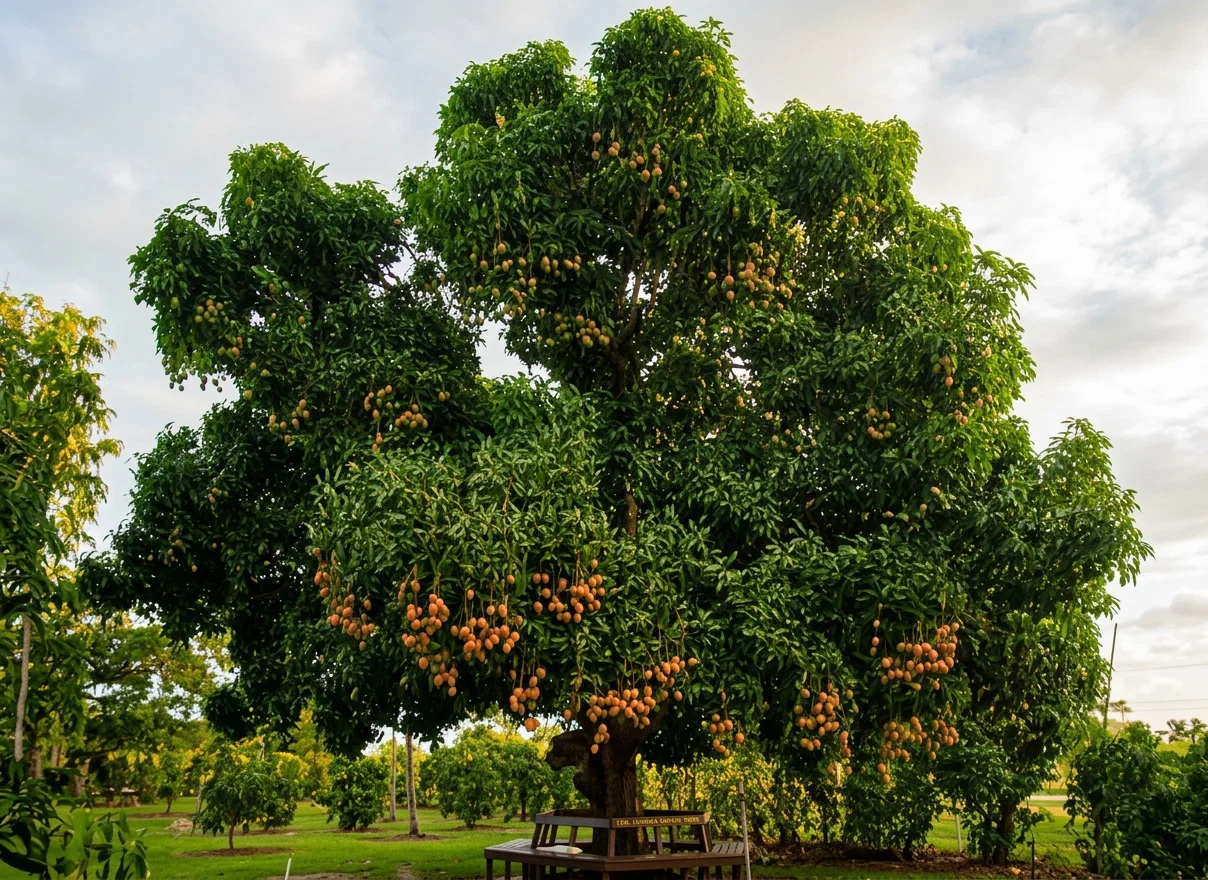
MANGO TREE, JAMAICA
As a great luminary, the third angel’s message had its rise in the fair land of liberty. From the township of Washington, New Hampshire, it began to diffuse its light; and as it rose higher and higher, its rays penetrated into other places, covering larger territories. Its advocates, burning with holy zeal, spared no sacrifice to publish the glad tidings—the truth that was so precious to them—to their neighbors, friends, and fellow men.
In the waters of the Caribbean, and nestled in her arms, are the romantic isles of the West Indies. No grander sight can greet the eye than the rays of the rising sun reflected on the waters of the sea. And as it scatters, it fills everywhere with light and glory. So it was, early in the nineties, when the rays of the third angel’s message penetrated beyond the shores of America. And glorious was the dawning of that morn on the fair island of Jamaica.
The canvassing work was started by Brother Patterson, of California. He had success in this. He was an experienced canvasser, and his purpose was to place the books and literature in the homes of the people. Many never knew to what denomination he belonged; but this they did know—that he was a Christian. It was impossible for the truth to be concealed. The soil had been prepared, the seed had been sown and watered, and it burst forth. A few in Kingston began the observance of the Sabbath. In the year 1893, Sister M. Harrison, who had previously accepted the Sabbath and its kindred truths, attended the General Conference, which was held in Battle Creek in the early part of February. An earnest appeal was there made for a laborer for Jamaica, and in May of the same year Elder A. J. Haysmer and his family were appointed to this field.
Meetings were first held at the home of Sister Harrison. But soon the house became too small, as the attendance increased. It was then decided to secure a larger place, and a house at 32 High-holborn Street was rented, which served as a dwelling-house, and also as a place in which to hold meetings. Soon the apartment on the lower floor became too small, and still the number increased, until all the partitions of the upper floor were removed, and this served as a meeting-room for some time.
Faithful house-to-house work was done. Hundreds of tracts and missionary papers were addressed and distributed, as in the early days in the States, and these, blessed of God, did not fail to bring good results. The staff of workers being increased by the addition of Elder F. I. Richardson, a tent effort was effected in August, 1894. The tent was pitched at the southwest corner of the Kingston race-course. The influence and memory of those meetings will long be retained by the writer. The tent was a forty-foot circular one, furnished with canvas stools, gasoline lamps, etc. The meetings were always crowded. The singing was inspiring. “Hymns and Tunes” was used, and the strains of those grand old hymns can still be heard ringing in the ear as they were sung then with devotion and fervency.
As the sublime truths of the prophecies and kindred subjects were presented, the hearts of the people burned within them. Little groups could be seen standing about the course, discussing the things they had heard; while many were pricked in their hearts, and were led to inquire, “Men and brethren, what shall we do?”
As a result of the tent effort, our numbers were so increased that our meeting-house became too small, and another place had to be sought. The Lord led in this matter. The way was opened for us to purchase an old Baptist church, which we had only to repair—the present building at 32 Text Lane. The love and union that existed then among the members will never be forgotten by the pioneers.
With Kingston as our center, the work began to extend to other parts of the island. Meetings were begun at Spanish Town, then at Font Hill, Devon, etc. Our force of laborers was increased from time to time, as the work assumed magnitude. As companies were raised up, buildings were erected in the respective places, which gave permanency to our work. The ministers of the different denominations did much to prevent the spread of the truth, telling the people that it was an American trick, and that the missionaries only wanted to get money from the people, and that when they had succeeded in this, they would go back to America. But as our churches were built, the people saw that our brethren had come to stay. The Lord greatly blessed the labors of the different workers, and in January, 1903, we were organized into a conference.
The Lord has truly blessed us, and now we are willing and ready to act our part in giving the message to those in other lands who have not yet had the light of the third angel’s message, and thus hasten the return of our Lord to earth.