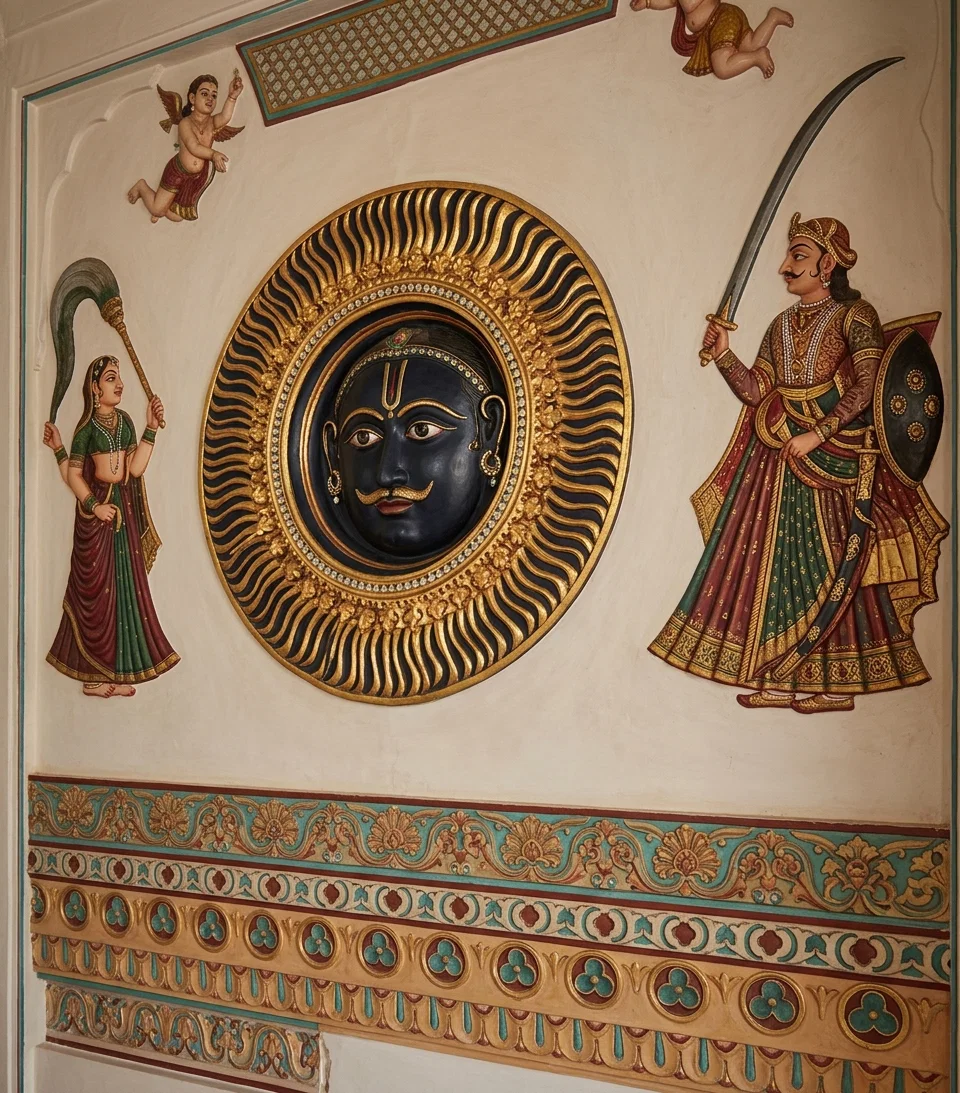
It is doubtless in India that we find modern practices most nearly approaching the ancient pagan forms of honoring the day of the sun.
The idea of sun-worship runs all through the religion of Hindu pantheism. Old temples bear carvings of the sun-god resembling those known in ancient Greek and Roman art. The god rides forth in his chariot, drawn by seven horses, representing the seven days of the weekly cycle.
A SUN PANEL IN UDAIPUR PALACE
In common every-day worship one may see the Hindu doing homage to the sun. Sun panels appear in decorations of temples and palaces. And the day of the sun itself is specially honored. Hunter, the great authority on modern India, refers as follows to the popular regard for the sun and the Sunday among Hindus in our own times:—
The sun-god in his golden chariot appears among the divinities which a native artist has figured as the objects of popular adoration in Orissa. Both there and in Bengal, the Brahmans daily repeat a prayer to the sun after bathing; and the stricter sort of Vishnu worshipers refrain from animal food on the first day of the week, which bears the name of Sunday alike in England and India (Robibar [sun-day]).
The common people in the plains merely bow to the orb after their morning ablutions; but in the highlands of Manbhum, to the northwest of Orissa, the low-castes do not break their fast till they catch a clear view of the deity,6and in cloudy weather have sometimes to remain a day without food.
During the whole harvest month (Agrahayan, falling within our November and December), each Sunday brings round weekly solemnities in honor of the bright god. Each village household prepares a tray covered with earth, into which rice seeds are dropped. Little earthenware cups containing pure water are placed upon it, and on Sundays the family priest goes through a few simple rites, pouring a libation of fresh water upon the tray, and invoking the sun.—“Statistical Account of Bengal,” Vol. XIX, page 84.
That writer in the North British Review coined a striking title for Sunday when he called it “the wild solar holiday of all pagan times.” It was never a day of rest among the pagans other than in the sense of being a festival of greater leisure than ordinary, when special honor was to be shown the gods. But from earliest times it was the rival of God’s own holy day. When the church itself went into organized apostasy, this solar holiday was set up in the place of the true Sabbath. It ought to make Christian people stop a moment and investigate when they find Hindu idol worshipers paying special regard to the first day of the week.
W. A. S.