Demon Worship in China

8%

Review and Herald Publishing Association · Washington, D. C. · Apr 27, 1905

FromReview and Herald, Vol. 82, No. 17.

Read the full edition

Demon Worship in China

A. C. SELMON
ONE evening, while sitting in front of our house, reading, we heard a great wailing in the courtyard adjoining. Two or three old women were running about, crying, “Laoho lai kia, Laoho lai kia.” We found that one of the boys of the family was sick. His name was Laoho. The two words—lai kia—mean, “Come home.” Although the sick boy was lying on the ground before them, yet they were calling for him to come home. He had just had an epileptic fit, and was in the deep stupor, or epileptic sleep. These poor people thought an evil spirit had snatched his soul away, and was making off with it, and this was why they were calling him home.
They continued their wailing for some time, and, as the boy seemed to be getting worse, as a last resort they called for the foreign doctor. There was very little that could be done. Hot and cold applications to his spine revived him quite a little, and I told them he would waken in a few hours, and be much better. I prayed earnestly that the Lord would bless the little that I had done, so that the people might listen to the “true doctrine;” this is the name the Chinese give to our teaching.
This same idea is held by the Chinese in regard to practically all their diseases. They attribute their sickness to the evil spirits and demons, and this is why their worship is one of fear, and not of love. They worship these evil spirits in order that they may not be afflicted with sickness, and that their live stock and crops may not be destroyed. This fear of evil spirits plays an important part in the lives of the Chinese.
Although Satan, in the form of a dragon, is the national emblem of this empire, being found on the flag and on all the coins, postage-stamps, etc., yet they live in constant terror of demons and evil agencies. This fear is so great that in the household no member of the family is allowed to mention the name mo quei—devil—during the early morning hours, for fear of the bad influence it will have on the day’s work.
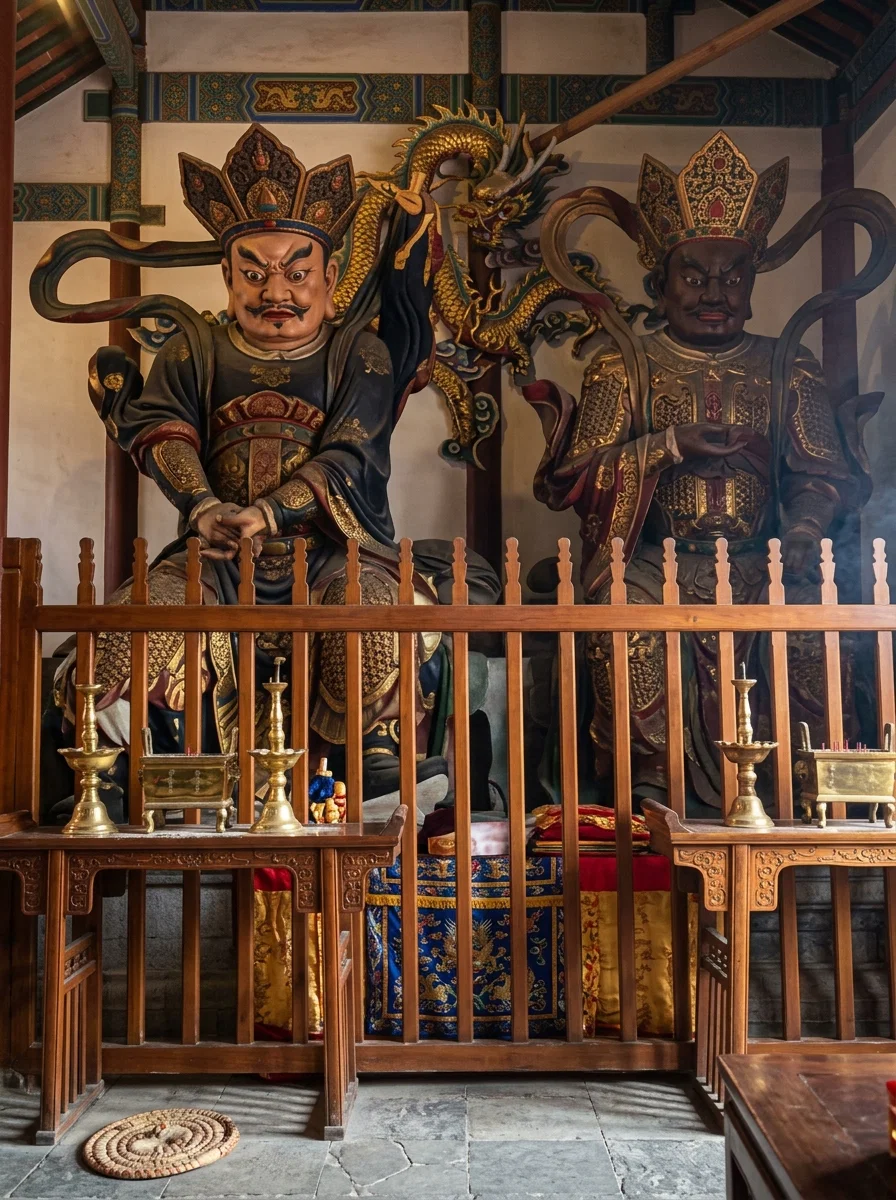
They use many resources to protect themselves from these influences. At new-year’s time the door of every Chinese home has pasted on it a picture of a very fierce-looking warrior, and long strips of perforated paper are pasted up over the door, and left to hang down in the entrance. The warrior is intended to frighten away the evil ones. And should they try to enter, they would become entangled in the perforated papers.
The crookedness of roads and streets, which has been mentioned by every one who has visited China, is not an accident, but is the result of this same purpose.
It is to be noticed, in naming their children, that the boys are always given names which signify very common and undesirable things; while the girls are given very pretty names, as of flowers and precious stones. They regard the boys as of far greater worth than the girls; yet they believe that by giving them very common names, the devil will be deceived, thinking they are of no value, and will let them alone. On the other hand, they do not care if he does take the girls, so they give them very nice names.
SOME CHINESE GODS
SOME CHINESE GODS
Near by our station I noticed a young peach orchard, which had just been set out. On the side of every one of these trees was a long white mark that had been put there to keep evil spirits out of the tree. Another method they have of accomplishing this same object is to stretch a cotton string around the orchard. The Chinese boy differs very much, in at least one respect, from other boys, for he rarely, if ever, throws a stone or a clod of earth. He does not throw a stone or a ball, because, if he did, he might hit one of the spirits in the air, possibly the spirit of one of his ancestors. While repairing one of our houses, we attempted to buy two small logs which were in an adjoining courtyard. We found that the owner could not be induced to sell them; for they had been lying in his yard many years, and he did not know but that the spirit of his old father had taken up its abode in one of them.
One can hardly imagine a religion better suited to the plans and purposes of the great enemy of all truth than this religion of the Chinese people. Nothing but the true Light can pierce the midnight darkness of this land. When Christ entered Capernaum, then was fulfilled the prophecy in Isa. 9: 2: “The people that walked in darkness have seen a great light: they that dwelt in the land of deep darkness [margin], upon them hath the light shined.” My brother, will you, as Christ’s ambassador, help in the work of holding up the Light in this land of great darkness?