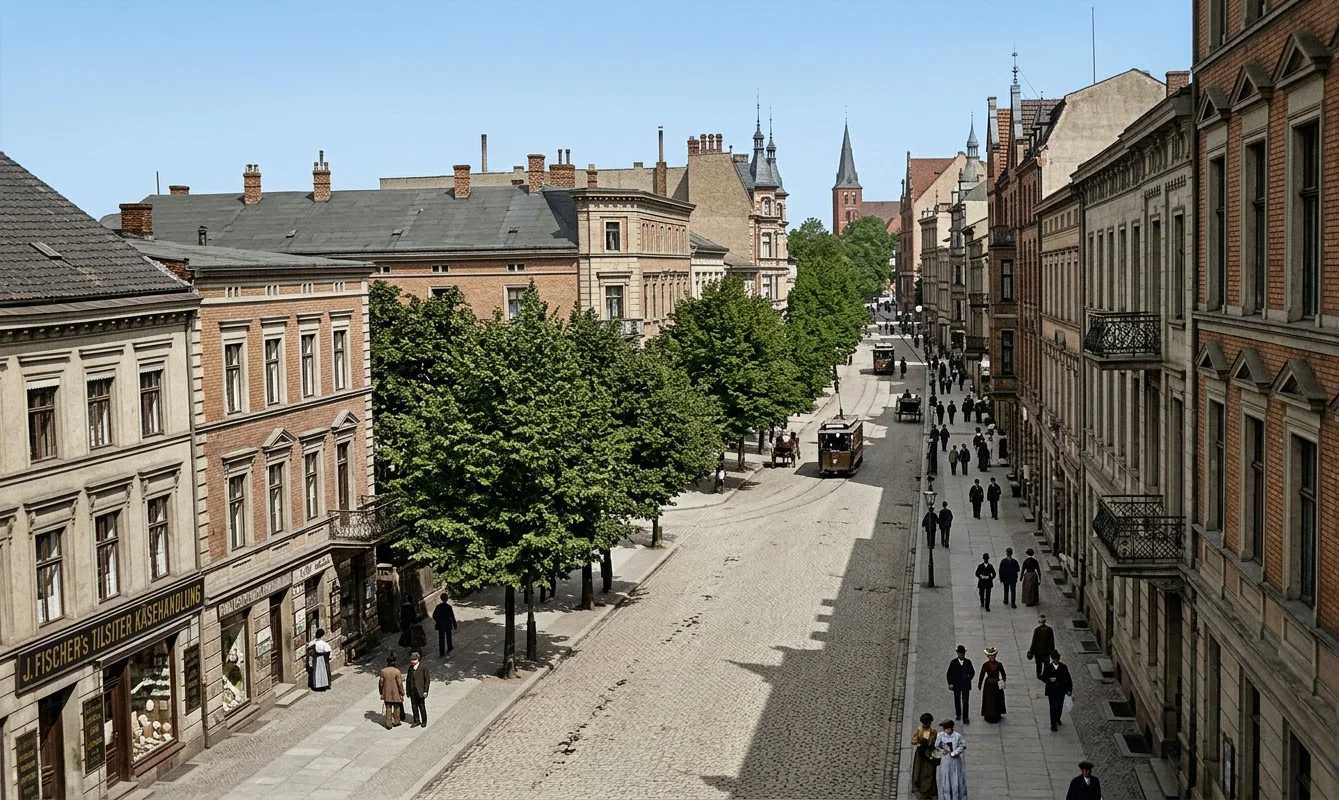
The last of our five German conferences was held in Tilsit, near the Russian border, January 25-29. Tilsit has about thirty-five thousand inhabitants.
HIGH STREET, TILSIT
The Prussian Conference has been organized only about fifteen months. It was formerly a part of the East German Conference. It comprises the two provinces, East and West Prussia: hence its name.
The first year of the Prussian Conference has indeed been a very promising one. With only seven workers, one of whom was an ordained minister, ninety-three were baptized, and twenty-two were taken in by vote, so that their present membership is four hundred and ninety-five. When we consider that these two provinces have a population of only three and one-half millions, we can easily see that they have proportionately the largest number of Sabbath-keepers to be found in any of the German Conferences.
Our meetings were held in public halls. We had a very fair representation from our churches throughout the field. Most of these churches are in the country.
Still, last year the church at Konigsburg, the leading city, with a population of about two hundred thousand, increased from thirty-five to seventy members.
There is a church also in Dansic, a city of one hundred and sixty thousand, with a membership of thirty-five. Eight companies and churches were received into the conference at this meeting.
Two of these, however, are made up of brethren who have moved from the Balkan States into some of the rural districts where the German government is settling immigrants. In order to counteract the Polish influence, the German government has bought a number of large estates of Polish noblemen, and is selling these estates to German settlers.
Our outside attendance here was the largest we have had in any of the winter meetings, as many as five hundred being present in the evening services. The halls were so crowded that many could not find room, and had to go home. Brethren Boettcher and Schuberth and I assisted in these services.
The delegates took a deep interest in the business of the conference. Everything moved forward in harmony. As this was a young conference, and the brethren were mostly farmers, and wages considerably lower than in other portions of Germany, some had feared that perhaps this conference would not be able to pay its two tithes to the German Union Conference as it had promised to do, but the Lord has so blessed the efforts put forth that they were able to pay the second tithe and settle with their workers and have about seventy dollars surplus in addition to the amount they had when they were separated from the East German Conference, and they are now increasing their corps of workers. When we called the attention of the brethren to the amount of money that would be needed to carry on the work the coming year, some offered a thousand dollars to tithe on their property, in order that the sum needed might be provided.
The tithe for 1904 was $2,629; the offerings were $539.
Elder Oblander was unanimously chosen president of the conference again, and besides him there are one Polish and one German licentiate, and also five Bible workers. Fourteen persons were baptized at this meeting, and three were received by vote. These, with some others who had been accepted as members earlier in the month, make thirty additions since January 1.
Considerable time was devoted to instructing our people, and dealing with the outside interest, for the business of the conference was speedily finished.13
Several workers remained to carry on the interest that had been awakened in Tilsit.
We feel grateful indeed that the Lord has so abundantly blessed our meetings in Holland and the five German Conferences, and it is our determination more earnestly to press forward with courage in his cause.
At present the German Union Committee is assembling at Friedensau, to audit the accounts of the mission field and the German Union workers, and to hold a general council.