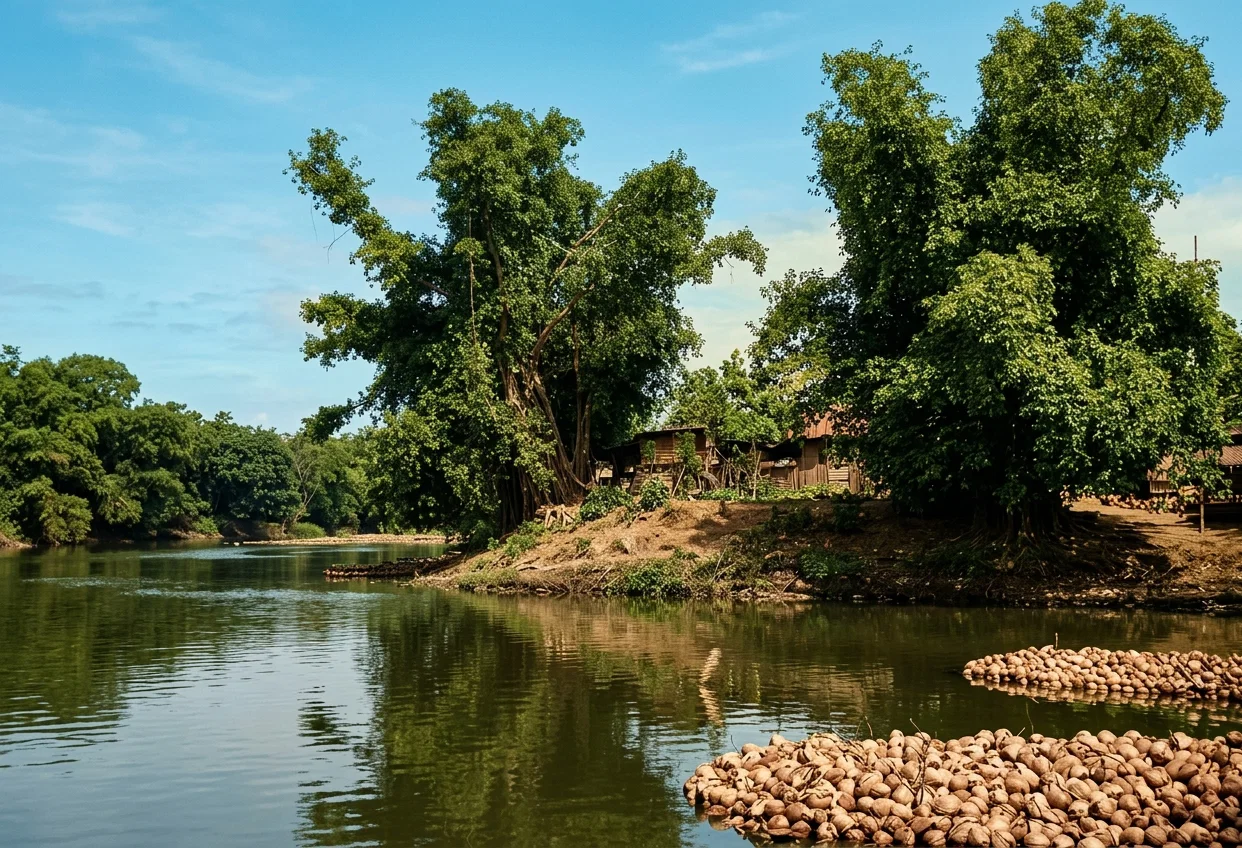
This island field is a large one. I am sure we have never sensed its magnitude. When we speak of the islands of the sea, we think of little spots that are dotted here and there in the great oceans. We do not realize that many are larger than six or eight of our States. I have learned this in the course of my travels. As we passed through one space which is blank on the map, we found in it two archipelagoes,—one with thirty islands, the other with more than twenty,—and every island was inhabited, the population varying from one hundred and fifty to five hundred. This one spot is no exception to the general rule. All around the New Guinea coast there are islands which are not marked on the map. In the Java Sea, from the northern part of Java to Singapore, we see but three islands on the map, but those who are familiar with this region tell me that there are a thousand islands in that space.
Take New Guinea. It has as large an area as the States of North Carolina, Virginia, West Virginia, Kentucky, Tennessee, Illinois, Indiana, and Ohio. Borneo embraces as much territory as Oklahoma, Indian Territory, and Texas; and Texas is as large as five of the ordinary States. Celebes has an area equal to that of Pennsylvania, New York, New Jersey, Maryland. Java is as large as Utah. Sumatra's area equals that of Arkansas, Louisiana, Mississippi, Alabama, Georgia, New Hampshire, New Jersey, Rhode Island, and Delaware. In seven of these large islands there are forty million people.
One question has been asked me several times since I have returned to the United States: “Do you think that those people are intelligent enough to be worth the effort that we are putting forth for them?” I know that the impression generally is that these people are of such a low order of intelligence that it seems almost useless to try to bring them to the gospel. I want to tell you, from our experience in these fields, that this is a very great mistake. I believe that these people, although they have lived for centuries in heathen darkness and blindness, have minds that will comprehend the truth; and they will comprehend it more readily than you and I suppose.
They are not idolaters in the sense13that they bow down to wood and stone. They are superstitious, and they have traditions, but they do not set up idols to worship. And I find that they have some traditions that give evidence that at some time in their past history they have had a knowledge of the Bible. We stopped at the island of Semari, just at the point of New Guinea. There the natives have this tradition: Many hundreds of years ago a man came down from heaven to earth regularly. There was a ladder reaching from earth to heaven. This ladder was made of the rattan vine, which grows on the island. This vine is very strong, grows to immense length, and is used instead of rope. Every time the man came down to earth, he brought with him a black pig. When he went back, they gave him a white pig, which he took with him. One time, when he had transacted his business, and was ready to go back, they gave him a spotted pig—part white and part black. This insulted him, and when he went back to heaven, he cut the ladder, and it fell to earth, and since that time there has been no communication between earth and heaven. Where did they get such a story as this if they did not at some time have a knowledge of the Bible? They must have had some knowledge of the sacrificial system of the Old Testament.
From these things we see that there is an intelligence even among these black people who have been so recently in cannibalism. Some in the interior of these islands are still practising cannibalism, and only the very best of them have been out of it perhaps but little more than half a century.
In our school at Avondale, Australia, we have had some pupils from these islands. We have had some from Fiji, who have been converted and were brought there to school. These young men, when in school, learn just as rapidly as the white people. They are just as obedient to the rules, and in every way their deportment is just as good. That demonstrates to me that they have bright minds and are susceptible to the gospel. And when it is carried to them in its purity and simplicity, in such a way that it may become the power of God unto salvation, I believe they will respond to it.
One thing I have noticed is that when missionaries once come in touch with these people, even with those in the darkest countries, they become greatly attached to the natives, and are unwilling to leave them. Brother Fulton lost his health, and had to go to Australia to regain it. All the time he was there, he was anxious to go back to the islands, and was very glad when the day came for him to return. When the ransomed of the Lord shall return to Zion, I believe there will be many in the company who have been gathered in from these dark islands of the sea.
Singapore
Singapore is the important center of all the East Indian field. It is on an island at the point of the Malay Peninsula. The population is 288,555. It is the seventh great commercial center of the world; London, New York, Hamburg, Antwerp, Hongkong, and Liverpool ranking before it. It is right in the artery that carries the life-blood of commerce around the world. Singapore has one of the most commodious harbors in the world. I was astonished beyond measure, when we steamed into that port, to see the shipping. There were ocean vessels from all over the world; the harbor was full of them. Singapore is not only a great commercial center, but an educational center as well, for this field. Every denomination recognizes this fact.
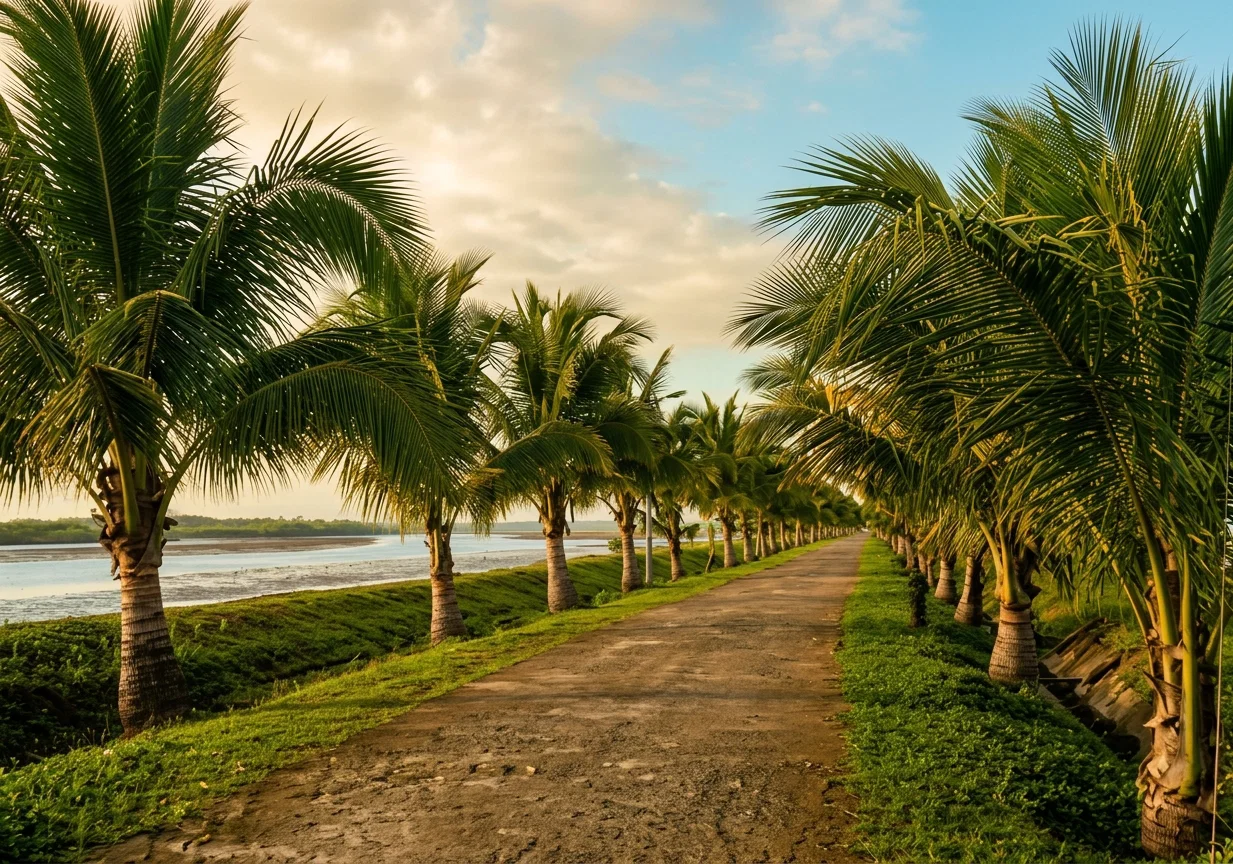
PALM DRIVE WAY, MANILA
The Straits Settlements is a free port. You are not bothered by the customs officer. The town of Singapore is English. It does not owe a dollar of debt; last year its income, above all debts, was $425,000.
Singapore is the most cosmopolitan city of the world. Every nation, kindred, tongue, and people is represented there. The Straits Settlements has a population of a little more than half a million. The largest number of any one nationality are the Chinese, with 281,000. The Malays come next. As you travel on the streets, you can hear every language spoken. The government is very liberal. I regard this as a very important place for missionary operations. I believe there is a grand opening there for our medical work.
I visited the American consul. He was very kind to me, and I secured from him all the information I expected to obtain. The next day he sent for me to come back. I went, and he began at once to speak of our medical work. Elder Gates had been there, and had told him something of this branch of the work, and he knew that I was there spying out a station. He said: “Mr. Irwin, if the time comes when you get a physician here and are ready to open medical work in this city, I stand ready to do anything I can to assist you. If you will come to me, I can go with you to the governor of the island and to the members of parliament, and I believe they will give you a grant of land, and assist you in your work. That kind of work is very much needed in this island. There is a great deal of sickness, and nurses are very scarce, and I believe your medical work would do a great deal of good.”
We already have a mission there. Brother and Sister Jones had been in Singapore about a month before I arrived. Brother Caldwell also went there from Australia, as a canvasser.
We held a council in Singapore. There were only five of us, but I know that the Lord was with us in that council. He blessed us as we prayed over the work. We asked him to guide us in what ought to be done to establish the work there. These workers were laboring under adverse circumstances. They had no money. They had no furniture in the house which they had rented, except one or two chairs that had been donated. Yet they were just as happy as they could be in their work. I believe the Lord is going before them. In fact, since we left them, we have heard that four persons have already begun to observe the Sabbath, through the efforts of these workers. They are missionaries in the truest sense, working among the people, and at the same time studying the Malay language. Brother Munson was there with me, and he gave them a lesson every morning from five to six o’clock. They were learning the language very nicely, and at the same time were going among the English families, working. Brother and Sister Jones were distributing tracts and papers, holding Bible readings and praying with the people, and success was attending their labors. We recommended that two nurses be sent to assist in the work in Singapore. The Australasian committee has selected two of the best nurses in the Wahroonga Sanitarium, and they are now on the ground.
The Philippines
I went from Singapore to Hongkong, and from there to the Philippines. I spent eight days in Manila, where I learned a great many things about this group that I could not have learned had I not gone there. Of the Protestant denominations, the Methodist, Presbyterian, Baptist, Congregational, Disciple, Brethren, and14Episcopal are represented. They have formed what they call the “Evangelical Society,” to which all the denominations belong except the Episcopalians. The denominations have divided the territory among them, so they will not conflict with one another in their teachings, and thus confuse the native mind. I had two or three pleasant visits with the Presbyterian minister. After learning who I was, he invited me into his pulpit with him, and requested me to open his meeting with prayer, and to pronounce the benediction at its close. The Methodists, Episcopalians, and Presbyterians are operating in the city of Manila. The others are in adjoining islands or country districts.
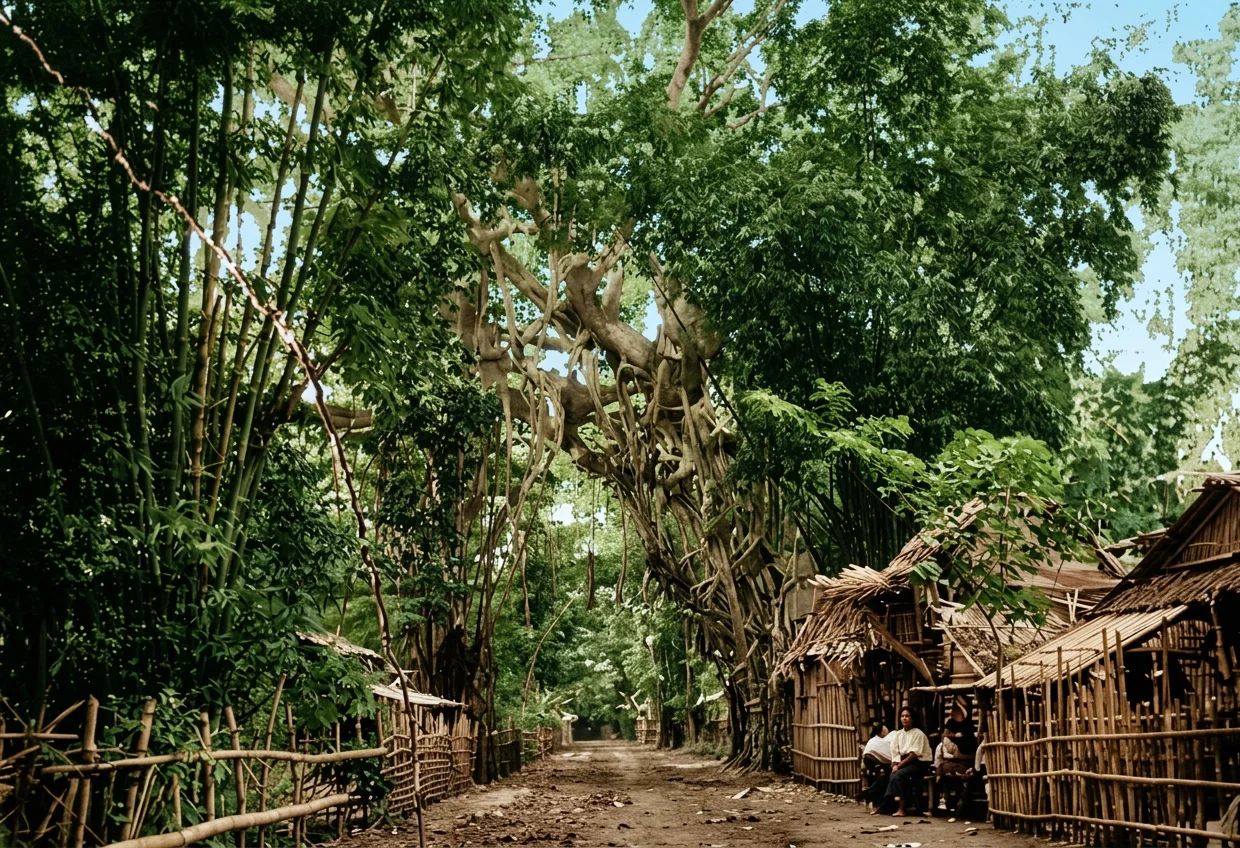
A SCENE NEAR MANILA
There are 3,140 islands in the Philippine group. From the census of 1903, taken and published by the United States government, I find that the archipelago has a population of 7,635,426. Manila has a resident population of 219,928, and, besides, it is estimated that there are 15,901 in vessels and boats in the harbor. The United States employs and pays in full at the present time about 4,300 teachers, eight hundred of whom are Americans, at salaries ranging from one thousand to eighteen hundred dollars a year. The others are native teachers, who receive an average fifty dollars a month. All this force is engaged in teaching nothing but English.
There are eighteen papers and periodicals published in Manila,—four English dailies, three weeklies, and one monthly; seven Spanish dailies and two monthlies; one Filipino paper.
The language question is also a problem to be solved. In the whole field there are forty-seven different languages, besides a number of dialects. In Manila and its vicinity there are three languages in use,—English, Spanish, and Tagalog. The latter is the native language of this and some other minor provinces, and is used by these natives in speaking to one another. Spanish is still the official tongue, and will be, according to the general order, until Jan. 1, 1906, when the English is to take its place. It is claimed that there is more English spoken now than Spanish.
Notwithstanding the Spanish ruled the country for many years, they did not encourage the natives to learn Spanish, believing, as the Dutch do in the Netherlands East Indies, that it is easier to rule and control the native peoples when kept in ignorance of the language of their rulers.
War prices still prevail, and as a consequence living is very high. Wages are also high, but the spirit of extravagance that always accompanies high wages, uses all their surplus. The soldier gets sixteen dollars gold a month, and is roomed, boarded, and clothed, and yet very few of them save anything. Clerks in the departments get from one to two hundred dollars a month. Ordinary policemen get ninety-five dollars a month after the second year. Board and house rent are in proportion, or even higher. A small house such as white people care to live in, rents for from forty to sixty dollars gold a month; while larger and more commodious ones reach as high as seventy-five or one hundred dollars. A nipa house, or shack, as the Americans call it, rents for from ten to twelve gold dollars. In good weather foreigners could get along quite well in such a house, provided they could get one by themselves; but in the rainy and typhoon season, I should think those houses would be quite uncomfortable. I have talked with a number of the American business men in the town, and they say that the price of everything runs from twenty to thirty per cent higher than it does in the States.
While at the government offices to obtain a copy of the late census, I called on the governor-general, Mr. Luke Wright, of Memphis, Tenn. He received me in that cordial, graceful style for which the Southerners are noted. We had a very pleasant visit for fifteen minutes. During the conversation he asked me to what denomination I belonged, and when told, he smiled, and said, “Your people believe in working six days as well as resting on the seventh. It would not be a bad thing to have some of your people over here to teach these people how to work.” I asked, “Will you give us a free hand if we come?” “Surely,” he said; “this country is free to everybody except criminals.” He then referred to the fact that he was officially connected with the government of Tennessee when Don Dickerson came down to plead the cases of our brethren who were arrested in Obion County, and that he heard the trial through. So he is not a stranger to our belief on the Sabbath question.
I could have awakened quite an interest while here, had I thought it for the best. It soon became known at the hotel that I was an Adventist, and they wanted to know when that denomination came into existence, and what we believed. And when I told them a few things about the Sabbath and the second coming of Christ, they said, “That seems all right. Let us hear more.” But I did not wish to stir up their interest, as we had no one to labor among them.
Manila is the place in which to start our work. It seems to me that we should begin with canvassing. They did not know of any books ever having been sold there by subscription. They have an agent of the Bible Society, but I understand his work is confined to Bibles. I have heard of no law that would hinder any one from selling books on the subscription plan. Some have wondered if it would not be best to get some American canvassers, but I find quite an interest in, and good feeling toward, Australia and Australians, and I think that our Australian believers, with the books having the imprint of that country, could do a good work. They get their meat and butter from Australia, and why not their spiritual meat as well? We need men here who will not faint at little difficulties, or large ones, and turn homeward. A beginning should be made at the earliest possible moment. Each month of delay will make it more difficult.