The Origin and History of the Text of the American Standard Edition of the Protestant Bible
By George L. Robinson
(Concluded)
King James’s Version; or the Fifth Revision of the Protestant Bible (1611)
THE Catholics published their New Testament in 1582. Among Protestants at that time, there was a growing rivalry between the Bishops’ Version, which enjoyed the ecclesiastical sanction of Anglicans, and the Genevan, which was the Bible of the Puritans. The necessity of having one authorized Protestant translation became more and more apparent. King James favored the idea, and called an ecclesiastical conference of both parties. In due time, fifty-four (or more probably only forty-seven) representative men, who were learned in Hebrew and Greek, were appointed to undertake the task, and the enterprise was launched.
Fifteen rules were drawn up to govern them in their work. How they actually proceeded is not definitely known; but from Dr. Smith’s preface to their version we may be sure that they carried out most thoroughly and systematically their instructions. They were divided into six companies, two meeting at Cambridge, two at Oxford, and two at Westminster. The work was apportioned among them. The time spent in the execution of the task was about two and three-fourths years. They are known to have consulted many sources. In their order of words, choice of vocabulary, striking phrases, and concise and literal renderings, they were sensibly influenced also by the Rhemish Testament. But their version differs from the Rhemish in seeking to fix an intelligible sense on the words rendered, and in leaving the literal renderings uncolored by any expository notes.
The faults of the King James’s Version, though insignificant compared with those of other versions of the same period, are nevertheless not inconspicuous. (1) Its inequalities. In the Old Testament, Job, the Psalms, and some of the prophets are very defective; in the New Testament, the epistles, but especially Romans and Corinthians, are poorly done. (2) It contains faulty renderings and occasional interpolations due to the scanty materials at the revisers’ command. The science of textual criticism was scarcely born in the seventeenth century. Only two of the great MSS. were known to them. (3) It fails to bring out the different shades of thought. The revisers’ knowledge of the niceties of Greek and Hebrew philology was limited, and so they often failed to catch the full force of a root, an article, a tense, and certain particles in the originals. (4) It sometimes obscures important distinctions through translating two or more words in the original by one in the English. (5) On the other hand, it frequently creates distinctions for the sake of variation when faithfulness to the original required the same word. The principle of avoiding mechanical uniformity is a legitimate one, but it is easily abused.
The merits of King James’s Version are especially noteworthy. (1) It is a revision, not an arbitrary translation disregardful of its English antecedents. On its title page it is described as “newly translated out of the original tongues, and with the former translations diligently compared and revised.” It represents, therefore, a fresh stage in the process of correcting and polishing through which the Protestant Bible has passed. (2) Its general accuracy. Almost every change which the revisers introduced was an improvement in the direction of absolute correctness. Bishop Westcott says: “When every deduction is made for inconsistency of practise and inadequacy of method, the conclusion yet remains absolutely indisputable that their work issued in a version of the Bible better—because more faithful to the original—than any which had been given in English before.” (3) It was the product of the ripest scholarship, not of one party, but of many parties. (4) Its matchless vocabulary and style, which are “equally admired by friends and opponents.” The revisers appropriated happy expressions wherever they found them. Their version is, therefore, a kind of mosaic of the best results of previous revisions. Not less than ninety per cent of its words are Anglo-Saxon. It combines Saxon strength and Norman grace with Latin majesty. It belongs to the golden age of English literature. It is elevated, venerable, sacred. It reads like poetry. As F. W. Faber has said, “It lives on the ear like a music that can never be forgotten—like the sound of church bells.”
But the original version was poorly edited, and consequently there arose variant editions. What is especially singular is the fact that though called the “Authorized Version,” so far as history knows, it was never authorized; and, though the canons and constitution10of the church in 1631 designated King James’s Version as the one with which every parish should be provided, yet two years later even these were rejected. Still, for nearly three hundred years it has held its place as the universal vernacular of the Protestant church throughout the English-speaking world.
The English Revised Version; or the Sixth Revision of the Protestant Bible (1881-85)
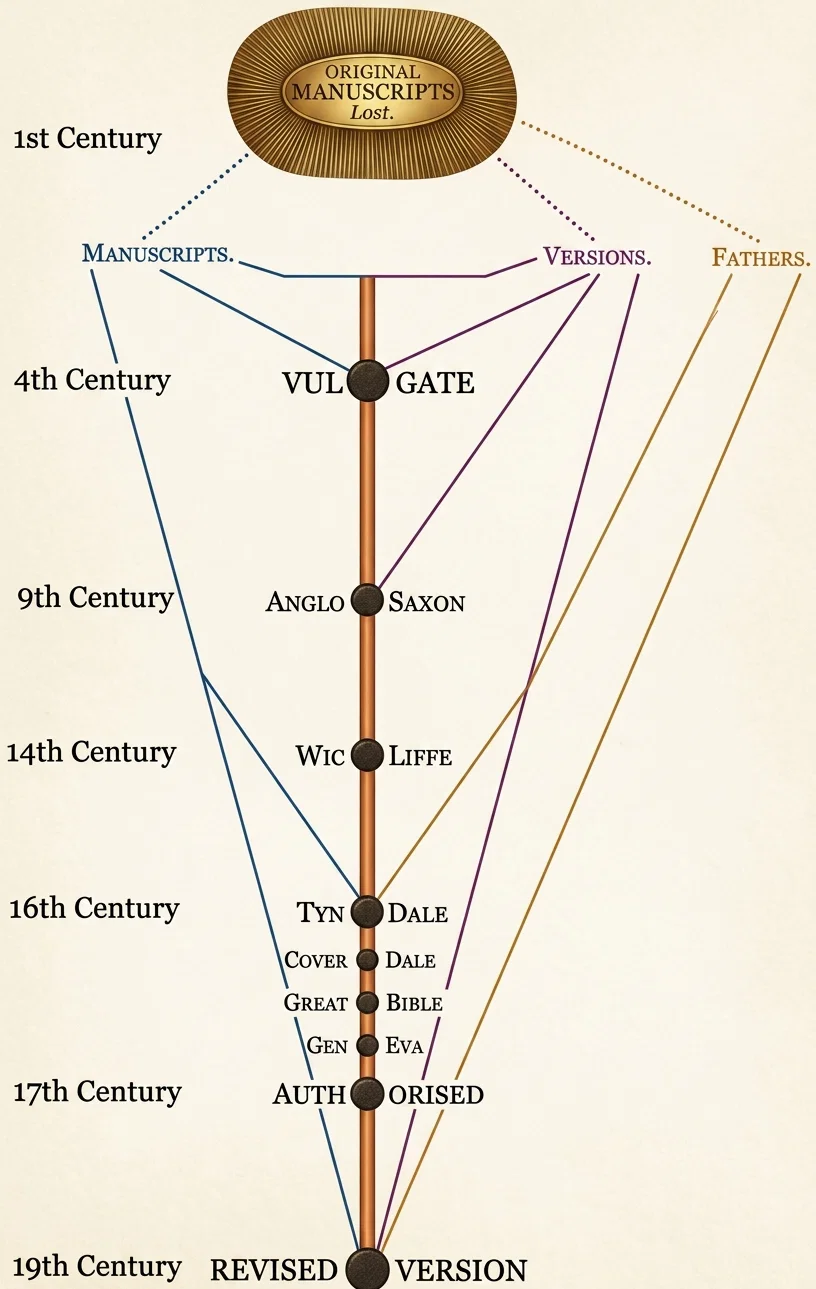
DIAGRAM SHOWING HOW WE GOT OUR BIBLE
As early as 1646, Dr. Lightfoot, in a sermon before the House of Commons, proposed a fresh “review and survey of the translation of the Bible,” and pleaded for “an exact, rigorous, and lively translation.” In 1652, and again in 1656, an order for a new revision was introduced into Parliament, but was dropped because of the dissolution of Parliament. Various other futile attempts to secure revision were made during the next century; the time was not yet ripe. Finally, in 1870, the Convocation of Canterbury took the initial step of a movement which resulted in producing what is known as the English Revised Version, or more correctly the Anglo-American Version.
Strictly speaking, it was a project launched and carried to its final consummation by the Church of England, though many celebrated linguists outside that communion were invited to and did assist in its execution. No less than ninety-nine representative scholars, of whom thirty-four were Americans, had a hand in its accomplishment. Old and New Testament companies were formed in both England and America; those in England meeting in the famous Jerusalem Chamber of Westminster Abbey, those in America at the Bible House, New York City. Ten and one-half years were spent on the New Testament, and nearly fifteen on the Old. The rules which governed them were, to introduce as few alterations as possible into the text of the Authorized Version consistent with faithfulness; to limit as far as possible the expression of such alterations to the language of the Authorized and earlier English versions; each company to go twice over the portion to be revised, once provisionally, the second time finally, all changes on the second revision to be ratified by two thirds of those present; the text to be that for which the evidence is decidedly preponderating; variant readings to be indicated in the margin.
Accordingly, the Old Testament Company used the Massoretic Hebrew text, and the New Testament Company a critical text based upon the newly discovered MSS. The character of their work was most thorough. It is usually called a “revision,” but so far as the New Testament is concerned it was little less than a new translation, being based upon a text older and purer than the so-called Received Text.
The simple aim of the entire committee was, without bias or sectarian prejudice, to give to the people an accurate and idiomatic equivalent for the Hebrew and Greek Scriptures, on the very basis of the idiom and vocabulary of the Authorized Version. Whatever defects their version may be found to have, it can never be charged with want of faithfulness. In removing from the Authorized Version its archaic and obsolescent expressions, freeing it from its artificial distinctions, and restoring certain real distinctions which had been obscured, correcting its slight errors, and bringing out more vividly the force of an occasional article and verbal form, the revisers were actuated by one sincere motive, to make the English Version as perfect a transcript of the original Word of God as was, humanly speaking, possible.
That they succeeded, in part only, was entirely natural. Their age was a critical one, and their perspective was naturally critical. Moreover, the Authorized Version, which they attempted to improve upon, was exceedingly precious to many a believer’s heart. Its language had become a part of its message. The revisers had in many cases ruthlessly, it seemed, altered passages which were very dear, and had substituted a verbiage which lacked both in idiom and rhythm. Of the thirty-six thousand changes in the New Testament many appeared to be changes for the sake of change. Hence their work was not appreciated. Twenty years have passed, and still it is valued chiefly by scholars. Yet it was intended to be a popular translation for the people. But its improved grammatical accuracy is not a sufficient compensation for the music of the old cadences, which in too many cases has been sacrificed for some trifling point in syntax. “Two thirds” majorities decided many of the changes, but to-day the reading public are deciding that the English Version can never displace the Authorized; and scholars are from time to time showing that in certain instances it is even less true to the originals than the old.
The American Standard Edition; or the Seventh Revision of the Protestant Bible (1900-01)
The American Revised Version is but a fresh recension of the Anglo-American or English Revision. It continues, corrects, and completes, as it were, the work undertaken by the Church of England in 1870. And, in a very true sense, it is essentially and historically the product of both American and English scholarship; it may fitly be regarded as the result of thirty years of active and almost ceaseless study on the part of many of the most scholarly men in the Protestant world.
When the copyright was given to the University presses of Oxford and Cambridge, it had been stipulated that for fourteen years the English Revision as published by them should contain in an appendix the preferred American readings; and it was promised by the American Committee that they, on their part, would sanction no other version during that period. The contract, which was faithfully kept by both parties, expired in 1899. Meanwhile, it became evident to the American Committee that their readings were regarded with sympathetic11favor on all sides, and in some cases by the English themselves. They also saw that they could improve in some particulars their own hastily prepared list, through addition and correction. Accordingly, they were encouraged to go forward. They not only revised their own readings of 1885, but added other new ones, and also revised the titles and headings of the various books of the New Testament, which the English Revision had left untouched.
It must be acknowledged that their changes show the touch of master workmen. One of the latest writers in England says of the American Revision, “That many improvements have been made upon the revision of 1885, none would wish to deny.” They labored with the conviction that every jot and tittle of God’s Word is important. And so they kept on, perfecting and polishing what their predecessors had bequeathed to them. For example:—
(1) For the first time in the history of the English Bible, the sacred name of “Jehovah” is given uniformly as the equivalent of the Hebrew name wherever it occurs in the Old Testament. All other Protestant versions and the Douay arbitrarily substitute for the Hebrew either “Lord” or “God,” thus slavishly following the Jews in reading the vowels instead of the consonants. But “Jehovah” was the personal name of the national God of Israel, which signified that he was their Redeemer and Saviour, the self-existent and covenant-keeping God; hence it ought no more to be obscured in the Old Testament than “Jesus” in the New.
(2) Correspondingly, in the New Testament, the American revisers are the first to use uniformly “Holy Spirit” for “Holy Ghost,” the intrinsic merit of which far outweighs the objection raised by Lupton that the latter “has become so deeply embedded in the creeds and formularies of the church that it would be difficult to displace it.” The English Revision had made the change already in certain cases; the Rheims has not begun to make the desired transition.
(3) “Sheol” and “Hades” are used for “hell,” “pit,” and the “grave,” when the abode of the dead is intended. Whether these foreign words will ever become naturalized one may reasonably doubt, but we have assimilated, directly or indirectly, from the Hebrew, Sabbath, manna, Satan, behemoth, Sabaoth, cherub, Nazarite, shekel, and many others, and why not these? The principle of introducing a loan word when the English has no proper equivalent is a sound one. The Catholic Version clings steadfastly to the old terms.
(4) In the use of euphemisms, to avoid words or expressions somewhat indelicate to the modern ear.
(5) In many passages, the American Standard Edition brings out more accurately than any other in the English language the true meaning of the original writers. This can be demonstrated.
Taken as a whole, it is the most faithful, the most accurate, and the most truly idiomatic version of Holy Scripture ever made in English for popular use. Well may the American Bible Society venture to issue the Standard Edition along with that of King James. It brings the reader more closely into contact with the exact thought of the sacred writers than any other.
Its excellences are manifold. In spelling, pronunciation, and grammar, in paragraph divisions, titles, marginal references, and parallel passages, in headings and chapter and verse divisions, in the elimination of Hebraisms and archaisms, and especially in its conformity to the originals, it is the model of what an English version ought to be. In short, it is simple, chaste, idiomatic, rhythmical, stately, scholarly, loyal to the truth, and in every sense, a living book, because the eternal truth of God has been reclothed in garments which are living and new.
Chronological Table of Bible Translations
250-150 B. C. Old Testament translated into Greek—Septuagint Version.
100-200 A. D. Bible translated into Latin—Itala Version.
390-405. Bible translated by Jerome—Vulgate Version.
1382. Wycliffe’s Version, translated from the Latin: the first complete Bible in English.
1525. Tyndale’s Version of the New Testament: from the original Greek.
1535. Coverdale’s Bible: the first complete printed English Bible.
1537. Matthew’s Bible (John Rogers’): the first revised and the first authorized version of Scripture.
1539. Tavener’s: an unimportant revision of Matthew’s version.
1539. The Great Bible: Coverdale’s revision of Matthew’s.
1557. Whittingham’s New Testament: the first in English to have chapter and verse divisions.
1560. Genevan Bible: the first complete direct translation into English from the originals throughout, and the first to be executed by a company of men rather than by a single individual.
1568. Bishops’ Bible.
1568. Catholic Seminary established at Douay by Wm. Allen.
1578-93. Douay Seminary temporarily transferred to Rheims.
1582. Rheims New Testament: the first Catholic translation in English.
1592. Clementine Edition of the Latin Vulgate: the first and only authoritative Standard Catholic Edition.
1609-10. Douay Old Testament: the first complete Catholic translation of the Bible in English.
1611. King James’s, or the Authorized Version.
1629. First Authorized Version to omit the Apocrypha.
1701. Bishop Lloyd introduced Usher’s “Chronological Notes” into the Authorized Version.
1750. Bishop Challoner’s Revision of the Rheims-Douay Version.
1782. Aitken’s Bible: the first Protestant Bible printed in America.
1790. Carey’s Bible: the first Catholic Bible printed in America.
1881-85. English, or Anglo-American Revision.
1901. The American Standard Edition.—Prof. George L. Robinson, Ph. D., in The Bible Record for November, 1905.