Fiji

7%

Review and Herald Publishing Association · Washington, D. C. · Mar 1, 1906

FromReview and Herald, Vol. 83, No. 9.

Read the full edition

Fiji

C. H. PARKER
At the beginning of the nineteenth century the people of Fiji were in the midnight darkness of heathenism, and were practising all the abominable rites of superstition. Temples dedicated to the devil were the only places of worship among them. These drew the veil of blindness over every town, and Satan rejoiced as the smoke of the burning flesh of human victims arose from these abodes of darkness. How true the scripture, “The dark places of the earth are full of the habitations of cruelty.” Cannibalism of the grosser sort was indulged in with seemingly no compunctions of conscience. Cakabau (pronounced Thackambau), who was the leading king in Fiji, went so far as to eat only the tongues and hearts of the victims of this cruelty, giving, as his reason, that the heart devised mischief, and the tongue spoke it. The life of no one was safe. Towns were depopulated, and tribes broken up. Continual warfare was carried on that their fiendish appetites might be satisfied.
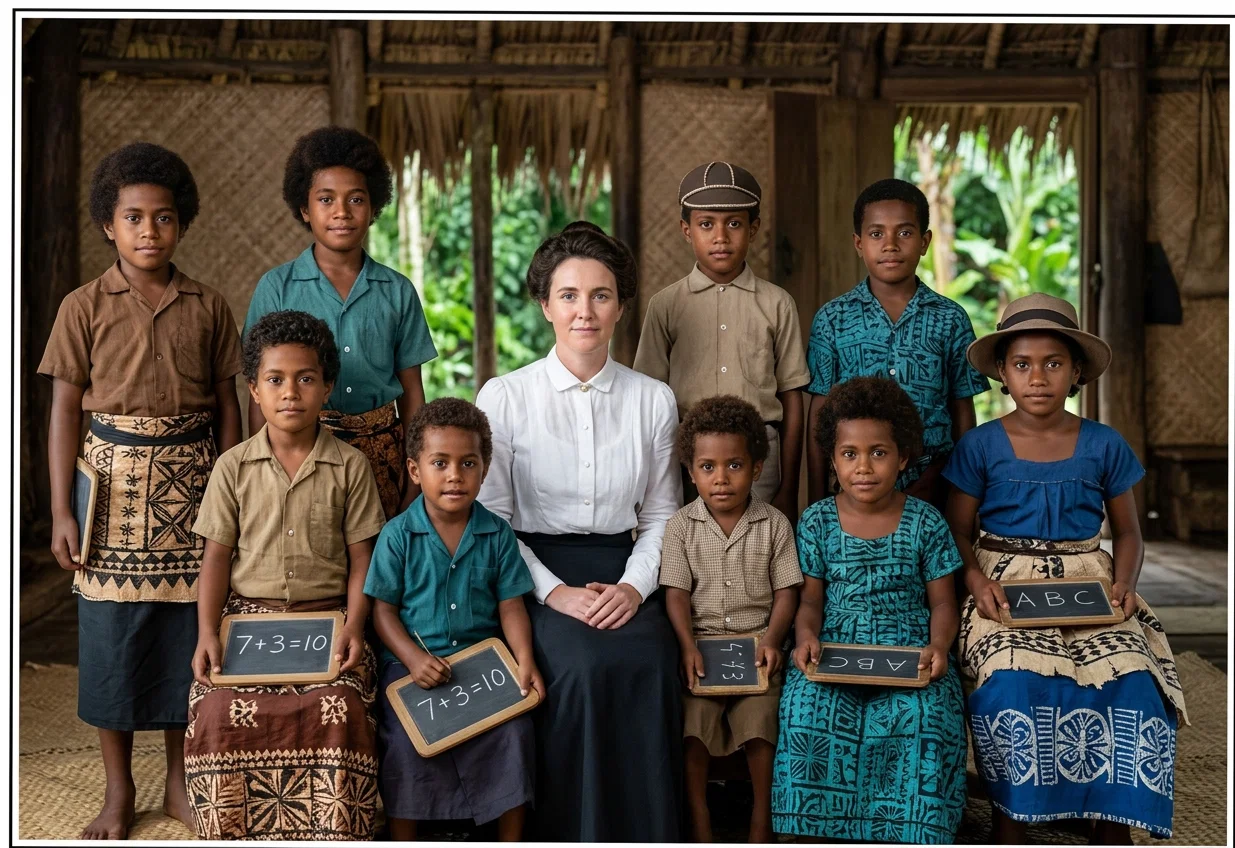
FIJI SCHOOL CHILDREN
About the year 1825 the gospel gained a foothold in the Tongan Islands, and soon was imparted by some of the native converts to the Fijians in the Lau, or eastern division of the Fijian group. About the year 1835 two Wesleyan missionaries, Pastors Cargill and Cross, established a mission on the island of Lakeba (Lakemba). Afterward they tried to begin work at the capital, which was Bau, but King Cakabau, being engaged in a war, would not allow them to settle there, but gave them permission to start a mission on the island of Viwa, a few miles from Bau. Cakabau, meeting reverses in the war that he was engaged in, sought help from King George of Tonga. King George sent word back that if Cakabau and his people would accept Christianity, he would come to his aid. This condition was yielded to, and he received the support promised. The proclaiming of the gospel in Fiji went with power at the time of the giving of the first angel’s message, and since then the whole group has been Christianized, so that all are nominally Christians, though it is equally true that a large number do not work at their profession.
Every town has its native pastor, who has to do with the teaching of the children from earliest childhood. Religious services are held Wednesday, Saturday, and Sunday evenings, also on Sunday morning at sunrise, and at ten and three o’clock.
The Fijian people are very devotional, and they never tire of meetings. Morning and evening worship is strictly observed. A pen picture of the inside of a church and their mode of worship might be interesting.
Their churches, except a few wooden structures which have been built during recent years, have no wooden floors or seats. Mats cover the ground, upon which they sit with their legs crossed under them. The only articles of furniture are a pulpit and a blackboard. As the people enter the door of their meetinghouse, they drop on their knees and bow their heads to the floor; they will either crawl or walk in a stooping manner to their places. The children always sit in front, while the women sit on one side of the building, and the men on the other side. The chiefly men and those who occupy positions, either in the government or in the church, sit behind and on either side of the pulpit. Fifteen or twenty minutes before the meeting begins, the people take their places, and the women chant the catechism. When the minister is seen coming, two young men beat, with four clubs, the lali, or native bell, which is a log from four to six feet long, hollowed out. As the teacher enters the door of the church and bows down, the women take up a chant that the Lord will bless him. After the singing of the hymn, the teacher offers prayer, then the women chant another petition that the Lord will bless his word, and close with the Lord’s prayer. This is all performed with their faces bowed to the floor. Each sentence always ends with a jerk or grunt. After another hymn theinstruction is given, then a closing hymn, and the benediction is given upon bended knee, with the chanted refrain from the people for God to help them to do what the minister has said. Perfect quietness and order prevail throughout the whole service.
Babies are christened the same as they are among the Europeans with the exception that the rite will not be performed unless a shilling is forthcoming.
Once every quarter they have a love-feast, and the sacraments are administered. At the end of each year they make a great feast. The young men and young women and children, with their bodies oiled and painted and bedecked with different ornaments, furnish amusement to the older people by singing, which is accompanied with different motions of the body, as well as of the head and the hands and feet. The singing is mostly historical and religious. War dances are always connected with this occasion. A teacher of elocution would feel that he had reached the acme of his profession, if he could but behold the graceful movements of these children of nature. Perfect rhythm and time are kept. During these entertainments mats are placed on the ground in the center of the rara (town commons), and a leading minister, with a number of subordinate ones on either side, sits down upon them. Then all vie with one another in seeing who can give the most money. They will have their money changed into the smallest coinage, for they seem to love display as well as white people, and they will pass up before the minister and throw down one or two coins. In a short time they will do the same thing again, and will continue to repeat this act until their supply is exhausted. Each time a piece of money is thrown down, all the ministers will clap their hands and say, Vinaka, vinaka (good, good).
The marriage ceremony is very interesting. The persons concerned must first get the consent of the town chief who is the town father. Then they are married, but have nothing to do with each other till some time later when they have a reception. Their friends come from all directions, bringing all the needful things for the setting up of housekeeping. Tappa (native cloth) is wound around the bodies of both bride and bridegroom till they take on enormous sizes, then the remainder is piled upon their backs, and they, bending and sweating under their load, bear the first-fruits of their married life to their new home, and for the first time they live together. For about four days after they are married, they neither bathe their bodies or faces nor comb their hair.
God has in the past blessed the labors of the Wesleyan missionaries here; but at the present, as in a great many other Protestant denominations, form has taken the place of the spiritual life, and a hollowness pervades all their spiritual exercises. How true it is, when we fail to keep step with the light, our abode becomes darkness.
The third angel’s voice is beginning to be heard by this people, and some who have been sitting in darkness are seeing great light, and are responding to the divine pleading. Persecution is brought against them, but they would rather suffer reproach with the people of God than to enjoy the pleasures of sin for a season, for it is given us not only to believe on Jesus, but also to suffer with him.
Mualevu, Loma Loma, Lau.