ON the thirteenth of December, in company with Brother Isaac and several others, I left home for a short visit to the Sabbath-keepers at Ranquitte and Hinche. The brethren had planned a general meeting to be held at the latter place, and such, indeed, it proved to be, for each of the three little companies in Hayti was well represented.
We arrived at Ranquitte on the afternoon of the second day, and found that nearly all the members of this company had already gone to the place of meeting, leaving word for us to follow. Being unable to do so that day, we concluded to remain there overnight, and finish our journey early the next morning. In the meantime I looked over the town, and called on some of the people. Ranquitte is situated high among the interior hills of Hayti. The air is fresh and cool, the water abundant and pure, and the soil very rich. The houses for the most part are built of mud, and thatched; but a few are of Spanish wall with corrugated iron roofing. By far the largest building in the place is the Catholic church, which, by the way, as a thing of beauty and cleanliness, could hardly be considered a good example for the people to pattern after. But what interested me most of all was what we may call the Seventh-day Adventist church. The past summer the Baptist congregation of fourteen members who owned this building, all embraced the message for this time, and as the church was their property, they naturally still retained possession of it. It is one of the neatest and best-built buildings in the town, and is the only Protestant church for miles around; as an example of true Protestantism, it will no doubt be a beacon light among the Haytian hills.
Four hours in the saddle the next morning brought us to our destination, the home of one of the members of the Ranquitte company. Here a booth of cocoanut branches had been erected for the meetings, and ample provision made for all who might attend. The power and presence of the Spirit of the Lord was felt in all the meetings, of which we held ten in two days. On the Sabbath afternoon four willing souls were buried with their Lord in baptism, and immediately afterward we celebrated the ordinances for the first time in Hayti. The solemnity that rested upon this service will not soon be forgotten by those present. These meetings resulted in strengthening our believers, and one man of intelligence from a place far to the south publicly declared his determination to keep the commandments of God and the faith of Jesus. On this trip we also learned that since our last visit to Grande Riviere the government doctor there has begun to observe the Sabbath. Thus we are able to report that the work still continues to gain ground.
Having now seen all the Sabbath-keepers in the republic, except two or three in the southern part, I am able to report as to the general aspects of the work here. Those who have embraced the message are, as a rule, from among the better class of native Haytians.
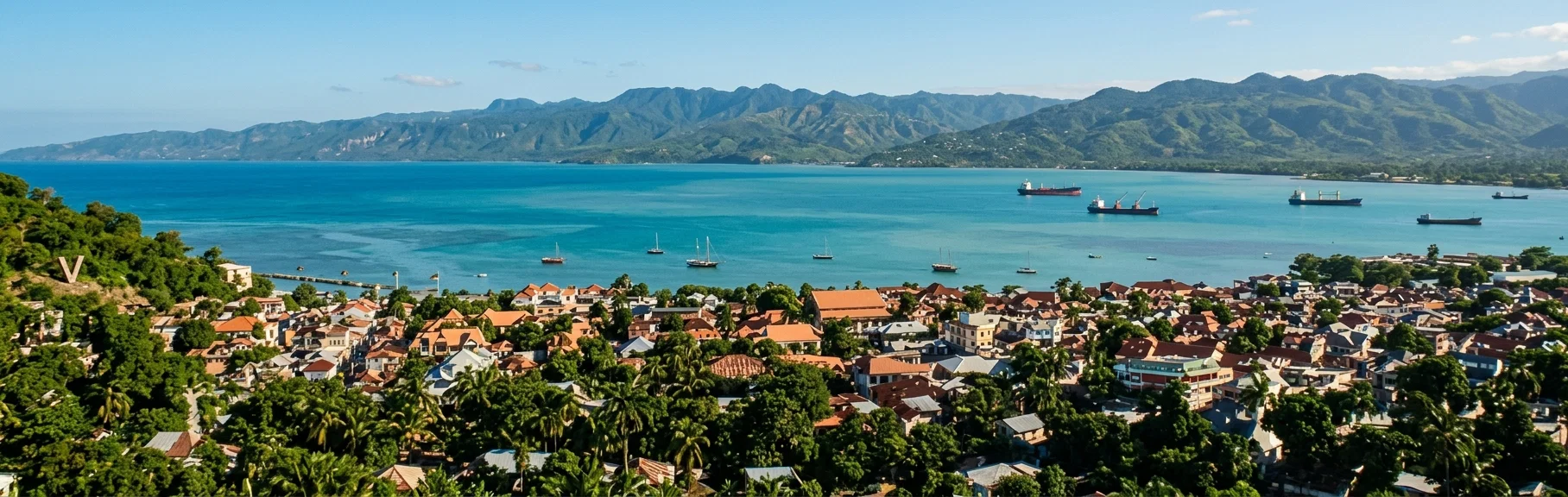
A VIEW OF CAPE HAITIEN
There are between forty and fifty Sabbath-keepers, fully four fifths of whom are educated. The significance of this will be appreciated when it is remembered that only ten or twelve per cent of the entire population can read or write.
Another feature of the work here is that the majority of the commandment-keepers are men. Among these are several young men of more than average intelligence, who, if they continue faithful and devoted, will help us solve the problem of supplying workers for this field when the time comes to increase our forces.
Of course it is not to be expected that these new Sabbath-keepers should be thoroughly informed on all points of our faith so soon after having left the errors of Babylon. However, they had a good understanding of the second advent and Sabbath questions when I came. One of the first things they asked me to explain was the state of the dead. In explaining this and other subjects it has greatly warmed my own heart to see the eagerness and satisfaction with which the truth is received by them. In this work, as well as in getting the truth before those who have not heard it, Brother14Isaac, the young teacher of whom I spoke in a former report, is a great help. We are able to instruct him, and then he is willing and glad to go and freely give to others that which he has received.
The chief difficulties that seem to stand in the way of the progress of the message here are the instability of the currency, the value of which is so uncertain from day to day as to make canvassing well nigh out of the question; the ignorance of the masses, which would naturally limit our canvassing work to the comparatively small per cent of educated people; and Roman Catholicism, the influence of which against truth and progress is well known. However, it is a source of consolation to know that the power of God which is in this cause will, somehow and surely, brush aside these obstacles, and quickly and effectively carry it, not only to Hayti, but to every other difficult country. That the Spirit is at work in Hayti there can be no doubt; the problem is how to keep pace with its movings.