LEAVING the wonderful city of La Paz, whose walls Jehovah has built, our electric train wound its way upward, around hills, over little valleys, making loop after loop, ever upward to the “alto” fifteen hundred feet above. One last look at the beautiful city lying at the bottom of that great hole in the vast plain that stretches out in all directions, and we take our train for Lake Titicaca. Over mile after mile of almost barren plain we speed on our way. We pass native Indian huts here and there, sometimes in little groups and sometimes in large settlements, all made of adobe or mud, with thatched roofs. The llama, one of the most common domestic animals of the high altitudes, is often seen along the way in groups, with burdens tied to their backs, or feeding on the tough, wiry grass that grows in little bunches on these plains.
Our train stops at a small town, and on the right not far from the station can be seen the ruins of a once-famous Inca temple, some of the large stone pillars or columns still standing. Lying only a few feet from the track, and just where our car stopped, was a massive stone from the temple. A little farther on, and some distance back from the track, we could see on our left some large stone towers built on the low mountains just above the plain, where we were told that some of the Inca rulers were buried.
We reached Guaqui, which is located at the extreme southern end of the lake, in time to get aboard the steamer “Coya” before supper. We were pleased to learn that we were to take what is known as the Northern Route, sailing around the east side of the lake, stopping at several small ports by the way, to the northeast side, and then straight across to Puno, which lies on the west shore. This is the longer of the two routes, taking us two nights and a day to reach Puno, but it gave us an excellent view of this beautiful and famous body of water.
Lake Titicaca lies nearly two and one-third miles above sea level. It is nearly one hundred and twenty miles long and sixty miles wide, and is surrounded by mountains that rise in many places abruptly from the water’s edge. As one views the landscape from the steamer deck, it has in many places the appearance of a patchwork quilt, due to the fields and little plots of ground that have been terraced and walled with stone by the Indians. These plots are of all sizes and shapes, according to the lay of the ground, one above another to the very top of some of the mountains. Some of the valleys running back from the lake are very beautiful, with these terraces running up on either side and as far back into the hills as one can see. Not all is so beautiful, however, for above the timber line not a tree or a shrub can be seen. The Indians living around the lake are found in the valleys, and when our steamer was near the shore, their little adobe houses could be plainly seen. There are several islands in the lake, the two largest of which are named after the sun and the moon, both famous in Inca tradition. Several times we saw a mirage in the distance, beautiful trees or rocky islands rising out of the water and then disappearing as we drew near or as our boat changed its course.
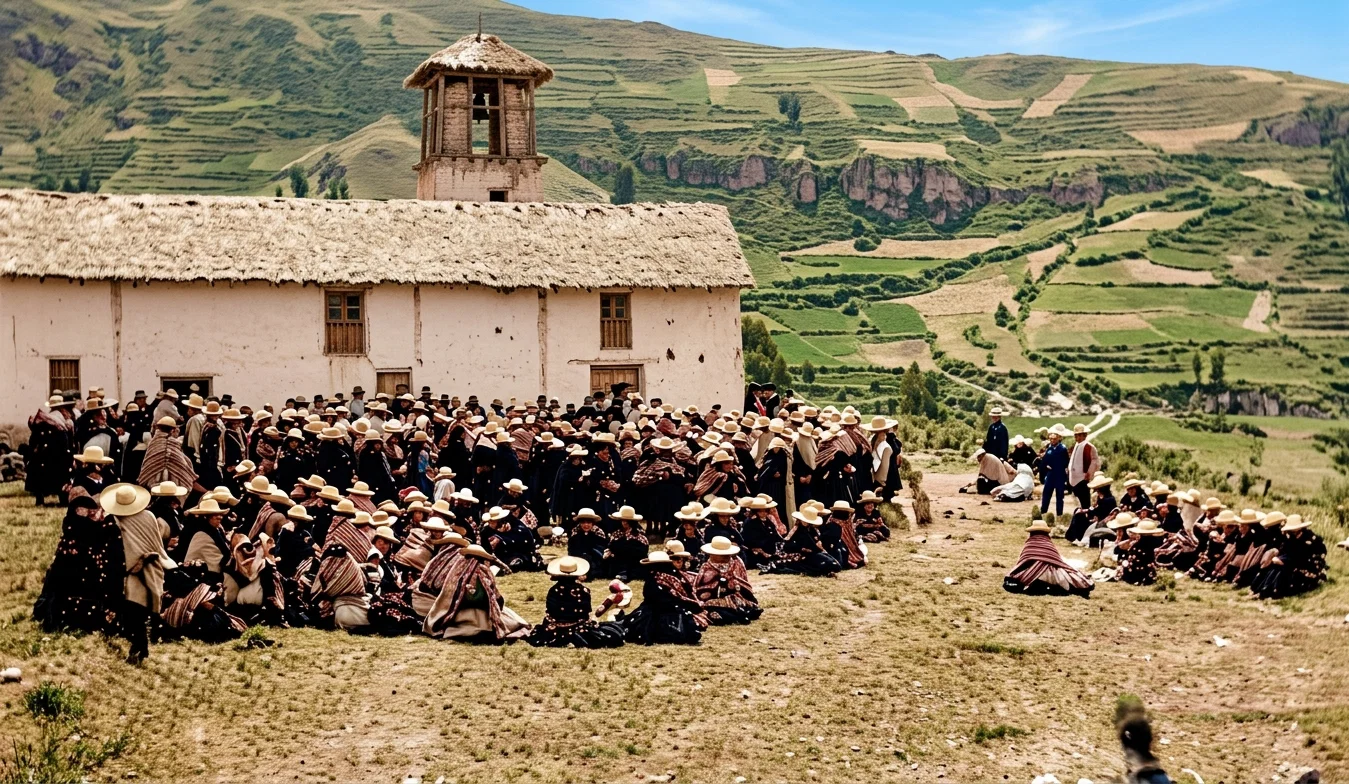
This shows a quarterly meeting in progress at our Indian mission at Plateria, Peru. The church building adjacent is not large enough to hold the congregation, so in this orderly manner these sacred ordinances are observed outside.
Early Friday morning we disembarked at Puno, and found Brother Stahl at the dock to meet us. Puno is the terminus of the railway that runs from Mollendo on the seacoast up over the mountains to Lake Titicaca. Like La Paz, the larger portion of its population are Indians. It is the port of entry from Bolivia, and one of the most important cities of that part of Peru. It is the trading point for our mission, which is located about twenty miles south and east along the lake shore. Brother Stahl took us to the home of Brother Arragon, where we enjoyed a good breakfast and arranged to leave the heavier part of our baggage. At the home of one of the sisters, the mission has a room rented that is used by the workers when they come into town, for they usually stay overnight. Here we found our horses waiting for us, in charge of two of our Indian brethren from the mission. Our passage through the town was filled with interest. The low adobe buildings; the narrow
streets paved with small cobblestones; the Indian merchants, traders, and venders, everywhere dressed in their gay colors and peculiar costumes; the pack trains of mules, with their burdens; many groups of llamas, their large, beautiful eyes filled with wonder and fear, timidly moving along, crowding close together and many times stopping, yet urged forward through the narrow streets by their Indian keepers,—all these were new and strange sights to us.
Professor Prescott was given the large roan horse, Brother Town had a fine little black one, Brother Maxwell had the favorite mule, Brother Stahl had his own mule, and I had the big bay horse. A few moments in adjusting saddles, lengthening stirrups, etc., etc., and we mounted and rode away at an easy pace, leaving the town at eleven o’clock. The road runs along the foot of the mountains, across low plains, and over low ranges of hills that run out to the lake.
As we came to the last range that we were to go over, we could see from a distance a group of men on top, each having a banner fastened to a long pole. They were an advance guard come to give us welcome. When we reached the top of the hill, we could see at a little distance on the plain a large number waiting for us with a brass band and many banners. We were soon met by a second company with banners and a band of native music; with this group were the members of the Plateria school, about one hundred pupils, besides teachers. Here the whole company was divided into two lines, one on either side of the road. The band with native instruments went ahead of us, and the brass band followed us, as with flying banners and much music we were escorted to the mission.
Upon our arrival at the mission, the Indians formed in a large circle in the yard, and we were each expected to make a short speech, which we did. Two or three of the leading Indians replied, bidding us welcome and giving a brief review of what had been done for them, and praising God for the blessed truth. Elder and Sister C. V. Achenbach, whom we had known in the States, Brother12J. M. Howell, whom we had met at Berrien Springs, Mich., and his wife, with Sister Stahl and daughter Frena, gave us a most warm and cordial welcome. They did not wave banners at us nor fill our ears with strange and plaintive music, but there was something in the expression of their eyes and in the grip of the handshake that spoke much to us. We were well cared for at the hospitable home of Brother and Sister Stahl.
The mission is nicely situated at the foot of a mountain, and overlooks the plain that stretches away to the lake, about a mile distant on the left, and to the mountain ranges some miles to the right. Scattered here and there over the plain are the Indian houses and settlements. The church building is on the lower side of the road, and just on the edge of the plain. On the upper side are the houses where the workers live. Brethren Achenbach and Howell occupy the house next to the road, each family having two rooms. Brother Stahl’s house is higher up on the hillside, with the dispensary building in the same yard. The Indian workers occupy a small building in the same yard with Brethren Achenbach and Howell, and the corrals are just back of this building. The situation is a commanding one, and the white mission buildings can be seen for miles from nearly every direction. The mission is well known throughout that whole country, for it is on the main road from Cuzco, the ancient capital of the Incas, to La Paz, Bolivia. We were told that this road was built by the Incas in the days of their strength.
When we went into the church Sabbath morning, we found the building full. Brother Stahl told us there were about seven hundred present, and there were many outside that could not get in. The women were all seated on the floor, with their babies tied to their backs; the men sat on the few benches around the sides and in the rear. After the Sabbath school Professor Prescott spoke, then I followed, and in the afternoon Brethren Town and Maxwell spoke. All the talks were interpreted in Spanish, and then in the Aymara, so each sentence had to pass through two interpreters to reach the people. Notwithstanding, the Lord blessed the meetings.
Early Sunday morning, before we were up, we heard music near by. I went to the window, and there were a large number of Indians in the yard with a band of native instruments, giving us a morning salute. This was the beginning of a busy day of work, and of study in regard to the present and future plans for the mission. Many different delegations of Indians were received, for they kept coming from every quarter until nearly midday, and all stayed until nearly night. We spent some time watching the dispensary work, as many of those who came needed medical help.