WITH every effort put forth in these islands to spread the truth for these last days, one is confronted with a great barrier in the faasamoa (Samoan custom); but it would be very hard to explain in a few words all that this means.
One of the degrading things in this faasamoa is the aitagi. The Samoan dictionary defines this as follows: “To eat weeping, a funeral feast. A recently adapted term.” But the Samoans themselves give the true meaning of the word as follows: “The word ‘aitagi’ comes from the word ‘ai,’ to eat, and tagata, man;” so the original meaning of the term ‘aitagi’ was to eat a man.”
In the days of heathenism, it was the custom when a person died, to call together all his aigas (relatives). Each one would bring something to make up the feast. Those who had pigs would bring pigs; others would bring fine mats and siapo (native cloth). A great feast would be made, and there would be an exchange of mats and siapo. But the feast was the most important part of the ceremony to the Samoan; and while it seems hard to believe it, the dead body formed part of the food given to the guests'; and this, with the pig and other foods, the exchange of mats and siapo, the drinking of much kava, and the smoking of native tobacco, formed the aitagi.
One might ask, After all these years of missionary effort, how does that custom stand today? The sad answer is, Just the same as it did in those days, with one exception, that is, the eating of the human body. This the missionaries have succeeded in eliminating from the aitagi, but all the rest stands as it did in those days; and when the news reaches a Samoan that one of his aigas has died, he prepares for the aitagi. Often he is there before death has taken place, for the thing that concerns him most is the feast.
One other very vile practice is tattooing. In many groups of islands the tattooing is confined to the face and arms, but with the Samoans every child has his name tattooed on his arm, and what is worse, those parts of the body that should be kept sacred from the public gaze are decorated in various designs. Tattooing is a very painful operation and causes much suffering. While it is being done, the aigas of the victim sit around on the floor of the house and sing to him, sometimes telling him that Jesus will help him to bear the pain. The operator, and his wife, who frequently assists him, sit on the floor with the victim in front of them. The operator’s tools are made of a number of needles tied together on a short stick. They are made according to the size of the figure in the design to be tattooed in the flesh. The instrument is dipped in a liquid made of candlenut and coconut oil, and is then struck with another stick. This pierces the skin through to about the depth of an eighth of an inch, making the blood flow freely. The woman then wipes off the blood with a dirty rag. Sometimes, on account of the weakness of the victim, it takes a few days to finish the operation. When it is completed, it may take days before even the lavalava can be borne against it, and sometimes the wound will fester and be sore for a long time.
This act is the Samoan recognition of manhood. The chief abettors of this cruel work are the women, for very few women have the courage to endure the ridicule of her people if she takes a man who is not tattooed. He is called a tama (boy) until the operation is performed.
From the foregoing it will be seen that there is much that enters into a Samoan’s life; and the higher his position, the more binding are these shackles of Satan. If a man is chosen chief (and the Samoan has no higher ambition), he is bound from head to foot with Samoan customs. These come first in everything, even before the Word of God. The Samoan professes to have very great respect for the Bible. He has family worship night and morning. At the same time the household may all be living in adultery.
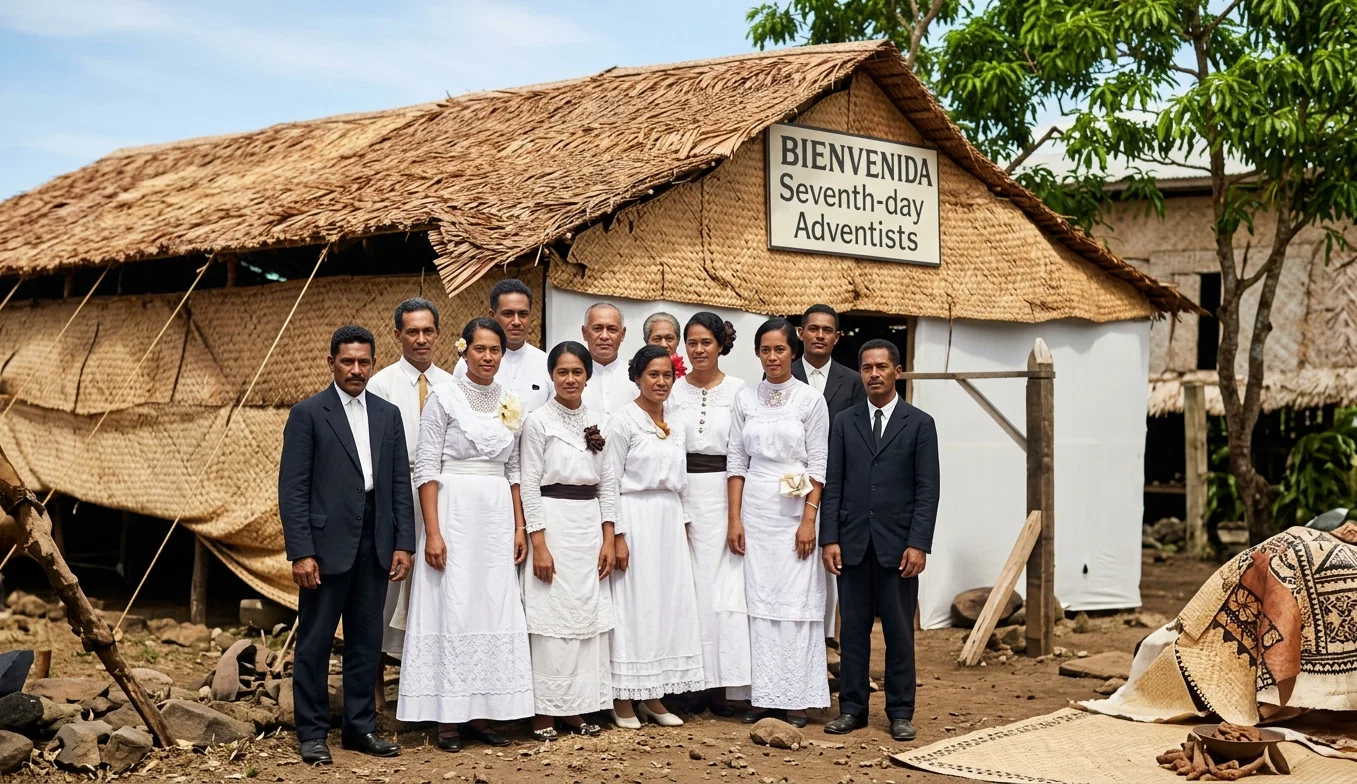
A NATIVE SEVENTH-DAY ADVENTIST CHURCH BUILDING IN APIA, SAMOAN ISLANDS, AND THE CHURCH MEMBERS
Marriage is very little known among them. This is also faasamoa, and is the only excuse presented for breaking the seventh commandment. And this excuse takes precedence of everything else.
Thus it will be seen that this faasamoa stands in the way of God’s work, and makes it very hard for those of older years to break away from its binding claims to walk in the light now shining from the courts of glory. It may be that this is the reason why the servant of the Lord has spoken so much about schools in these island fields, so that the young people may be reached. If the young men can be brought under the influence of this message by training in our schools, there is hope that the leaven will extend, and that more fruit will be gathered.
At present there is quite a strong desire on the part of some of the young men to come to us for training, but we have to turn them away, as we have no school. Our great need is a school.
We have already seen the wonderful power of this message working on hearts bound by these satanic customs. We have also seen the struggles of the evil one in trying to win back those who have been taken from his grasp.