A Visit to Our Mission on Lake Titicaca
6%

Review and Herald Publishing Association · Takoma Park Station, Washington, D. C. · Nov 30, 1916

FromReview and Herald, Vol. 93, No. 59.

Read the full edition

A Visit to Our Mission on Lake Titicaca

(Concluded)
O. MONTGOMERY
MOUNTING our horses Monday morning, we rode away to visit the believers at Whatta, on the peninsula, about eighteen miles from the home station. Juan Huanka, one of the Indian workers, with another young man as assistant, is conducting a school of about ninety pupils and holding Sabbath services at this place. These young men received their training at the Plateria Mission under Brother Stahl and his coworkers, and are now doing acceptable service.
As we came within sight of the place, we could see a large company coming out to meet us with banners, and soon we could hear the strains of their native music. The musical instruments are made of pieces of reed or bamboo of different lengths and sizes, tied together, on which they blow; and with the addition of a large drum and a small one, the band is complete. Before we reached the people, they halted and formed two lines; then as we drew nearer, two young women, with their outer skirts filled with flowers gathered from the mountains, came forward and showered us with the blossoms. Then with music and flying banners we were taken to the chief’s house, where we each made a short speech, to which the chief and the teacher replied. The chief then took us into the house, and himself served us with a real Indian dinner which the women had prepared. It was really a good meal, and after our long ride we ate with a relish.
Dinner over, we went outside and watched Brother Stahl treat the sick. This was an intensely interesting sight. He pulled teeth, gave stomach washes, opened abscesses, dressed wounds, anddealt out medicine, with remarkable skill. He treated between forty and fifty persons in about an hour, and with the most meager facilities,—only a low table or bench on which to lay his instruments, medicines, bandages, etc. With the Indians crowding around, he was scarcely able to keep his footing while at work. The Lord has wonderfully blessed his labors among these Indians, and there have been some most remarkable results.
On our way home we were escorted by the entire company of nearly two hundred as far as the summit of the mountain range. Here, at an old stone altar that had been used in their heathen worship and around which they had held their dances, we bade them farewell, and with music and banners they returned to their homes. We reached Plateria just before night, greatly pleased with the day’s trip.
Thursday we rode twelve miles south to Esquenas, where Brother Martin Velasques, a faithful native, is at work. Here the Indians have built a nice schoolhouse and furnished the teacher with a house to live in, without expense to the mission. At this place the experiences of the day before were repeated almost exactly, so I will not describe them again.
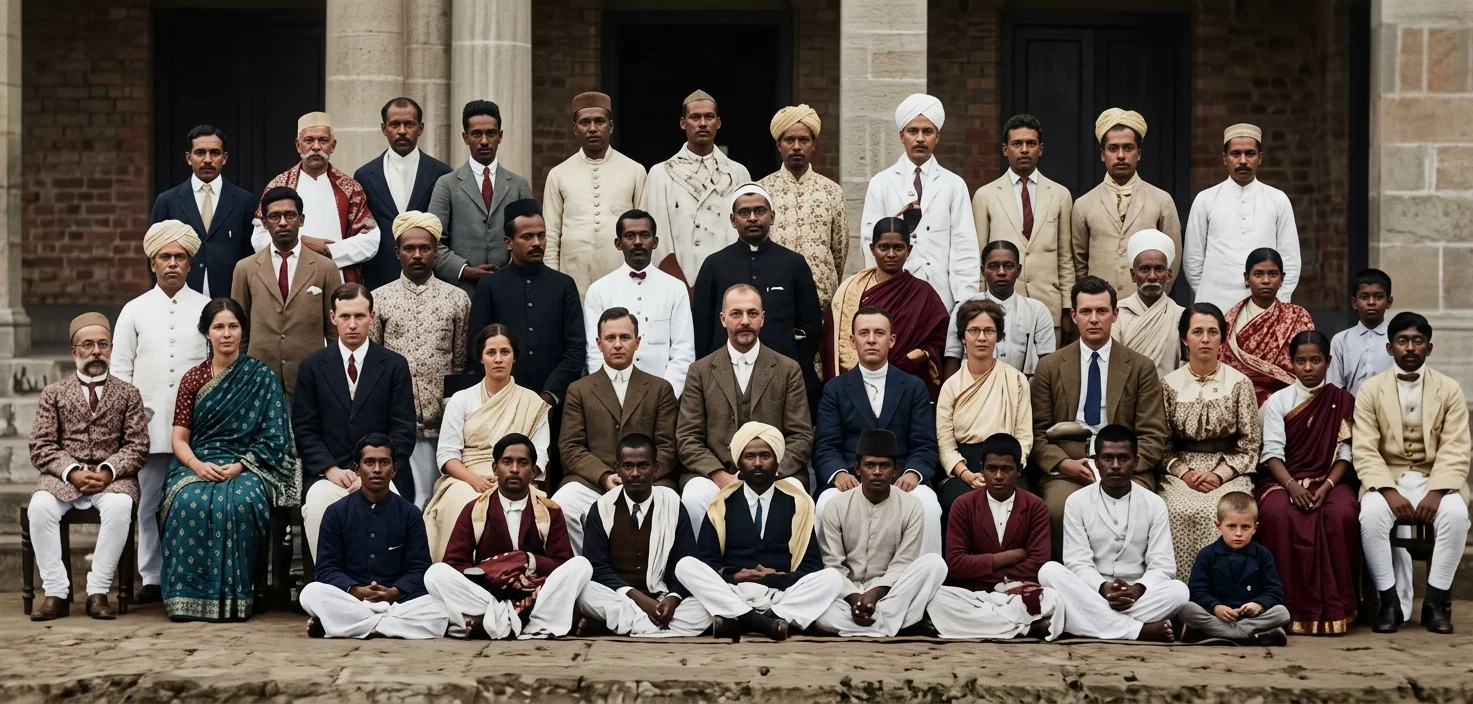
WORKERS GATHERED AT A GENERAL MEETING AT COIMBATORE, SOUTH INDIA
Three languages are represented here — the three main tongues in south India.
WORKERS GATHERED AT A GENERAL MEETING AT COIMBATORE, SOUTH INDIA Three languages are represented here — the three main tongues in south India.
Wednesday was an important day. First, the weekly prayer meeting was held in the church at about seven o’clock. The workers of the mission and about three hundred Indians were present, some having come several miles to attend at this early hour. Professor Prescott gave a short Bible study, and then between forty and fifty of the Indians took part in the prayer service. In the praise service there was much liberty, and a large number spoke. These prayers and testimonies were interpreted into English for our benefit, and we were much impressed with their clearness and depth of meaning. They had the right ring, and it did our hearts good to hear these people praise the Lord for the “true way,” as they expressed it.
About ten o’clock the school from the peninsula came, and a little later the school from Esquenas arrived. Then the Plateria school was dismissed, and the three schools marched in military order up the hill, with waving banners and much music, to the yard in front of Brother Stahl’s home, where they formed in double line, making three sides of a hollow square. Each school in turn went through different exercises, and then one school sang one verse of “Jesus Loves Me,” in English. Following these exercises some of the young men played Indian games for our benefit. These were very amusing.
Among those present were several who had come long distances as special representatives of their tribes, to ask that teachers be sent them. Each was received in turn by the committee. The requests were about the same; all wanted teachers, that they might be taught the “right way.” The earnest pleas touched our hearts. Some of them had been waiting for months, but they had to be told that they must wait still longer until more help could come. One young man who had come two days by horse from the high mountain region, when told by Brother Stahl that there was no teacher to send and that he would have to go back and wait a little longer, replied that he would not go back with out a teacher. He had been there four times, and he could not face his people again to disappoint them. He would wait there until one could be sent with him. It was finally decided to send Ascensio Sosa, the assistant teacher at the peninsula, to answer this urgent call. An advanced student from the Plateria school was put in his place.
During the day thirty or forty were treated at the dispensary. The school in session was visited, and when toward evening the Indians took their leave, we felt that the day had been well spent. One is impressed with the striking contrast between those who have accepted the gospel and those who have not.
The truth has wrought a wonderful change in these Indians. The habit of chewing cocoa leaves, from which cocaine is made, is common among all the Indians, as well as among the white people of these regions, and is very demoralizing. The use of tobacco, drinking, stealing, and many other wicked habits are some of the things from which these natives have been saved, and their faces are alight with joy and hope.
At the time of our visit, there were three hundred and thirty-five baptized believers, besides about as many others who believed the truth. A large number are living earnest Christian lives and waiting for baptism. Brother Stahl has since reported the baptism of fifty at a distance from Plateria.
The workers are all enjoying good health, and are of the best of courage. They are working hard to keep up with the rapidly advancing work, but are utterly unable to respond to the many calls that are coming. It was decided by the committee to ask for seven new workers, to enable the mission to answer the most urgent of these calls. It was also decided to build an addition to the church, and two new rooms to the house now occupied by Brethren Achenbach and Howell, also a three-room cottage for additional workers. The mission was organized with Brother Stahl as superintendent, and Brother Howell as secretary and treasurer.
Thursday morning we were to take our departure. Very early the Indian brethren began to come from every direction until about three hundred had gathered. Accompanied by Brethren Stahl, Achenbach, and Howell, and all the Indians, we mounted our horses and rode out of the yard and off for Puno. When we reached the hill where we were met by the Indians on the day of our arrival, a halt was called. Professor Prescott and Brother Town each made a brief farewell speech, after which I offered a short prayer; then we rode away. When we came to the top of the next hill, we stopped a moment for a last wave of the hand in response to their waving banners. With the soft, sweet strains of their music still sounding in our ears, we passed out of sight, our hearts lifted in grateful praise to our loving heavenly Father “for his goodness, and for his wonderful works to the children of men.”