Rumania and the Third Angel's Message

6%

Review and Herald Publishing Association · Takoma Park Station, Washington, D. C. · Aug 3, 1911

FromReview and Herald, Vol. 88, No. 31.

Read the full edition

Rumania and the Third Angel's Message

H. F. SCHUBERTH
RUMANIA, which belongs to the Balkan Mission Field, with its seven million inhabitants, seems to be an especially good territory, and ripe for the third angel's message. The enemy has, therefore, been alert, ever since we began working there, to hinder the spread of our truth. This opposition reached its climax in 1910. Just one year ago both the church and the state began systematically to work against us. The two metropolitans sent a notice to their six bishops; these wrote to all the parishes and priests, who, in turn, communicated the matter to all the members of the churches. The following is a copy of one of the notices which a bishop wrote, and had posted in all the public thoroughfares. It was also published in a pamphlet, twenty thousand copies of which were printed, and distributed in the schools:—
The Decree of the Bishop of the Lower Danube Against the Sect of the Adventists
“PIOUS FATHERS AND DEAR CHRISTIANS: Some time ago strange people settled down in our land, faith, and nation, and spread a new religious doctrine among the peasants, factory workers, mechanics, and soldiers, called ‘the doctrine of the converted,’ or ‘of the enlightened.’ These are generally known under the name of ‘Adventists,’ or ‘Sabbatists.’
“This sect has its origin and seat in Hamburg, Germany, and is supported in an underhanded way by a foreign Jewish alliance.
“Because it seems too difficult for the Young Jews to spread their religion, with its morals of the Mosaic law, in foreign lands, and because they want to sway the whole world spiritually, which they have already partly economically got possession of, they thought to invent a new ‘modern religion,’ by which they intend to bring about confusion in the world.
“Consequently they had to take on the principles and form of some kind of religion; for the Jews abhor the Orthodox (Greek-Oriental) religion and its worship, like fire. Since we make the sign of the cross, on which our Lord Jesus Christ was crucified, an obligatory act in the practise of our patriarchal religion, the Jew turns from it. He can bear everything but the holy cross, and every one knows the reason.
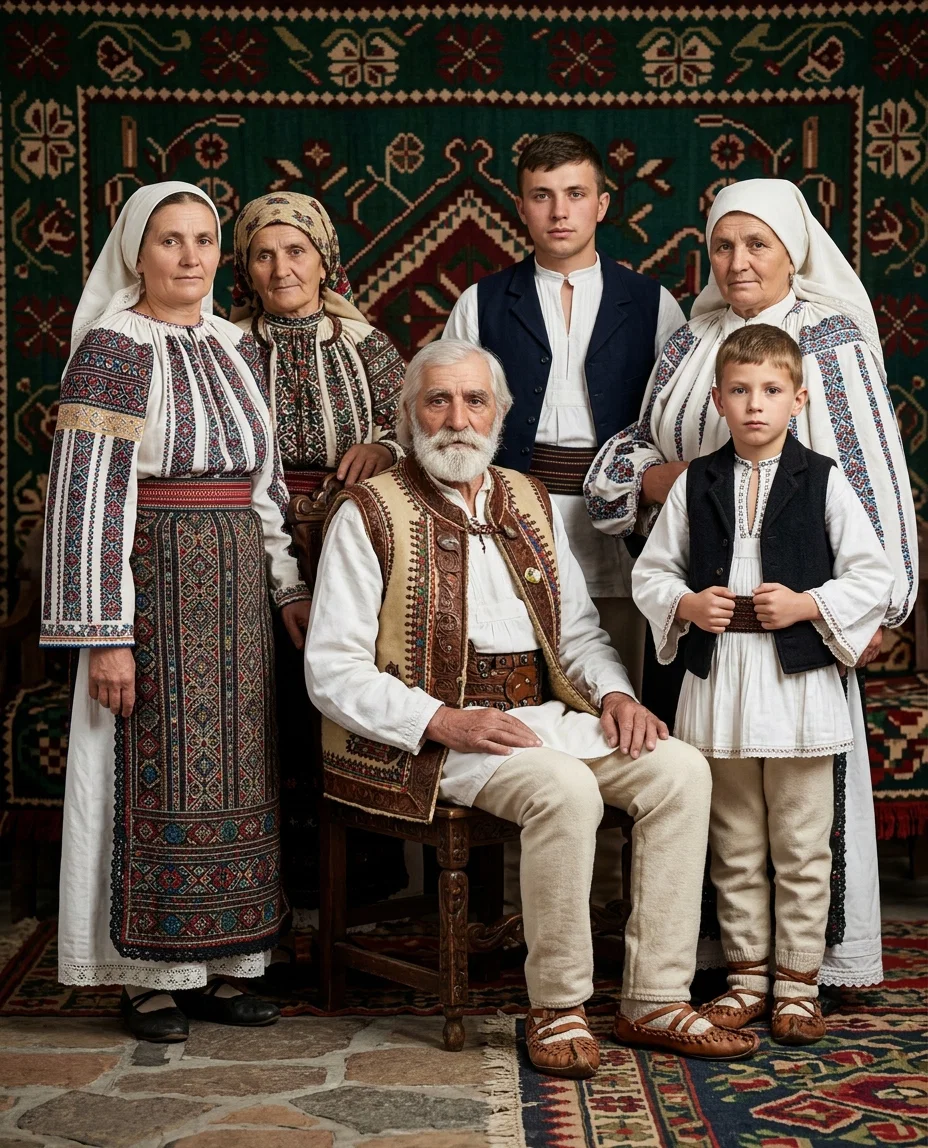
A RUMANIAN FAMILY
A RUMANIAN FAMILY
“It was easier for the Young Jews to adopt the Protestant confession, because it does not enforce the holy crucifix and the holy pictures in its worship. And, after having taken the fundamentals of the Protestant form of worship, they teach by means of twisted explanations, contrary to the founded teachings of the orthodox Christian church, that Saturday should be sanctified in the place of Sunday. They despise the worship of the holy pictures, and forbid the taking of the oath, which every state officer and soldier must take before the throne, state, and fatherland. By harmful and tyrannical ideas they bewilder the minds of credulous people, whom they gather together in a special house, where a minister plays them some melancholy hymns on an organ. Tracts, which are printed in Hamburg and sent here, are distributed. . . .
“I call your attention, my dear pious fathers, that you watch the flock entrusted to your protection with open eyes, and preserve it, by sermons and good advice, from infection by the false doctrines of this sect. I have also handed petitions to the minister of the interior, to the minister of ecclesiastical affairs, and to the minister of war, concerning this matter, that they may take the necessary steps against those who dare endeavor to divert our meek people from their patriarchal faith. . . .
“Take care, if any one of these propagandists settles in your villages, to expel him at once. Inform your spiritual shepherds, or the mayor of the village, if any such wolf in sheep's clothing endeavors to creep into the flock.”
A league was formed, which should give itself up entirely to studying our work and hindering us in every possible way. The minister of the interior informed all the prefects, and these, in turn, all the mayors, that all Adventist missionaries should be taken to the police station, and if they were foreigners, should be at once expelled. Attention should also be given to the members, and all propaganda hindered.
The minister of war sent a notice to all the officers, captains, and regiments, that if any one should be found reading the Bible or Adventist literature, he should be admonished; if he did not then refrain, he should be court-martialed.
Through this well-organized opposition, every office and official court was soon thoroughly acquainted with our cause. Now that a year has passed, we can only thank the Lord for the good progress our work has made in that field. The free advertisements, which cost them so much money and trouble, have not been without results. The proof has again been furnished that “we can do nothing against the truth, but for the truth.” The press has also tried its best, through about twenty different newspapers, to warn the people against us, and has used this publicity for its political purposes. This gave us a good opportunity to give a short reply in one of the best newspapers, which was well thought of by the people. Preparations are also being made to lay the whole matter before the minister of ecclesiastical affairs at the most opportune time, so that he may get a right conception of our message.
In Bukharest, the capital of Rumania, we have an active church of 140 members; in Constanza there is a church of thirty members; also one in Ploesti with the same number. In three other towns we have a good start, and prospects for growth.
Although our meetings are visited frequently by the secret police, and our workers are often called before the police, they are of good courage and happy in their work.
Let us not forget this needy field in our prayers.