Ceylon

6%

Review and Herald Publishing Association · Washington, D. C. · Sep 1, 1904

FromReview and Herald, Vol. 81, No. 35.

Read the full edition

Ceylon

HARRY ARMSTRONG
Ceylon is now a Seventh-day Adventist missionary field; and because of its peculiar need, it should be one of the most interesting fields ever opened by the people who are representatives of the third angel's message. As I said in a previous article, Ceylon is called the “Eden of the East,” and by many it is believed to be the original Eden, or paradise, the garden of God. There is on the island a mountain peak called “Adam's Peak,” on which, engraved in the solid rock, is a human footprint believed by the Mohammedans to be the footprint of Adam, but by the Buddhists to be a footprint of Buddha. There may be no truth in either of these two cherished traditions, but there has been no mistake in calling this island the “Eden of the East;” for its beauty and grandeur are living monuments and memorials of the Edenic home of our first parents.
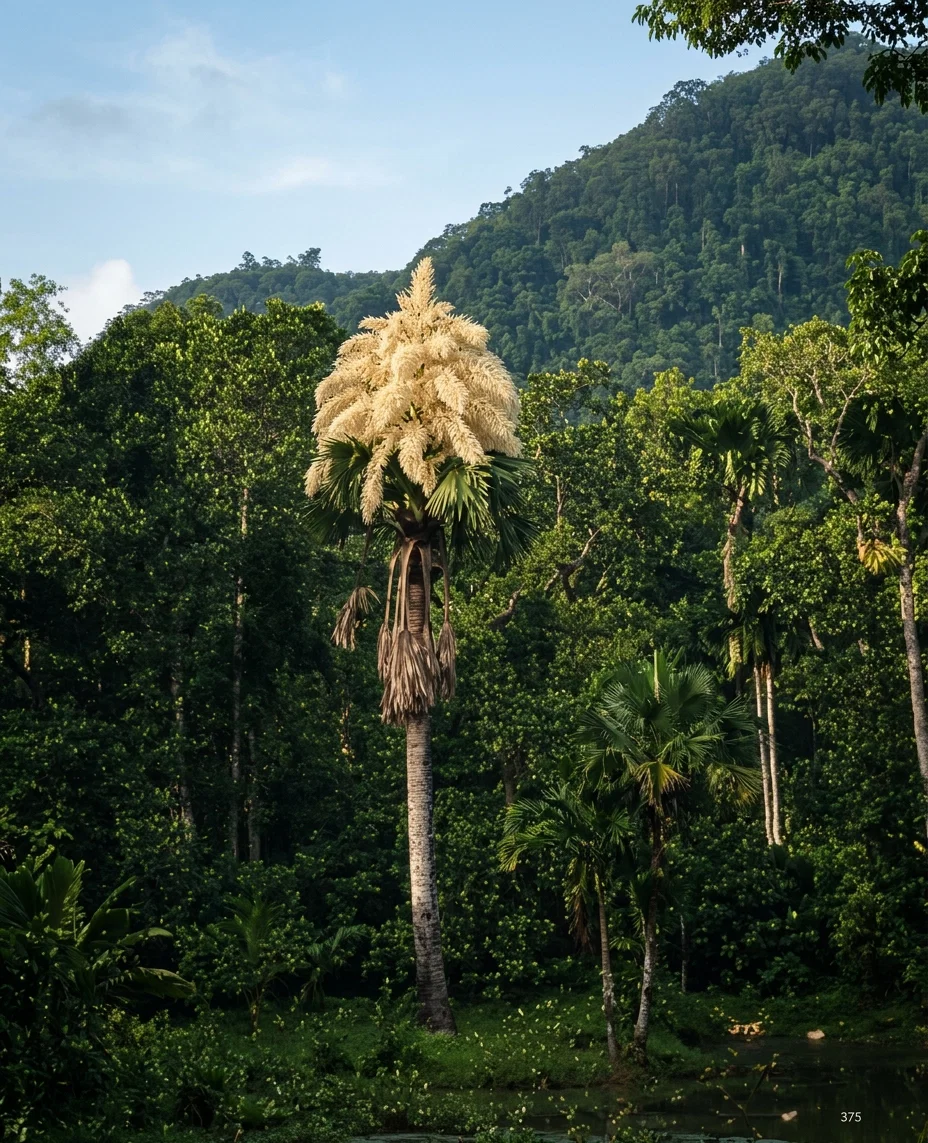
TALIPOT PALM IN FLOWER
Almost everywhere, as in the first Eden, you may see that which is pleasant to the eye, and good for food. And as the poet has said, “The gifts of God are strown with lavish kindness.” And yet there is to be seen here scenes both intensely sad and pathetic; for the people who live in such a paradise of light and glory walk in darkness and superstition.
The chief religion of the Singalese people is Buddhism. They are not only followers of Buddha, but many are worshipers of Buddha, and their temples of worship are scattered throughout the land. The life story of Buddha is strangely pathetic, and the religion of the his followers is correspondingly sad. He was born the son of a king in a city of northern India, about four or five centuries before Christ. Surrounded with every good that wealth could procure, he grew up into manhood, among all that was beautiful, in the palace of his father, the king.
Having never left the palace grounds, when he had grown to manhood, and after his marriage, he had an unconquerable desire to see the rest of his kingdom; and it was then, when going forth, that he for the first time looked upon deformity and death. In returning to his palace he tearfully said, “What have I to do with pleasure?” He sought the sacred books of the Hindu religion for a deliverance from all these things, but found none. Then, not being able or willing to live a life of pleasure with so much misery around him, he took a sorrowful leave of his wife and father, and in secrecy of the night left the palace. For six long years he led a lonely life among the hills, but one day while sitting beneath the “tree of wisdom,” he seemed to find what he had been seeking, and from that time he was known as Buddha, which means “the enlightened.”
What Buddha found is not known even by his followers, but he broke down that awful wall of caste which binds the Hindu devotee, declaring all men to be equal, receiving at the hand of a poor goat-herd a cup of milk. After this he returned home preaching salvation, called by Buddhists “the way.” There was nothing definite, however, in what he taught, and his religion was still full of sadness; for he had no hope, and was without God in the world. He did not preach any God, and perhaps because of this, Buddha himself is now, after many years, worshiped as a god in all the Buddhist temples.
Only last Sabbath a Buddhist procession passed down our street. They were going from one temple to another, carrying with them presents suitable for their idol deity. One poor devotee, under a vow, was bleeding from the cheeks and mouth. A large needle had been passed through each cheek and tongue, and then a wooden peg inserted. I never saw a more pitiable sight, and yet all the pain and suffering was faithfully endured in the hope that it would secure some favor from the gods. These scenes are of common occurrence, and many are the sights that make the heart sick.
Another point of significance in Buddhism is the place and interest which the serpent holds in the temple and worship. It is stated that each temple owns a live cobra, which is a most deadly serpent. The cobra, according to tradition, is thus treated because of its having once protected Buddha from the heat of the sun, by spreading its hood and forming a canopy above his head. An image of Buddha thus protected, was placed near our house while the procession passed. It suggested the motive power of Buddhism to be an overshadowing of that old serpent, the devil and Satan.
It is because these dear people are walking in “the way” of darkness and death, that God is sending a message of life and light to them. I think of all our people in the home countries, and wish they could see the need of the East. I am sure many loyal hearts would respond to this need, which can not be written in words, just as they have responded in times past. Many who can not come over to help us can send their means. It would be an investment that heaven would honor, and now the time has fully come for all who have means to put it into the cause. Soon it will be too late.
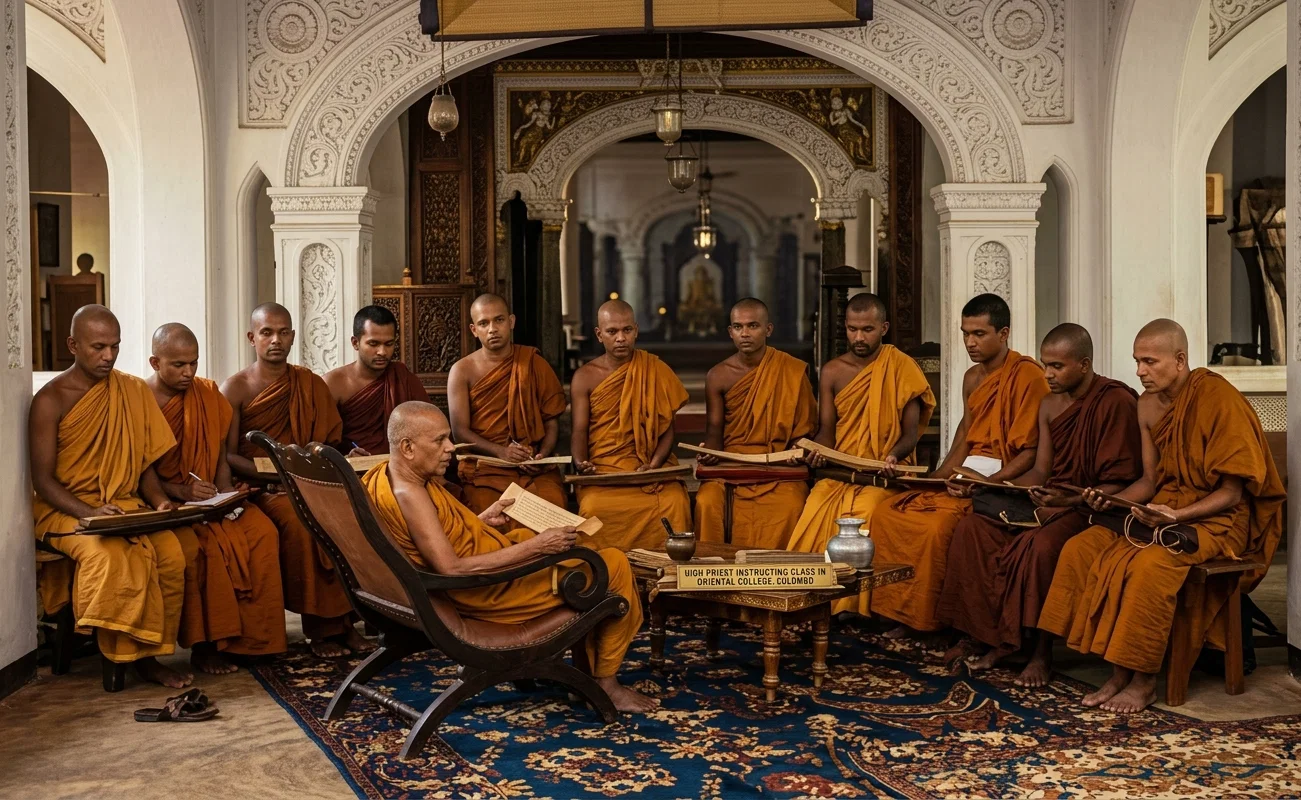
HIGH PRIEST INSTRUCTING CLASS IN ORIENTAL COLLEGE, COLOMBO
There has been a revival of Buddhism of late, and many schools of learning are now being opened. The accompanyingillustration will show you what the priests are doing. Books, as we know them, are still unknown or unused among the Buddhist students. They use the “ola book” made from the young fronds of the talipot palm.
The process of making this ola book is an interesting one. The young leaves of the talipot, or palmyra, palm are cut before they acquire the dark-green shade. They are then soaked in hot water or milk to preserve the flexibility, after which they are submitted to pressure to render their surface uniformly smooth. They are then cut into strips two or three inches in breadth, and from one to three feet long. These are pierced with two holes, one near each end, through which a cord is passed. The leaves thus strung together form an ola book. The writing is done with an iron stylus, which furrows the characters desired. These furrows then receive an application of charcoal and oil, which makes them easier to read, and also acts as a preservative against the inroads of insect life.
The accompanying illustration is a good picture of the royal talipot palm. Its straight, stately trunk rises to a height of sixty or seventy feet, but its crowning glory is its fan-like leaf. One leaf is sufficient for the hood of a carriage, and is even now carried over the heads of Kandian chiefs upon all state occasions. It blooms but once, and then dies. After living a life of from sixty to seventy years, it is said to gather up its strength in one supreme effort, bursting into a mass of bloom of great magnificence. When the flowers fade, the tree loses all its stately grandeur, and dies.
The palm branch has always been held in royal favor. These branches were waved before Christ as he entered the beloved city Jerusalem. And even now they are held over the heads of earthly monarchs. To this we have no objection, but we long to see the time when the characters of a false religion shall no more be engraved on the “ola page.” The glorious truth of a living Christ and a coming Christ has entered this land, and it will stay until a people, having been called out and sanctified by the truth, shall be translated from the “Eden of the East” into the paradise of God. Colombo.