The India Mission field includes the peninsula of Hindustan, the province of Burma, and the island of Ceylon. Its area is 1,807,453 square miles, which is equal to one fifteenth of the habitable globe, or that portion of the United States east of the Missouri River. The population, according to a recent census, is 297,638,046, or one fifth of the population of the entire world.
As Calcutta was where our work first started, and as it is the chief city of India, it has been made the headquarters of our work in this field. Our tract society office is here, and, until the beginning of the present year, our small printing plant was here. About eight years ago Dr. Place opened up medical work in the city, and since then this work has been developing until, at the present time, we have a small sanitarium quite well equipped, and able to accommodate about twenty patients. There is a large field for medical missionary work, not only in Calcutta, but in all parts of India. By means of this branch of work all nationalities can be reached. Christians, Hindus, Mohammedans, and Parsees are patients at our sanitarium. Our medical work in Calcutta has been carried on with no little strain both to those managing it and to those working in the institution. This is attributable to several causes. The cost of rent is exorbitant. The smallness of our constituency in India has made it difficult to get suitable help, and the long, heated season has been very trying to workers from the home land. Our physicians have shown a willingness to persevere under trying circumstances, and well-nigh all connected with the work have manifested a real spirit of self-sacrifice in building up this branch of the cause.
Karmatar
The next place at which our work was opened up was at Karmatar, which is one hundred and sixty-eight miles northwest of Calcutta. Our present mission premises were first leased as a home for the children taken during the famine of 1897, and as a center for the opening up of medical missionary work. In many ways the location is desirable. The climate is very favorable to the health of our workers, and a fairly large native population live in the surrounding villages. There are about sixteen children in the orphanage, and a real effort is being made to give them each a good education and training, both in English and in Bengali. In connection with the orphanage there is also a small training-school, where an effort is being made to train some of the older children of our Bengali brethren for the work. Can come in for teachers, and the plan is to train these young people as far as possible to act as teachers in surrounding villages. The school is small; at present there are not more than eight or ten attending it, but among them are some very bright students, and the teachers are making an earnest effort to give them as good a course of instruction as possible.
Ever since our work began at Karmatar, medical work to a greater or less extent has been carried on with it, but unfortunately the continuity has been broken up; first, by the death of Elder Brown, and afterward by the withdrawal of others who engaged in this line. For the past two years Sister Samantha Whites has given much of her time to this work, and people from far and near have come to receive help, and a very favorable impression has been made.
Simultala
Our mission at Simultala is situated about forty miles northwest of Karmatar, and two hundred miles from Calcutta. Five years ago work was begun among the Santals by Brother Barlow. Three acres of ground was purchased by him, and with much difficulty he collected money in various places in India to build the present house and make other improvements. The mission now has a fairly comfortable house, a building suitable for a school, several godowns, and a small chapel. At the general meeting in January Brother Barlow signified his willingness to deed to the Indian Mission the land and buildings which are free of debt. He also proposed giving to the mission another piece of ground in a very favorable position about ten miles distant at Babochahal, which has upon it a small house recently built for mission work. For the latter he wishes only the actual cost, amounting to seventy-five dollars.
The Santal school has made encouraging progress during the past year. From fifteen to twenty young men have been in attendance. The school is conducted on the industrial plan; the morning is spent in study, and the afternoon in work. Thus far the boys have not been able to earn their living by their labor, though in time this may be done. During the year three pupils gave evidence that they had accepted Christ as their Saviour, and were baptized. They showed some knowledge of the cardinal points of truth.
There are about 1,830,000 Santals. They live in the hilly districts of Bengal, which are comparatively healthful. They are not bound by the iron fetters of caste, and so are easier to reach. We should have a score of missions among these people. It is said on good authority that the faithfulness and sincerity of the Santal Christians equals that of any other race in India, if it does not surpass it.
At the general meeting held last January in Calcutta a plea was made for a school for Santal girls, that the women as well as the men of Santal may have the opportunity to learn of the religion14of Jesus Christ. A recommendation was passed advising a school for Santal girls.
Burma
Our work in Burma was opened up several years ago by canvassing, and it has proved a good field. Many books and papers have been sold to the English-speaking people, and although this part of the field has been gone over at least four times, the field is still good. In 1902 public meetings were started in the city of Rangoon by Brother Meyers, and have continued since that time. As a result several have begun the observance of the Sabbath; some are English-speaking people, and some are Burmese. The circulation of our literature, and the Bible work which has been done in Rangoon, have created some stir among the Burmese Christians, and they are eager to learn what we teach. At the conference in Calcutta Brother Mong Mong, who has been working at his own charges for the Burmese people during the past two years, made an earnest appeal for help. He has written an open letter on the Sabbath question to the Burmese Christians, and published it largely at his own expense. Elder Votaw and his wife have lately gone to Burma to learn the language and give themselves to work among the Burmese people. Brother Hansen and his wife have also gone from Calcutta to Burma, to assist in the work in that field.
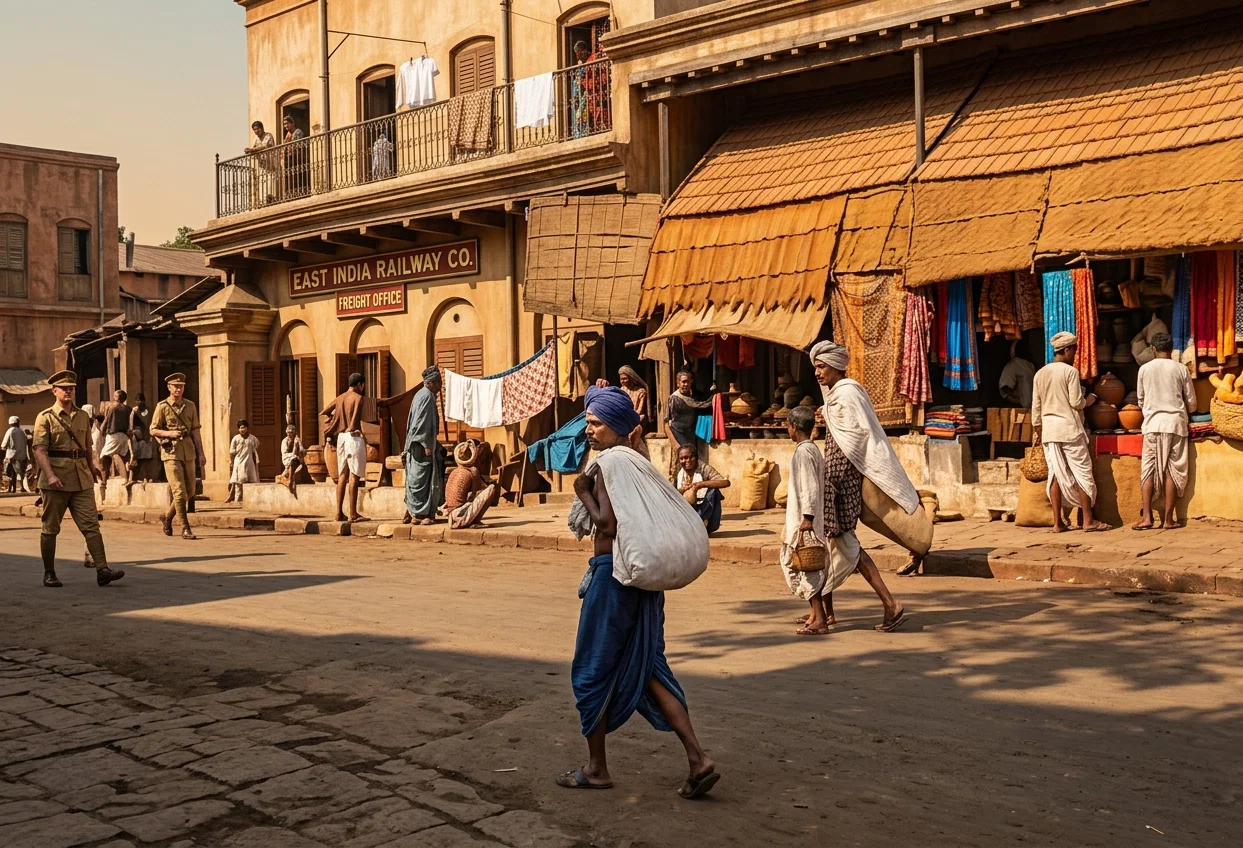
A SCENE IN CALCUTTA
We should have literature in Burmese. The people are willing to buy. It is the boast of the Burmese that all are able to read and write. They are liberal in spending their money, and we should hasten to get small publications on present truth translated and printed to sell among them. At present we have only two small tracts.
Ceylon
Work was started in Ceylon about a year ago when Elder H. Armstrong went to this island. Before that time our canvassers had sold a number of books, and taken subscriptions for the Oriental Watchman, both in Colombo and at Kandy; but until Brother Armstrong located in the city of Colombo, we had no permanent representative on the island.
Thus far facilities for carrying on the work have been small. Without a hall, without a tent, and with only a small room in his own home, Brother Armstrong has begun the work of unfolding the Scriptures. Through the kindness of the students of Healdsburg College, a tent has been made, and donated to the work in Ceylon, and is now probably on the way. Several sites for the tent are in view, and before the present year expires, we expect a strong tent effort will be made. We should send help at once to strengthen the hands of those who are holding up the banner of truth in this station in the highway of nations. Something should be done for the remaining three million souls upon this beautiful island, the gem of the East.
Publishing Work
Our little plant was put in operation two years ago by our beloved fellow laborer, W. W. Quantock, who has been laid to rest. The outfit consists of a cylinder press, a job-press, a paper-cutter, a stitcher, and a fair amount of job and body type, together with sufficient Hindi and Bengali type to do a considerable amount of printing in these languages. The plant has recently been moved to Karmatar, with the object of affording employment and instruction to students in the training-school, and partly for the purpose of reducing the cost of rent and labor.
There has been no part of the work in which we have realized more of the blessing of God than in the canvass work. Our workers have gone to all parts of the field with our books and papers, and though our force of workers has been very small in this line, they have been remarkably blessed in the efforts to get the printed page into the hands of the people. At our general meeting in Calcutta, our sisters, Orr and Jewett, reported that in Southern India they met many well-to-do, educated native gentlemen who subscribed for both papers, Oriental Watchman and Good Health, and also bought many of our books. The first year one Parsee gentleman who would have nothing to do with religious books, took the English Good Health. This year, when called on, he seemed pleased, and said, “That was a good paper: I enjoyed it so much that I have renewed my subscription for this year also.” When shown the Oriental Watchman, he subscribed for it, and bought two books, “Prophetic Lights” and “Object Lessons.” Brother James in canvassing Simla, the summer capital of India, this year received three hundred subscriptions where one hundred had been secured the year before. Through the canvassing work during the past year, a young woman of promise, the daughter of a wealthy Armenian, has taken her stand for the truth. Just before we left, she gave her first tithe. The step she has taken has entailed no little sacrifice on her part.
The Oriental Watchman has had a circulation the past two years varying from three to four thousand copies monthly, and has been widely circulated by faithful canvassers in all parts of India, Burma, and Ceylon.
The Indian edition of the English Good Health has been carrying a subscription varying from one thousand to fifteen hundred monthly. It is sold in connection with the Oriental Watchman, and takes well with the educated Hindus. There is a large field for health literature among the educated people.
Something has been done in printing and circulating literature in the vernaculars. Aside from tracts on different points of truth in Bengali and Hindi, “Steps to Christ” has been lately printed in the Bengali language. We have done, as it were, nothing in placing our truths into the languages of India. Multitudes, vast multitudes, able to read are waiting for the gospel message in their tongue, and in harmony with our faith we must with courage meet the problems which shall arise in this mighty undertaking.
Self-supporting Workers
There are at the present time three workers who have gone to India at their own expense, and are now working at their own charges. Miss Wilcox has been devoting her energies to the health work in Simla, the summer capital of India, and by giving massage and teaching physical culture, has been able to make her work fully self-supporting. Elder Owen has been working among both Europeans and English-speaking natives, while Sister Kellogg Mookerji has devoted her efforts entirely to English-speaking natives. There is a large field for those willing to go to India and work at their own charges, and by tact and perseverance they may make their work at least in a measure self-supporting.
Statistical
The number of Sabbath-keepers is about one hundred and twenty-five. The tithe in 1903 was $2,340.50; Mission Board appropriations in 1903, $5,928. The number of foreign workers in 1903 was 26; local workers, 13; conference-paid foreign workers, 14; local-paid workers, 9. Tithe for 1904 was $2,047.30; Mission Board appropriations, $7,280. The number of foreign workers was 22; local, 11; conference-paid foreign workers, 10; local, 7.
Climate
It is useless to contend that the climate in India is as favorable to the foreigners as Europe or America. We have two graves in India, which thus15far witness to our efforts, and we must not be discouraged if there are others to mark our way among these unwarned millions. They are appeals, silent appeals, for more men and means to push and hasten on the work.
Needs
We have mentioned our need in Ceylon, and our duty to strengthen the forces there. We have also mentioned the need of men and means for the translation, publication, and circulation of literature in the vernacular. In fact, there is not a part or department of our work which does not need to be strengthened. While the work has widened out and taken a foothold in new places, the facts are, the number of foreign workers in India is less than it was two years ago. It would be difficult to express the feeling of joy and thanksgiving which came over the little band of workers met in council when the last workers reached India. It is expressed in the following resolution:—
“Whereas, Our people have nobly responded to our call for help from the home field, and have sent us seven workers in this hour of great need, therefore,—
“Resolved, That we express our united praise and thanksgiving to God, and extend to the General Conference and the Ohio Conference a vote of thanks and appreciation for this liberal donation of workers for the work in India.”
At the same meeting another resolution was passed, which is as follows:—
“Whereas, We recognize the urgent call in Bombay, and the need of a minister to open up work in that great city,—
“Resolved, That we unite in an earnest appeal to the General Conference that such help be sent as soon as possible.”
Bombay is waiting. For several years we have been hoping and praying that work might be opened up in this great city of nearly a million. With Madras, Lucknow, Lahore, and other cities of this mighty empire, she waits. The Hindu, the Parsee, the Mohammedan, the Buddhist, the Jain, are waiting, unknowing and unwarned. We may ask, How, by whom, and when shall these millions hear this last message? Some way, some how, and by some in this generation shall the final gospel call search out the honest hearted among these people.
This is the hour of opportunity in India. The hand of Providence has opened wide the door. While native rule prevailed, says Dufferin, “scarcely a twelvemonth passed without the fair fields of India being watered with the blood of thousands of her children.” To-day India is in peace; from the Himalayas in the north to Cape Comorin in the south quiet reigns. Sixty million Moslems, more than three times the number under sultan rule, are at rest; and without fear and without government interference the gospel can now be carried to these people. Not necessarily need we go by the slow bullock cart of fifty years ago, but with railways running to every part may the final gospel call be carried.
Does not this make the present hour not only an hour of opportunity in India, but as well an hour of tremendous responsibility?