Seven years ago the fifteenth of this month, I landed with my family in South Africa. When the Mission Board asked us to go to Africa, they told me that I was wanted for a hard field. This did not frighten me in the least, for I was willing to work hard; but I confess that I knew very little of the trials and perplexities that were before me. But Father knew all about them, and I am thankful to say that his grace is sufficient for all our needs. Without, our work has been hindered by the bubonic plague; by the war between the Briton and the Boer, during which the country was under military law, the people not even being allowed to visit adjoining farms; and later a commercial and business depression that still causes hard times all over South Africa. Within, we wrestled with various problems, one of which, and not the least, was our debts. We tried to labor with courage and hope, although all about us were strong men who, at times, were fainting in their minds, and some were sounding the signal of retreat.
Two years ago last January the South African Union Conference was organized. It embraced the Cape Colony Conference, the Natal-Transvaal Conference, the mission fields south of the Zambesi, and also a vast field of unentered territory. Since the conference meeting in January, 1903, the General Conference asked us to take the supervision of the Plainfield Mission, in Nyassaland. So at our conference meeting this year we added British Central Africa to our field of labor. This makes a vast field of more than one million square miles, containing between nine and ten million inhabitants, of whom only six hundred and seven are known to be Sabbath-keepers. Scattered over this large territory are to be found only 1,150,000 Europeans; this makes it a very hard field in which to reach the white population.
The Cape Colony Conference
including the Orange River Colony as a mission field, has 327,101 square miles of territory, and a population of 2,790,397. The tithe for the past two years has been $17,000, or a yearly amount of $23.42 per capita. They have nine churches, numbering 371 members. Elder Hankins, with his corps of laborers, is scattering the truth to every part of this field. Quite a number of Dutch farmers have accepted the truth during the past year.
The Natal-Transvaal Conference
is small in membership, but large in extent of territory, and much of it is very difficult to work. Its area is 156,642 square miles, with a population of 2,266,429. There are but three churches in this conference, with a membership of 106. With this little flock Elder H. J. Edmed is attempting to give the third angel's message to these two colonies. They have paid into the treasury $7,276.25 tithe during the past two years, which amounts to $34.32 per capita per annum. This we consider very good.
Tithes and Offerings
It may be interesting to note that the total amount of tithe paid in this field during the past two years amounts to $25,737.45, which is $21.22 per capita for each year, and we must not forget that fully one fourth of our membership are natives and colored people, who have very little, if anything, on which to pay tithe. The various offerings made by our people to the work of the union conference amount to $3,845.82, and the tithes, including the tithe of the tithes from the two conferences, to $3,907.82, making a total of $7,747.64. We are thankful to say that our few Sabbath-keepers in South Africa have not only supported the work in the two conferences, but have furnished nearly half the funds necessary to maintain our native missions.
Union College;
Our college has been a great help to the work in our field. It has ever been loyal to the cause of truth, and our teachers have done what they could to prepare young people for the work. The number in attendance averages about ninety-five. A few of our young people have completed the normal course, and have entered this field of labor, while others are engaged in other departments of the work. The demand for teachers is greater than the supply.
The Sentinel Printing Plant
This is a small but well-equipped printing plant, and is located at Kenilworth, on the college grounds. We have received donations enough to pay half the initial cost of the plant, and also to put it in a good condition for our work. The South African Sentinel, with a circulation of four thousand, is printed there, and also the South African Missionary. We are printing a good supply of literature in the Zulu, Kaffir, and Sesuto languages, and we hope soon to begin to print in other languages also. Brother R. F. McPherson, the manager, takes a deep interest in this work, and is doing all he can to make it succeed.
The Sanitarium
The building at Plumstead formerly used as an orphanage has been converted into a sanitarium. The building is small, and contains but sixteen rooms, still it has served us well thus far. Two years ago we opened work at this place, but did not accomplish very much until Dr. Thomason arrived last June. Since that time the work has progressed very favorably. The doctor has a large outside practice. Reports from the sanitarium show that the receipts are several hundred dollars in excess of the expenditures. The prospects are that we shall have to build cottages, or provide some other means for accommodating the patronage, but we lack funds with which to build up this work.
The Mission Work
If there is one department of our work above another where the blessing of God has been manifested, it is in our work for the African native. I have taken a place in the schoolroom and in the field, and have there labored with and for the native boys, that I might become acquainted with their ways and needs, and know how to help them. Let me assure you that this is a school from which one can not be graduated in a few months. Those who have spent many years among this people say that the native is still a puzzle to them. But the work is extremely interesting, although very perplexing at times, and I think I can safely say that our missionaries never get lonesome. During the past year it has been my privilege to visit each of our missions, and I have been very thankful for the opportunity.
The Mission Farm
This station is located in Rhodesia, about thirty-two miles from Buluwayo. Elder M. C. Sturdevant is the superintendent, and Brother Claude Tarr and his wife are his assistants in the work. The work at this, our oldest mission has been greatly blessed of the Lord. They now have a church of sixty-three members. There are twelve young men who have been so far trained that they are teaching either at the mission or at one of the village schools which they are conducting. In the mission school they have an average of eighty-five pupils. About fifty of these live at the mission, while the remaining thirty-five attend from the surrounding villages. The income from the farm and the store has sustained the school and native teachers,5and also assisted in paying the missionaries. One result of the work of the mission is that an interest is springing up all about that section, and the natives are beginning to seek after the Lord, and some are beginning to obey.
ON THE PLAINFIELD STATION
Somabula Mission
This mission station was started by Elder F. B. Armitage about three and a half years ago, and is located nearly one hundred and fifty miles northeast of the mission farm. Through the blessing of God those in charge have been able to support the school of sixty-five boys and girls. Between thirty and forty of these live at the mission. When we consider that it costs twenty-five dollars a year to support a boy, we see that it costs no small sum to support these schools. A good interest has been shown by the natives, and the workers are of good courage, although Brother Armitage has recently had a very severe illness. They have been conducting two out-schools near this station, and the boys who are teaching send us good reports of their work.
Mkupavula Mission
This mission is located twenty-one miles from the mission farm, and is conducted by Brother C. R. Sparrow, who works on a self-supporting basis. We furnish him two native teachers who conduct a day-school. There has been a good interest at this place for some time. At present they have an enrolment of seventy-five pupils, and the work is very encouraging.
Plainfield Mission
This mission is located in Nyassaland, British Central Africa, and Elder T. H. Branch is the superintendent. His daughter, Mabel, and three native boys constitute the teaching force. I spent a month at this station last year, and found the work prospering. They have a school numbering seventy-three, and twenty-eight of these are living at the mission, and assist Brother Branch with the farm work. They have started two out-schools, which are prospering. Sabbath afternoons the older boys visit the native villages, and hold meetings with the people. In this way many hear the gospel. This same work is carried on at each of the missions already mentioned.
Kolo Mission
The Kolo Mission is located in Basutoland, with Brother J. A. Chaney in charge. He has one native teacher to assist him. The work at Kolo has gone very slowly, but we are looking forward to the time when this people who have heard the gospel so long will be awakened by the third angel's message. There are a few middle-aged and elderly natives who have accepted the truth. We have a small day-school at Kolo, and we hope soon to open a boarding-school. Our only hope in accomplishing much in this work is to gather a number of the young men about us and keep them with us till they are educated and trained to go out and work for their people.
Kaffir, or Amaxosa, Mission
This work is in the Cape Colony, and is being conducted by Elder G. W. Shone, who is assisted by a native laborer, Brother R. Moko. For several years the Cape Conference has had Brother Moko at work for this people, but not until the past year has a white laborer been set apart for this work. Several educated natives have accepted the truth, and the message is spreading rapidly among that people. We hope soon to have a mission site, and buildings erected, so we may begin to train these men whom the Lord has given us. Khama, the chief, is very anxious for us to begin work among his people. Calls are coming, asking us to open work in other sections. The Spirit is certainly at work among this people, and now is our time to press the work on with vigor. The Cape Conference is supporting the laborers in this field until such time as the South African Union has funds for this work.
Summary
From the foregoing you will see that we have six missions and ten village schools, in which four hundred and fifty boys and girls are being taught the message. Four of these missions are being supported by the union conference, one by the Cape Conference, and one is self-supporting. There are one hundred and thirty Sabbath-keepers at these stations, and several others will be baptized soon. We have sixteen European and nineteen native teachers who are pushing forward this work. You will see that we have scattered our laborers when you consider that at one time there were twelve European workers at the mission farm, while now we have but sixteen European workers for the six missions scattered in this great field.
Our Needs
In closing this report, I would not be true to my trust if I did not present the needs of the Dark Continent to this conference. The message has reached us that “Ethiopia is stretching out her hands unto God.” Brethren, what does she want?—It is the bread of life—the message that is to meet the needs of every nation, kindred, tongue, and people. I appeal to you: Shall she have it? or shall we treat her as many do the ordinary beggar asking for bread? While we long to see the work opened among the great Zulu people, and also among the Bechuanas in Khama's country, our heart goes out to the unentered regions of Central Africa. Every year the way is becoming more difficult, as other societies are seeking out every available spot in which to locate missions. Progress is being made wherever the truth has entered, and we believe it is time to bestir ourselves and establish centers from which the light may shine out to the millions who stand pleading with outstretched hands.
PREACHING THE GOSPEL TO THE NATIVES
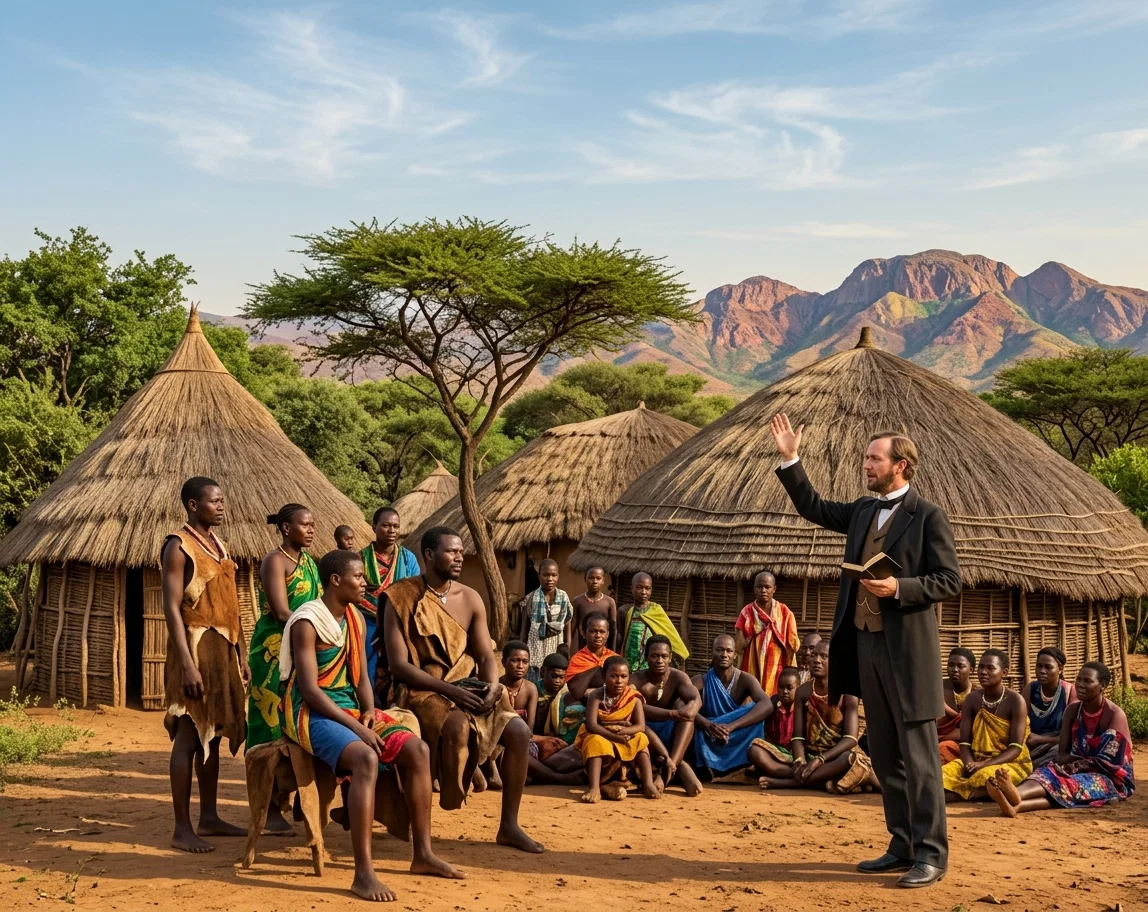
Let me give you a few facts just to show you how the African is awakening. For many years the missionaries in South Africa labored on, and saw but few signs of real life among this people. But a few years ago a change came. The natives began to organize independent churches, and to reach out for light. Some saw light on baptism and accepted it, and this brought in another division. Again the light from the sanctuary shone upon this people, and they saw the truth in the ordinance of humility, and these were called the Cushites. Recently an old native was found by our brethren who has kept the Sabbath for many years. I am sure you will say that the Spirit of God has been leading these native minds. Very recently a native who worked in the post-office at East London accepted the truth. He at once wanted to return to Kaffirland to tell his people, but the brethren feared he did not understand the truth well enough to go. But he would go, and God went with him. We soon had the report that several were keeping the Sabbath. His father, an old native evangelist who had labored for years with Sister Lang and her husband, accepted the light, and rejoiced that God had spared him to see the truth. Another who had not met with this native6brother, hearing of these things, became convicted, and began to keep the Sabbath. A Zulu in Natal heard the Sabbath truth, accepted it, and then went up through Zululand preaching it everywhere. One of Lobengula's aged queens came to the Somabula Mission to attend services. When asked why she came so far, she said she was tired and soon must die, but she must know this Jesus first. These, and many other things, prove, without doubt, that Ethiopia is stretching out her hands unto God.
It will not be necessary to establish missions in every part of the country, but at great centers where we can reach many tribes, and there gather in young men and teach them the truths of the last message. As these learn the truth, the Spirit fills them with an intense desire to go to their people and spread the glad tidings abroad. At some of our missions we have boys representing six or eight different tribes and tongues. These are longing for the time to come when they can return to their homes and take up this work. Brethren, we know of no other way for the truth to go to the many tribes of Africa. Shall we answer the calls that come to us from Ethiopia? We should open a training-school in Rhodesia at once. We have strong young men who need a better training than it is possible for a mission school to give them. If this work is done, we shall soon have young men ready to translate from the English into the Zulu, and native teachers who will be able to take the place of some of our white teachers in our schools. Our constant prayer has been that God would lay the burden of Africa heavily on the hearts of his people, so that we should have both teachers and funds for the work, and we are sure he will not disappoint us.
W. S. Hyatt,
Superintendent.